The Greek Dark Ages were a period of transformation after the Mycenaean palaces began collapsing around 1200 BCE, commonly dated approximately 1180–800 BCE or 1100–750 BCE. Palace administration and Linear B writing disappeared from the Greek mainland, while settlements became fewer and smaller. Yet places such as Lefkandi retained wealth and overseas connections as communities reorganized.
How could a period associated with shrinking settlements also produce a monumental building measuring 50 × 13.8 metres? Lefkandi brings that question into focus. If you follow its buildings, graves, and imported objects, you can trace both the losses after the palaces and the development of new social structures.
How are the Greek Dark Ages dated, and why do their boundaries vary?
The Greek Dark Ages have no single agreed date range. English Wikipedia uses approximately 1180–800 BCE. Turkish Wikipedia places the period around 1100–750 BCE. These ranges overlap, but their different boundaries show why a date attached to the label needs context.
Antonis Kotsonas’s 2016 study documents a broader spread of scholarly choices. Researchers have placed the beginning around 1200 BCE or around 1125–1100 BCE. Proposed endings fall at different points between 900 and 700 BCE. You therefore need to check which historical or archaeological change a particular chronology follows.
The boundaries vary because classifications emphasize different evidence. Some begin with the collapse of the palaces. Others focus on iron use or pottery styles. Kotsonas explains that these schemes cover different portions of the years between 1200 and 700 BCE. They do not divide the past in precisely the same way.
The name is also debated. Some researchers prefer “Early Iron Age” because “Dark Age” carries an implication of decline. Kotsonas found that both terms continued to appear in academic publications. Lefkandi’s wealthy burials help explain why an unqualified picture of darkness is difficult to sustain.
How did the collapse of the palaces affect writing, settlements, and trade?
The Mycenaean palaces did not all end in a single moment. Their collapse began around 1200 BCE and unfolded over decades. This timescale matters: the end of the palace system was a process, and the archaeological evidence records changes across that process.
One clear break concerns writing. Palace bureaucrats had used Linear B to keep records in Greek. After the palace system collapsed, its use ended on the Greek mainland. The disappearance of this script marks the loss of a particular administrative practice tied to the palaces.
Settlement evidence records another major change. The number and size of settlements declined after the collapse. Archaeologists interpret this pattern as an indication of population decline. That interpretation rests on the surviving settlement pattern; it should not turn every individual community into an identical example of abandonment.
The earlier trading world had been extensive. According to the Metropolitan Museum of Art, Mycenaean goods and commercial connections reached from Spain to the Levant before the destructions that ended palace civilization. This geographical reach gives you a sense of the networks against which later evidence must be assessed.
At Lefkandi, luxury objects from the eastern Mediterranean and imported pottery appear in tenth- and ninth-century BCE burials. These objects challenge the claim that all Greek communities had become cut off from the outside world. They demonstrate continued connections at one important centre, without establishing that the earlier palace trading system survived intact.
How have excavations at Lefkandi challenged the narrative of universal decline?
Lefkandi lies on Euboia, between ancient Khalkis and Eretria. Bays on either side of the Xeropolis settlement form natural harbours. Lefkandi-Xeropolis became especially important after about 1200 BCE, placing its development directly within the period following the palace collapse.
Excavations began in 1964 under Mervyn Popham and Hugh Sackett, through the British School at Athens. The cemeteries cover approximately 1050–825 BCE. Their contents provide direct archaeological evidence for material wealth during centuries often grouped under the Greek Dark Ages.
The strongest architectural example is the monumental building at Toumba. Constructed in the middle of the tenth century BCE, it measured 50 × 13.8 metres. Its scale complicates any account in which the disappearance of Mycenaean palaces meant the disappearance of all ambitious construction.
The graves make the challenge more specific. Weapons, jewellery, and objects originating in the Near East and Egypt were found in the Toumba cemetery. The excavation team interprets these as signs of wealthy local ruling elites. The evidence concerns both valuable possessions and distinctions within the community.
Lefkandi does not erase the wider evidence for fewer and smaller settlements. It shows that decline was uneven. Monumental construction and imported goods existed alongside the broader changes associated with the end of the palaces. Any explanation of the period must accommodate both patterns.
How did new settlements and forms of social organization develop?
At Lefkandi, rebuilding included direct reuse of older structures. Excavations in 2007 established that an Early Iron Age megaron incorporated some walls from a preceding Late Helladic IIIC building. The transition between periods therefore included physical continuity within the settlement.
The earlier building measured at least 12 × 5.5 metres. Its main room measured 7.5 × 5.5 metres. For an everyday-life connection, think of renovating a home while keeping useful walls: Lefkandi offers an actual archaeological case of later construction incorporating earlier fabric. A change of period did not require every building to begin from scratch.
Burial arrangements offer another view of social organization. After the Toumba building and its central graves were covered by a mound, the area in front of its eastern entrance became a cemetery. Later burials thus occupied a space closely associated with the earlier monumental structure.
The excavators suggest that those buried outside may have belonged to the same kinship group, or oikos, as the people inside. This remains an interpretation, rather than an established family relationship. The spatial connection is visible; the precise biological relationships are not demonstrated by that arrangement alone.
The Metropolitan Museum places the Geometric period at approximately 1050–700 BCE. It describes these centuries as a time when city-states, major sanctuaries, and Panhellenic festivals took shape. These developments overlap with several proposed definitions of the Greek Dark Ages, making reorganization part of the period itself.
Writing also appeared in a different form. Around 800 BCE, the Greek alphabet emerged through adaptation of Phoenician writing. It was not a revival of Linear B. At Lefkandi-Xeropolis, Late Geometric buildings have yielded early graffiti in the Euboian alphabet, alongside evidence of bronze-object production.
Timeline
- Around 1200 BCE: The palace collapse begins, and Lefkandi-Xeropolis gains importance.
- Around 1100 BCE: A bronze krater is made in Cyprus; it later holds cremated remains at Toumba.
- Approximately 1050–825 BCE: The date range represented by Lefkandi’s cemeteries.
- Mid-tenth century BCE: The monumental Toumba building is constructed.
- Around 800 BCE: A Greek alphabet adapted from Phoenician writing appears.
- 1964: Popham and Sackett begin excavations at Lefkandi.
- 2007: Excavations document wall reuse between Bronze Age and Early Iron Age buildings.
Details you won’t find in guidebooks
Two central grave pits give the Toumba building a more intimate scale. One contained the cremated remains of an armed man and the skeleton of a woman with jewellery. The other held the remains of four horses. These deposits lay within the same monumental structure.
The man’s ashes were placed in a bronze krater made in Cyprus around 1100 BCE, according to the National Archaeological Museum in Athens. By the time it entered the grave, the vessel was already old. Its production date and its later burial use belong to different moments in the object’s history.
A large linen textile also survived inside the funerary vessel. It had sewn sides, fringes, and bands of geometric decoration. If you picture only weapons and metal jewellery when imagining these burials, the preserved cloth adds evidence of a material that also formed part of the burial assemblage.
Settlement excavations recovered a much smaller feature: a mudbrick box measuring 70 × 40 centimetres. Associated with the Bronze Age–Iron Age transition, it contained pottery fragments and about six murex shells exposed to high heat. The reported contents are specific, even though they do not establish a definite function for the box.
Another find connects the settlement to food preparation. Cut animal bones came from a pebble-paved outdoor area dated approximately to the tenth century BCE. Specialist E. Christodoulou associated them with probable butchery activity. Alongside monumental graves, Lefkandi preserves traces of practical work involving animal remains.
FAQ
When were the Greek Dark Ages?
Common date ranges include approximately 1180–800 BCE and 1100–750 BCE. Boundaries vary because scholars use different markers, including palace collapse, iron use, and pottery styles.
What happened to writing after the Mycenaean palaces collapsed?
Linear B, used by palace bureaucrats to record Greek, ceased to be used on the Greek mainland. Around 800 BCE, a Greek alphabet appeared through adaptation of Phoenician writing.
Why is Lefkandi important?
Lefkandi preserves evidence of monumental construction, rich burials, and imported objects after the palace collapse. These finds challenge the idea that every Greek community experienced poverty and isolation.
Did the Greek Dark Ages lead to new forms of social organization?
Lefkandi’s burials reveal wealthy local elites, while reused buildings show continuity between periods. The Metropolitan Museum places the formation of city-states, major sanctuaries, and Panhellenic festivals within approximately 1050–700 BCE.
Sources
- Vikipedi — Yunan Karanlık Çağı tr.wikipedia.org
- Wikipedia — Greek Dark Ages en.wikipedia.org
- Antonis Kotsonas, American Journal of Archaeology — Politics of Periodization and the Archaeology of Early Greece ajaonline.org
- The Metropolitan Museum of Art — Greek Art: From Prehistoric to Classical resources.metmuseum.org
- University of Oxford — Excavations at Lefkandi lefkandi.classics.ox.ac.uk
- University of Oxford — The Protogeometric Building and the Cemetery of Toumba lefkandi.classics.ox.ac.uk
- National Archaeological Museum, Athens — The urn krater of the Lefkandi lord namuseum.gr
- National Archaeological Museum, Athens — The Lefkandi Textile Study Program namuseum.gr
- University of Oxford — Lefkandi-Xeropolis 2007 Season, Region I lefkandi.classics.ox.ac.uk
- University of Oxford — The Cemeteries lefkandi.classics.ox.ac.uk
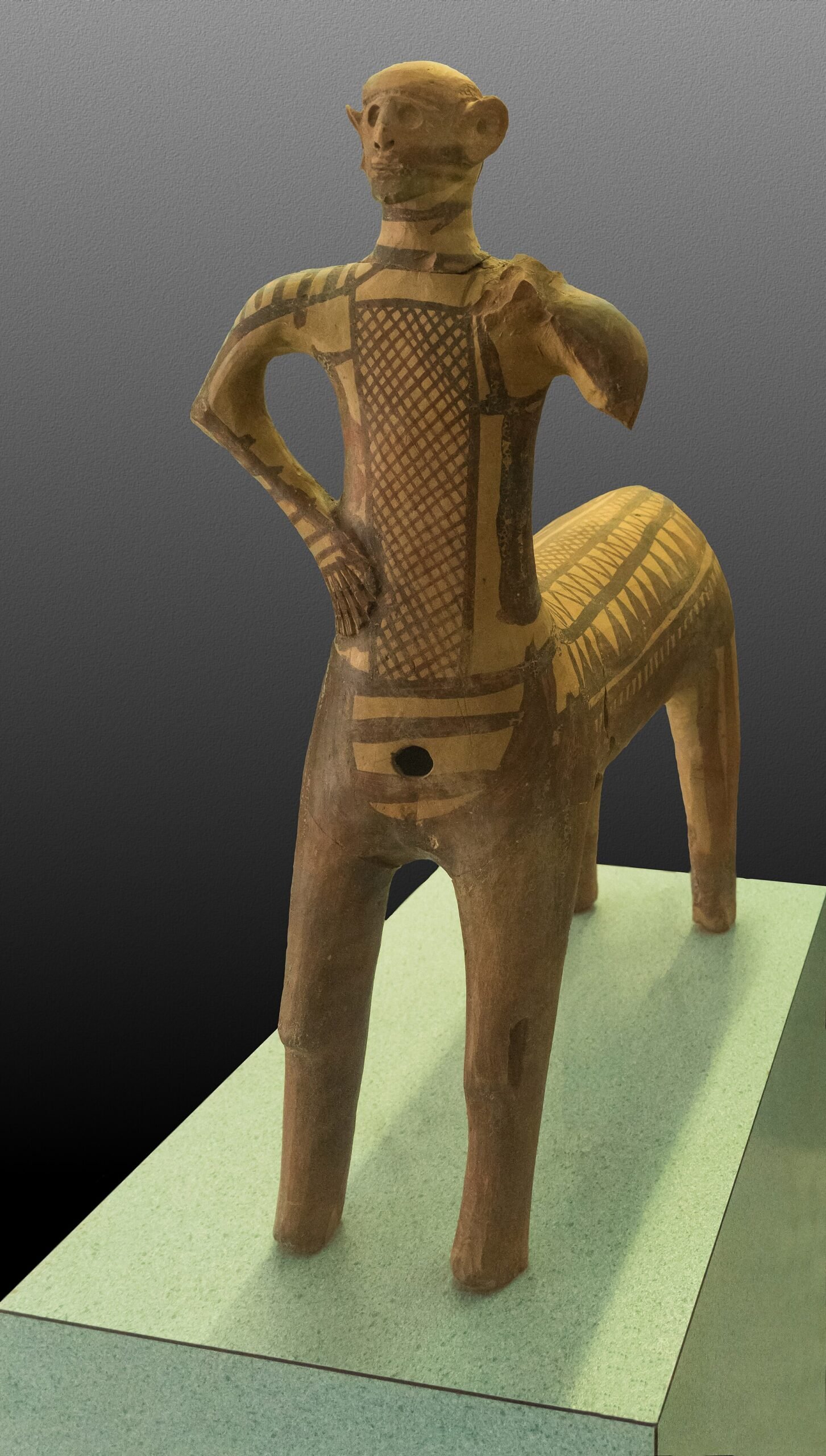
Image: Centaur Chiron of Lefkandi, Archaeological museum of Eretria, Greece.jpg — Jebulon, CC0