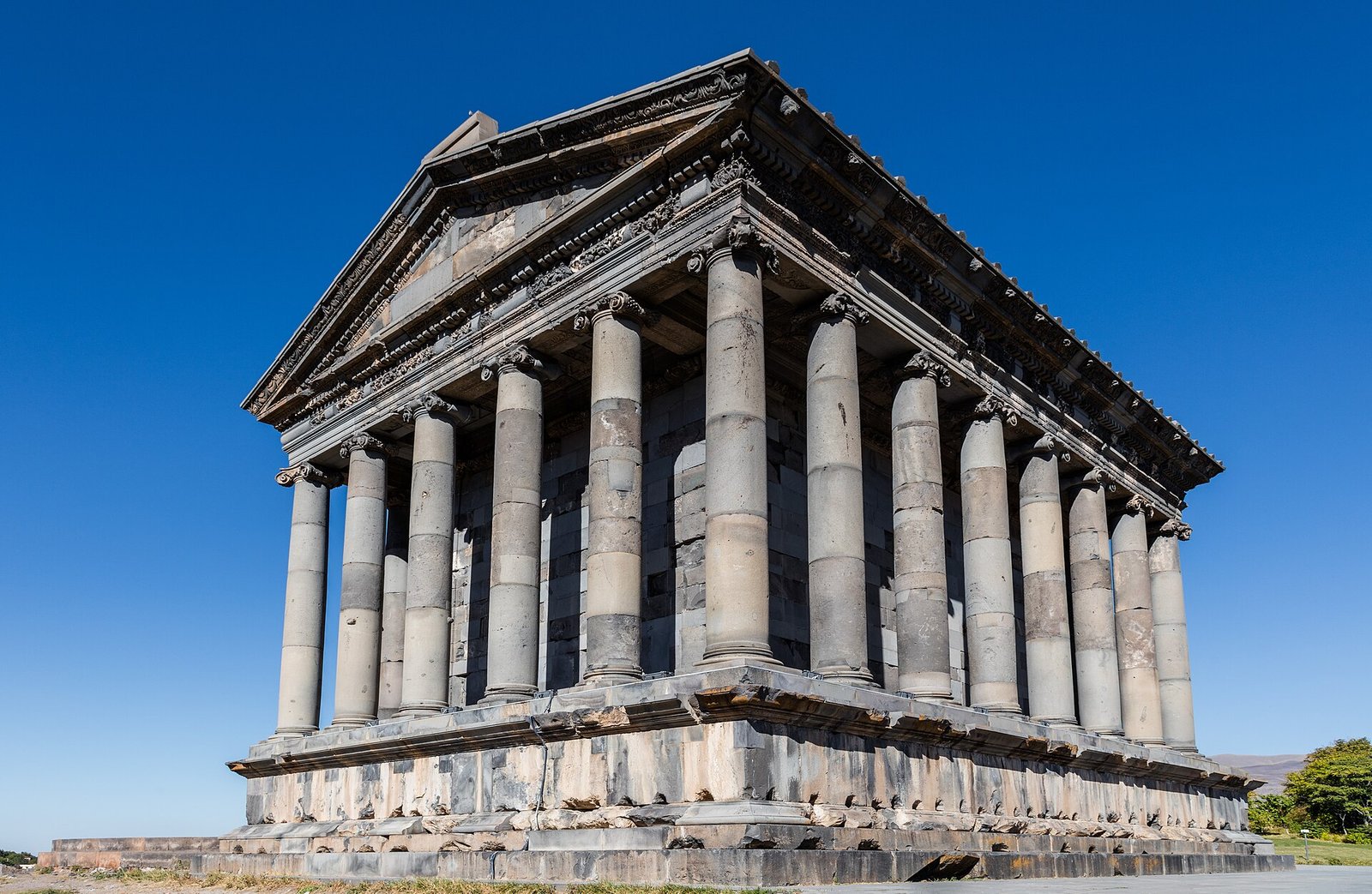
Garni Temple is traditionally credited to King Tiridates I, who is believed to have commissioned it around AD 77 for the sun god Mihr. That attribution remains disputed: Richard D. Wilkinson proposed that the building was a monumental tomb constructed in the second half of the second century AD.
A Greek inscription lies at the centre of the dating debate, but scholars disagree about which structure it describes. If you follow that question through Garni’s columns, bath mosaic and reconstructed stones, the landmark becomes more than a name attached to a king. Its history also involves an earthquake, excavations and a careful rebuilding campaign.
Where is Garni Temple in Armenia?
Garni Temple stands in Garni village, in Armenia’s Kotayk province. It is approximately 28 kilometres east of the capital, Yerevan. That places the monument within a clearly defined setting: in a village, overlooking the Azat River canyon.
The building occupies a triangular plateau approximately 1,390 metres above sea level. The setting includes both built remains and the natural basalt formations below.
Garni is also described as a symbol of Armenia’s pre-Christian period. Yet the complex contains remains from different religious and royal contexts. Alongside the columned building are a royal bath, palace ruins and the remains of the seventh-century Surp Sion Church.
Who built Garni Temple, and why is its history disputed?
The traditional explanation identifies Garni as a pagan temple dedicated to Mihr. It places construction around AD 77 under Tiridates I.
A Greek inscription discovered in 1945 has been used to support the traditional dating. The difficulty concerns its subject. Scholars dispute whether the inscription refers to the columned building or to the fortress. Its discovery therefore did not settle the identity and date of the structure beside it.
In 1982, Richard D. Wilkinson advanced a different explanation. He argued that the building was a monumental tomb dating from the second half of the second century AD. His case drew on nearby graves, fragments of sarcophagi and architectural comparisons.
These interpretations differ in both date and function. One identifies a temple commissioned by Tiridates I around AD 77. The other identifies a later funerary monument. When you encounter Garni described simply as a temple built in AD 77, you are reading the traditional account of a debated building.
How old is Garni Temple?
Under the traditional dating, Garni’s origins are approximately 1,950 years old in 2026. Wilkinson’s proposed date would place its construction later, in the second half of the second century AD. Its age therefore depends on which interpretation of the ancient building is accepted.
The standing monument also has a modern construction history. The columned structure collapsed during the earthquake of 1679. Its reconstruction began in January 1969 under architect Alexander Sahinyan and was completed in 1975. Ancient material and modern rebuilding both belong to what visitors see today.
What should you look for in Garni Temple photos?
Garni’s raised podium is surrounded by 24 Ionic columns. There are six columns across the front and six across the rear. Each side has eight when the corner columns are included in both adjoining rows. Those shared corners explain how the arrangement totals 24.
The podium measures approximately 15.7 by 11.5 metres. The building’s total height is about 10.7 metres. These dimensions give useful scale to photographs in which the columns dominate the frame and the canyon stretches beyond the plateau.
Look closely at the grey and bluish basalt blocks. They were joined without mortar, using iron and bronze clamps. Garni’s construction therefore depended on fitted stone blocks and metal connections. Its masonry offers another subject for photographs beyond the familiar view of the colonnade.
Photographs can also reveal evidence of reconstruction. Replacement stones were left undecorated so they could be distinguished from surviving ancient pieces. If you examine the contrast between carved fragments and plain additions, you can read part of the rebuilding process in the surface itself.
How was Garni rebuilt after the earthquake?
The earthquake of 1679 brought down the columned building. Archaeological work later included Nikolay Marr’s investigations between 1909 and 1911. Systematic excavations began in 1949 under Babken Arakelyan, before the reconstruction directed by Sahinyan.
The rebuilding used anastylosis: surviving original stones were returned to their positions. Work ran from January 1969 to 1975. This method made the ancient fragments central to the reconstructed structure, while replacement pieces filled gaps left by missing material.
The distinction resembles an everyday repair in which a plain replacement tile remains visible beside an older patterned one. At Garni, undecorated replacement stones allow you to distinguish additions from decorated ancient fragments. The repair becomes part of the building’s visible history.
Timeline
- Around AD 77: According to the traditional account, Tiridates I commissioned a temple dedicated to Mihr. Its dating and function remain disputed.
- Second half of the second century AD: Wilkinson’s alternative theory places construction of a monumental tomb in this period.
- Seventh century: Surp Sion Church was built within the complex.
- 1679: An earthquake destroyed the columned structure.
- 1909–1911: Nikolay Marr conducted investigations at Garni.
- 1945: The Greek inscription used in the dating debate was discovered.
- 1949: Systematic excavations began under Babken Arakelyan.
- 1969–1975: Alexander Sahinyan directed reconstruction of the columned building.
- 1978: A memorial fountain honouring Sahinyan was built at Garni.
- 2011: The museum-reserve received the UNESCO–Greece Melina Mercouri International Prize for safeguarding and managing cultural landscapes.
- 10 March 2025: The Garni Archaeological Complex and Basalt Organ formation were submitted to Armenia’s UNESCO World Heritage Tentative List.
Details you won’t find in guidebooks
The royal bath contains a mosaic with figures of Okeanos and Thalassa, accompanied by Greek inscriptions. According to the museum’s description, the mosaic was made from natural stone in 15 different colours. Its materials reward attention alongside the figures and lettering.
Sahinyan’s contribution is marked by a memorial fountain built at Garni in 1978. The fountain adds a later commemorative feature to a complex already containing ancient royal remains and a seventh-century church. It records the architect responsible for raising the columns again.
The Basalt Organ formation lies approximately 900 metres southeast of the archaeological complex, in the Azat canyon. Its natural columns form part of the landscape included with Garni in the 2025 Tentative List submission. Their inclusion connects the archaeological site with its geological surroundings.
That submission should be read alongside Garni’s earlier conservation recognition. The museum-reserve received the UNESCO–Greece Melina Mercouri International Prize in 2011. The award concerned safeguarding and managing the cultural landscape; the Tentative List submission followed on 10 March 2025.
FAQ
How old is Garni Temple?
The traditional date of around AD 77 makes its origins approximately 1,950 years old in 2026. Its present standing form dates from reconstruction between 1969 and 1975, using surviving original stones.
Sources
- American University of Armenia — Armenia Hidden Gems: Garni Temple armeniahiddengems.aua.am
- UNESCO World Heritage Centre — Garni Tentative List submission whc.unesco.org
- Garni History and Culture Museum-Reserve — Museum information, history and admission garni.mus.am
- English Wikipedia — Garni Temple en.wikipedia.org
- Turkish Wikipedia — Garni Tapınağı tr.wikipedia.org
- Service for the Protection of Historical Environment and Cultural Museum-Reservations of Armenia — Garni cultural programme report hushardzan.am
Image: Templo de Garni, Armenia, 2016-10-02, DD 03.jpg — Diego Delso, CC BY-SA 4.0