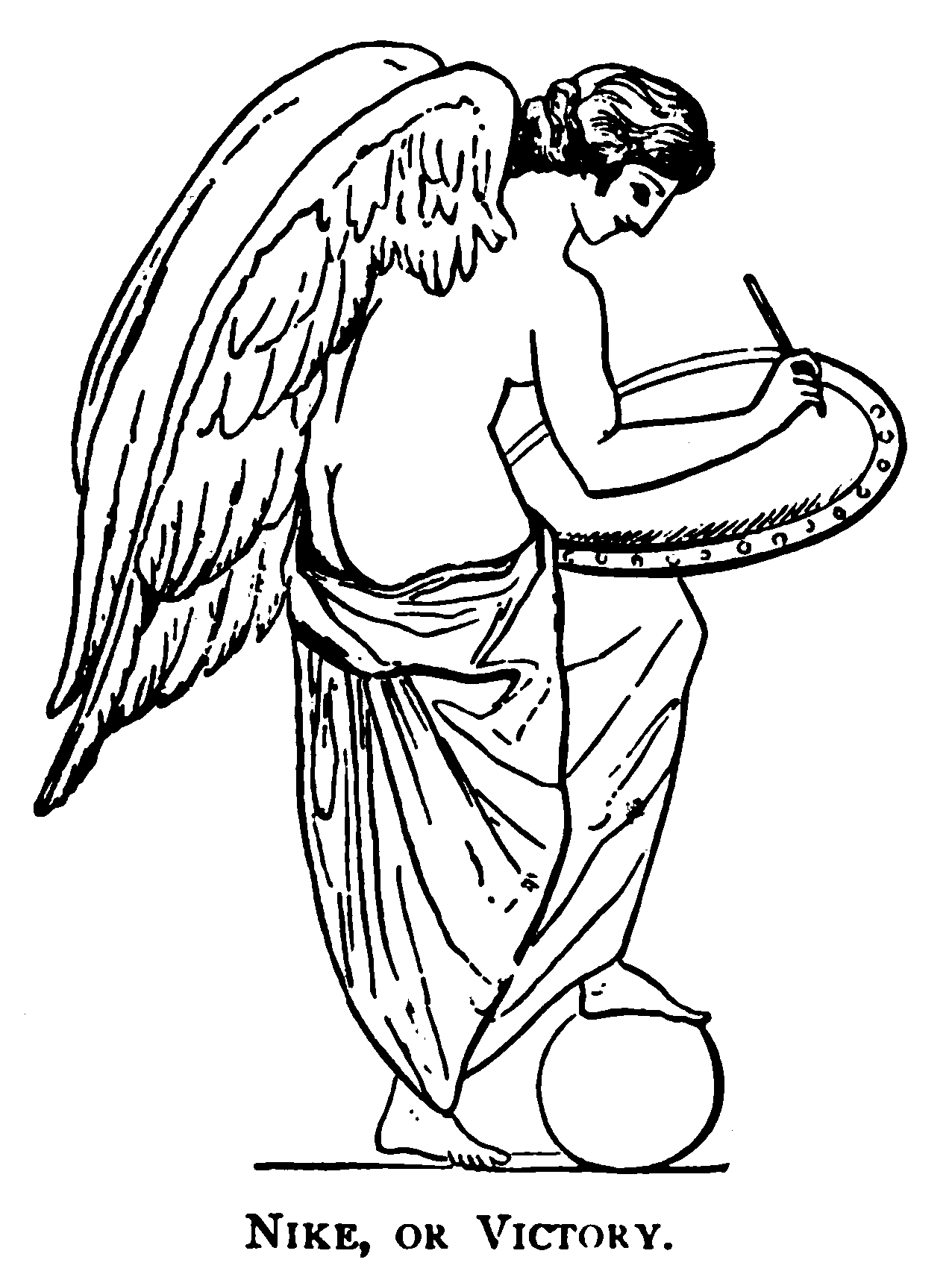
Nike was the Greek goddess and personification of victory in war and peaceful competition; her name, Νίκη, means “victory.” She was usually depicted with wings because they expressed her ability to move swiftly from place to place.
Yet a wingless image also belonged to the cult of Athena Nike in Athens. That apparent puzzle leads through Nike’s divine family, her wreaths and palm branches, and sculptures that capture her arrival. If you want to recognize her in ancient art, these details explain both her appearance and her relationships with other gods.
What are Nike’s mythological origins and relationships with other gods?
In lines 383–385 of Hesiod’s Theogony, Nike is the daughter of Pallas and Styx. Styx is herself a daughter of Okeanos. This genealogy places Nike within a family whose members embody forces closely connected with victory.
Her siblings are Zelos, who represents rivalry; Kratos, who represents strength; and Bia, who represents force. Nike personifies the successful outcome alongside these related powers. Their names give the family a clear connection with struggle and achievement.
In Hesiod’s account, Styx and her four children join Zeus against the Titans. Zeus rewards them with permanent honor on Olympos. Nike’s connection with Zeus therefore includes both allegiance during conflict and an enduring place beside his divine authority.
The surviving traditions do not all give Nike the same father. Line 4 of the Homeric Hymn to Ares calls Ares the father of warlike Nike. This is a different mythological genealogy from the Pallas–Styx account in Hesiod.
Nike’s relationship with Zeus also appears in sculpture. In the cult statue that Pheidias made for the Temple of Zeus at Olympia, Zeus held a winged Nike in his right hand. Victory became a visible figure within the image of the god.
How was she associated with victories in war and competition?
Nike’s role covered success in warfare and peaceful contests. Athletic victory belonged within her sphere alongside military victory. Her identity therefore extended across different kinds of competition, with the successful outcome as their common element.
The wreath and palm branch made this role visible. Both were symbols of victory and distinction awarded to winners. When you see Nike carrying either object, you are looking at an image tied to the honors of success.
Ancient vase paintings also show Nike with a lyre, an incense burner and vessels for liquid offerings. These objects connect victory celebrations with music and religious offerings. Her imagery includes what people did to celebrate and honor a successful outcome.
A red-figure lekythos in the Metropolitan Museum of Art shows her running toward an altar with her arms extended. Dated to 450–425 BCE and attributed to the Carlsruhe Painter, it places her movement within a scene of religious observance.
The altar matters to the image’s meaning. Nike’s presence belongs to an act directed toward a sacred setting, while her running pose gives the scene motion. The painting brings victory, movement and offering into the same composition.
What do wings, wreaths and palm branches signify in her imagery?
Nike’s wings express speed and her ability to travel swiftly between places. They also give artists a way to show her in motion. The Metropolitan Museum of Art describes three-dimensional representations as attempts to capture flight or the moment of landing.
Wings, wreaths and palm branches communicate related but different things. The wings concern Nike’s movement. The wreath and palm branch concern the victory and distinction bestowed on a winner. Together, they make her arrival and purpose visible.
A small terracotta Nike in the Metropolitan Museum of Art shows how this imagery could work at a modest scale. The statuette dates to the late fifth century BCE and measures 17.8 centimeters in height. Its inventory number is 07.286.23.
The Winged Victory of Samothrace develops the landing motif in a different setting. Now in the Louvre, the statue represents Nike arriving on a ship. It was prepared as a votive offering for the sanctuary on the island of Samothrace.
The Louvre dates the sculpture to 200–175 BCE. Its ship-shaped base gives Nike’s arrival a specific setting, while the winged figure embodies victory. You can read the pose as the moment when swift movement becomes a visible presence.
How is Nike related to Athena Nike and the Roman Victoria?
Athena Nike is a cult title identifying the victory-granting aspect of Athena, the protective goddess of Athens. The title connects Athena with victory. Nike also appears as a separate winged figure in the right hand of Pheidias’s Athena Parthenos statue in Athens.
The Temple of Athena Nike stood on the bastion guarding the southwestern entrance to the Athenian Acropolis. According to the Acropolis Restoration Service, it was built between 427 and 424 BCE. Its position placed the cult at this entrance to the Acropolis.
The temple is Ionic, with four columns on its front and four on its rear. These architectural details identify the building associated with Athena’s victory-granting role. The temple’s imagery also helps explain why Nike could appear with or without wings.
Writing in the second century CE, Pausanias called the wingless cult image Nike Apteros. He explained its lack of wings through the belief that victory should remain in the city. His explanation belongs alongside the identification of the image with Athena Nike’s cult.
The temple’s parapet reliefs, however, show winged Nike figures. They erect victory monuments and lead sacrificial bulls in the presence of a seated Athena. The wingless cult image and the winged relief figures thus belonged to the same religious setting.
Nike’s Roman counterpart was Victoria. Her Latin name also means “victory.” The connection rests on the divine personification of victory shared by the Greek Nike and Roman Victoria.
Details you won’t find in guidebooks
The Metropolitan Museum’s small terracotta Nike has lost its wings, but their attachment points remain significant. The wings were made separately and fitted into sockets in her back. The surviving body therefore preserves evidence of parts that are now absent.
Another Metropolitan object requires caution about a smaller detail. On the lekythos numbered 41.162.153, Nike may hold a wreath. Paint loss prevents a firm identification, so the museum presents the wreath as a possibility.
The relief known as The Sandalbinder, made around 410 BCE, brings Nike close to an everyday action: adjusting footwear. According to the Acropolis Museum, she adjusts or loosens her sandal so that she can enter the sanctuary barefoot. If you pause over this gesture, her wings share the scene with a familiar movement of the body.
Made from Pentelic marble, the relief stands 1.06 meters high. It was found near the Temple of Athena Nike in 1835. Its combination of wings and sandal adjustment places divine identity beside a concrete act of preparation.
The Samothrace statue also reveals careful assembly. Nike’s figure is made from Parian marble, while the ship-shaped base uses Lartos marble. The body and wings were carved separately and joined together.
Her right hand supplies another revealing detail. Found in 1950, it showed that the hand was empty. This discovery displaced earlier suggestions that she had held a wreath or trumpet in it. A missing attribute should therefore never be supplied automatically from Nike’s usual imagery.
Timeline
- 450–425 BCE: The lekythos attributed to the Carlsruhe Painter depicts Nike running toward an altar.
- 427–424 BCE: The Temple of Athena Nike is built on the Athenian Acropolis.
- Late fifth century BCE: The Metropolitan Museum’s terracotta Nike is made with separately attached wings.
- Around 410 BCE: The Sandalbinder relief is made for the Temple of Athena Nike’s parapet.
- 200–175 BCE: The Winged Victory of Samothrace is made, according to the Louvre’s dating.
- Second century CE: Pausanias records Nike Apteros and the explanation that victory should remain in Athens.
- 1835: The Sandalbinder is found near the Temple of Athena Nike.
- 1863: The Winged Victory of Samothrace is found during Charles Champoiseau’s excavation on Samothrace.
- 1950: The Samothrace statue’s empty right hand is found.
FAQ
What was Nike the goddess of?
Nike was the Greek goddess and personification of victory in war and peaceful competition. Her Greek name, Νίκη, means victory.
Why was Nike depicted with wings?
Nike’s wings expressed her ability to move swiftly from place to place. Sculptors also used flight and landing poses to represent her arrival.
Who were Nike’s parents?
In Hesiod’s Theogony, Nike was the daughter of Pallas and Styx. A different tradition in the Homeric Hymn to Ares calls Ares her father.
Was Athena Nike the same as Nike?
Athena Nike was a cult title expressing Athena’s power to grant victory. Nike also appeared as a winged figure held in Athena’s right hand.
Sources
- Theoi — Nike theoi.com
- University of Missouri Museum of Art and Archaeology — The Goddess Nike maa.missouri.edu
- Brigham Young University — Nike ogcma.byu.edu
- The Metropolitan Museum of Art — Terracotta Statuette of Nike metmuseum.org
- The Metropolitan Museum of Art — Terracotta Squat Lekythos metmuseum.org
- Acropolis Restoration Service — Temple of Athena Nike ysma.gr
- English Wikipedia — Nike (Mythology), Athena Nike#Athena_Nike) en.wikipedia.org
- Acropolis Museum — The Sandalbinder theacropolismuseum.gr
- Musée du Louvre — Un escalier pour la Victoire louvre.fr
- Musée du Louvre — Victoire de Samothrace, Collection Record collections.louvre.fr
Image: Nike, or Victory. (Greek mythology systematized).png — Illustrated by Engravings on Wood., Public domain