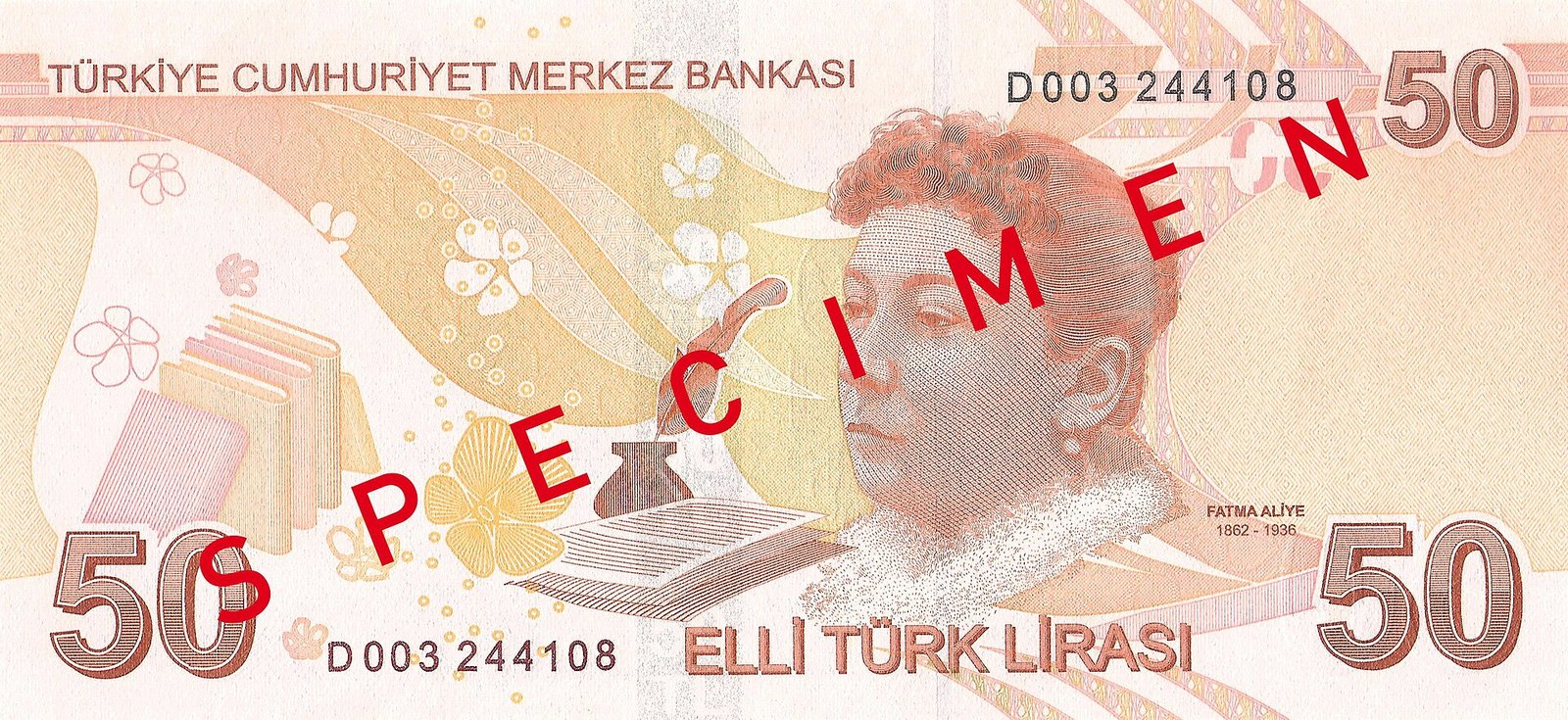
Take a 50-lira note out of your wallet. The woman on the back is Fatma Aliye. Many people handle her face without knowing her story. This guide tells it in order, from a pasha’s household in Istanbul to a bank vault of national portraits.
Who Was Fatma Aliye Topuz?
Fatma Aliye was an Ottoman writer. According to the TDV Islamic Encyclopedia, she was born in Istanbul on 22 October 1862. She wrote novels, but also translations, history, philosophy and work on women’s rights.
She took the surname Topuz in 1934. That is why you will see her named both as Fatma Aliye and as Fatma Aliye Topuz. She died in Istanbul on 13 July 1936 and was buried in Feriköy Cemetery.
Fatma Aliye’s Father and Family
Her father was Ahmed Cevdet Pasha, an Ottoman jurist, historian and statesman. Her mother was Adviye Râbia Hanım. Fatma Aliye grew up in the home of a man whose work was law and history.
His posts also moved the family around. Because of her father’s duties, Fatma Aliye lived in Aleppo, Yanya, Damascus and Beirut.
Her schooling came through her brother. Teachers were hired for her older brother Ali Sedat. Fatma Aliye learned from those lessons and picked up French and Arabic.
Her Marriage and Her Daughters
In 1879 she married Faik Bey, a kolağası (a senior captain) who served as an aide to Sultan Abdülhamid II. She had four daughters: Hatice, Ayşe, Nimet and Zübeyde İsmet.
The youngest, Zübeyde İsmet, took a different path. After leaving her family she became a Catholic nun.
Fatma Aliye’s Granddaughter: Suna Selen
Searches for her descendants usually lead to the stage actor Suna Selen. The Turkish World Encyclopedia says Fatma Aliye was Suna Selen’s maternal grandmother. The link runs through Fatma Aliye’s daughter Nimet Selen.
Fatma Aliye Topuz’s Books and Works
Her literary career began with a translation. In 1889 she turned Georges Ohnet’s French novel Volonté into Turkish under the title Meram.
Her works fall into a few groups:
- Novels: Muhadarat, Refet, Udi, Levayih-i Hayat and Enin.
- A joint novel: Hayal ve Hakikat, written with Ahmed Midhat Efendi.
- Essays and nonfiction: Nisvan-ı İslam, along with writing on history and philosophy.
- Translation: Meram.
Muhadarat, published in 1892, was the first novel to appear under her own name.
Refet follows an orphan girl whose relatives treat her unjustly. She fights to become a teacher. Levayih-i Hayat is built differently. It consists of ten letters in total, written by five women about their marriages.
Nisvan-ı İslam came out of conversations she held with Western women. They talked about Ottoman family life, polygamy, concubinage and veiling.
How She Went From “A Lady” to Fatma Aliye
She did not start under her own name. She published Meram under the signature “Bir Hanım”, meaning “A Lady”. Most readers never saw her name on that first book.
The change came on 8 October 1890. In a piece called “Sürat: Eiler’in Prensese Yirmi Birinci Mektubu”, she signed as Fatma Aliye and revealed who she was. Her first novel under that name followed two years later.
Ideas: Education, Work and Polygamy
Fatma Aliye argued that women should be educated and should have professions. She did not stay out of public arguments. She debated Mahmut Esat Efendi on polygamy, according to the Ministry of Culture and Tourism’s e-book on Nilüfer Mizanoğlu.
She also acted outside print. After the Ottoman-Greek War of 1897, she took part in founding the Cemiyyet-i İmdadiyye. Its aim was to help the families of the fallen and of veterans.
Was She Really the First Female Novelist?
The label “first female novelist” is contested. You should know both sides before you repeat it.
Zehra Toska has shown that Zafer Hanım’s novel Aşk-ı Vatan appeared in 1877. That is before Fatma Aliye’s novels.
The other side points to the length of her career. Literary history credits Fatma Aliye with five novels, a sustained body of work. Zafer Hanım has one known novel.
This is why the central bank’s wording is careful. Its brochure calls her “one of the first female novelists” in Turkish literature, and also the first female philosopher.
Why Fatma Aliye Is on the 50 Turkish Lira Note
On 3 October 2008, TCMB Governor Durmuş Yılmaz announced the rules for choosing people for the new banknotes. The person had to:
- have worked in science or art,
- carry national and universal value,
- not be identified with a political view,
- not have appeared on banknotes before.
Fatma Aliye met those criteria. The first 50 TL note of the E9 series, carrying her portrait, went into circulation on 1 January 2009.
The design points to her work. The back of the note carries an inkwell, a quill, paper and books. TCMB says these motifs stress her identity as a writer.
Fatma Aliye and Atatürk on the Same Note
People often ask about Fatma Aliye and Atatürk. The link is the banknote itself. The front of the 50 TL shows Atatürk. His portrait was built from a photograph taken by Cemal Işıksel in 1931 at the Gazi Farm.
So one note holds two faces. Atatürk is on the front, and Fatma Aliye is on the back.
Timeline
- 1862: Fatma Aliye is born in Istanbul.
- 1879: She marries Kolağası Faik Bey.
- 1889: She translates Volonté as Meram.
- 8 October 1890: She reveals her identity by signing a newspaper piece “Fatma Aliye”.
- 1892: Muhadarat, her first novel under her own name, is published.
- 1893: Her biography and works appear in the Woman’s Library exhibition and catalogue in Chicago.
- 1897: After the Ottoman-Greek War, she joins relief work for families of the fallen and veterans.
- After 1924: Health problems pull her away from writing.
- 1934: She takes the surname Topuz.
- 13 July 1936: She dies in Istanbul and is buried in Feriköy Cemetery.
- 3 October 2008: The rules for choosing banknote portraits are announced.
- 1 January 2009: The 50 TL note with her portrait enters circulation.
Details You Won’t Find in Guidebooks
A hidden first book. Her debut translation, Meram, carried the signature “Bir Hanım” rather than her name.
A letter that named her. Her identity became public on 8 October 1890 through one signed piece in a newspaper series of letters.
Ten letters, five women. Levayih-i Hayat is told entirely through ten letters about marriage.
Chicago in 1893. Her biography and works were included in the Woman’s Library exhibition and catalogue in Chicago.
A permission slip for the portrait. For the portrait used on the note, TCMB obtained permission from the Istanbul Metropolitan Municipality Directorate of Libraries and Museums.
Seeing Her Today
You do not need a museum ticket to meet Fatma Aliye. Every 50-lira note you receive as change carries her portrait. Look at the back and find the inkwell, the quill and the books. Then you know who they honor.
If you want to go further, Feriköy Cemetery in Istanbul is her burial place.
FAQ
Who was Fatma Aliye Topuz?
She was an Ottoman writer born in Istanbul on 22 October 1862. She wrote novels, translations and essays on history, philosophy and women’s rights. She died in Istanbul on 13 July 1936.
Why is Fatma Aliye on the 50-lira note?
The Central Bank of Turkey (TCMB) put her portrait on the first 50 TL note of the E9 series, issued on 1 January 2009. Its brochure presents her as one of the first female novelists in Turkish literature and as the first female philosopher.
Was Fatma Aliye really the first female novelist in Turkey?
It is debated. Zehra Toska has shown that Zafer Hanım’s novel Aşk-ı Vatan, published in 1877, came before Fatma Aliye’s novels. The traditional title rests on the fact that Fatma Aliye kept writing across five novels, while Zafer Hanım has only one known novel.
Who was Fatma Aliye’s father?
Her father was Ahmed Cevdet Pasha, an Ottoman jurist, historian and statesman. Her mother was Adviye Râbia Hanım.
Is the actor Suna Selen related to Fatma Aliye?
Yes. The Turkish World Encyclopedia says Fatma Aliye was the maternal grandmother of the stage actor Suna Selen, through her daughter Nimet Selen.
Sources
- TDV İslâm Ansiklopedisi — Fatma Aliye Hanım islamansiklopedisi.org.tr
- Vikipedi — Fatma Aliye Topuz tr.wikipedia.org
- Wikipedia — Fatma Aliye Topuz en.wikipedia.org
- Anadolu Ajansı — Romanları ve fikir yazılarıyla kadınların sesi olan öncü yazar aa.com.tr
- Kapadokya Üniversitesi — Fatma Aliye Hanım: İlk Romancı ve Öncü Bir Kadın acikerisim.kapadokya.edu.tr
- Türk Dil Kurumu — Fatma Aliye… Bir Zamanlar Hayatın Sahnesindeydi tdk.gov.tr
- Kültür ve Turizm Bakanlığı — Nilüfer Mizanoğlu ekitap.ktb.gov.tr
- Türk Dünyası Ansiklopedisi — Fatma Aliye Hanım turkdunyasiansiklopedisi.gov.tr
- TCMB — Türk Lirası Tanıtım Broşürü www3.tcmb.gov.tr
- TCMB — 50 Türk Lirası, I. Tertip tcmb.gov.tr
- TCMB — Türk Lirası Tanıtım Toplantısı www3.tcmb.gov.tr
- Dünya — Yeni paralar görücüye çıktı dunya.com
Image: 50 Türk Lirası reverse.jpg — Central Bank of the Republic of Turkey, Public domain