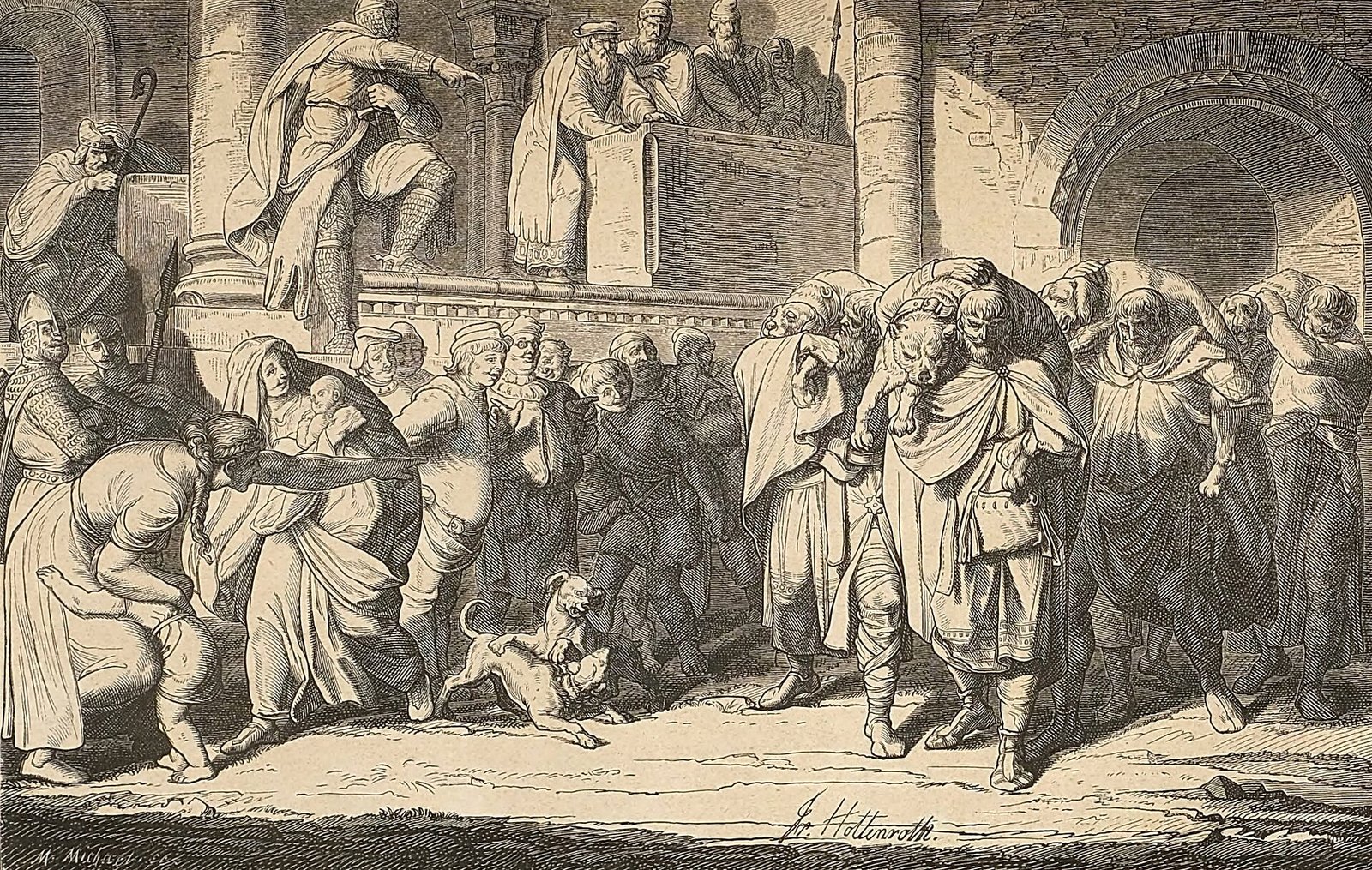
At the Diet of Worms in April 1521, Martin Luther appeared before Emperor Charles V and the imperial estates and refused to retract his writings. He said his conscience was bound to God’s word unless Scripture or clear reasoning proved him wrong. Charles defended Church tradition, and the subsequent Edict of Worms placed Luther under an imperial ban.
The encounter involved more than a refusal: Luther asked for time, distinguished between different kinds of books, and offered to retract demonstrated errors. If you want to understand his decision, those details matter as much as the famous words attributed to him. The path from his summons to his protection at Wartburg also explains how an imperial ban failed to end his work.
Was the Diet of Worms a church council or an imperial assembly?
The Diet of Worms was an assembly of the Holy Roman Empire convened by Charles V. It was not a church council. Luther’s questioning took place at the Bishop’s Palace in Worms on 17–18 April 1521. The religious dispute had therefore reached an imperial setting, with the emperor and imperial estates hearing his response.
Luther had already been excommunicated before he arrived. His appearance at Worms followed that Church action, rather than deciding whether it should happen. Keeping those events separate helps you understand the stakes: papal condemnation preceded the hearing, while the imperial ban followed it.
Why was Luther summoned to appear?
On 15 June 1520, Pope Leo X issued Exsurge Domine. The document condemned 41 propositions drawn from Luther’s writings and demanded their withdrawal. Luther publicly burned the papal document threatening excommunication in Wittenberg on 10 December 1520. His response made his rejection of that demand explicit.
Excommunication followed on 3 January 1521 through the papal document Decet Romanum Pontificem. Frederick the Wise, Elector of Saxony, opposed placing Luther under an imperial ban and imprisoning him without a hearing. That objection concerned whether Luther would be heard before imperial action was taken against him.
Charles V’s summons, dated 6 March 1521, promised safe conduct for Luther’s journey to Worms. Luther set out on 2 April and reached the city on 16 April. When he appeared the following day, the questions concerned his books: were they his, and would he retract their contents?
On 17 April, Luther asked for time to prepare his answer. He received until the next day. The refusal associated with Worms thus followed a pause for consideration. His first appearance ended with additional time, while his detailed defense came on 18 April.
How did Luther and Charles V defend their positions?
On 18 April, Luther divided his writings into three groups. These covered faith and life, criticism of the papacy, and attacks on individuals. This distinction mattered because he did not treat the demand to retract all his books as a single, straightforward correction. He defended different writings on different grounds.
For the books criticizing the papacy, Luther argued that retraction would strengthen oppression. For his attacks on individuals, he admitted that his language had been harsher than his Christian identity warranted. Yet that admission did not lead him to withdraw everything he had written against those people.
His central condition was proof. Luther said he would retract if Scripture or clear reasoning showed him to be wrong. He argued that popes and councils could err and contradict one another. Their authority alone therefore could not settle the matter for him. His conscience, he maintained, remained bound to God’s word.
There is an everyday connection here: if you have ever been asked to withdraw a statement, you know the difference between receiving a demand and receiving a convincing correction. Luther made that distinction through his stated willingness to accept scriptural proof. He even offered to be the first to throw his books into the fire if convinced of his errors.
Charles V answered on 19 April. His response argued that a single monk could not be right against more than a thousand years of Christian tradition. Communicated through a spokesman the day after Luther’s defense, it rested on his obligation to preserve his ancestors’ faith and the traditions of the Roman Church.
The disagreement therefore concerned how religious truth should be judged. Luther appealed to Scripture and clear reasoning against authorities he considered fallible. Charles defended the inherited faith and Church tradition he believed himself obliged to protect. Luther’s refusal and Charles’s response followed from those different grounds of authority.
What evidence supports the words Here I stand?
The phrase traditionally attributed to Luther is “Here I stand, I can do no other.” Whether he spoke those exact words remains uncertain. BYU Studies discusses the possibility that the German wording was added later to a printed Latin text. The familiar sentence should therefore be treated as an uncertain quotation.
The defense published by GHDI contains Luther’s refusal to act against conscience and his appeal for God’s help. It does not contain “Here I stand.” You can explain his position without relying on the disputed phrase: he rejected retraction unless Scripture or clear reasoning demonstrated his error.
The claim that Worms was the birthplace of modern freedom of conscience also requires care. The Museum im Andreasstift treats that account as a historical interpretation connected with Luther’s later elevation into a hero. His stated conscience at Worms was specifically bound to God’s word. That religious basis belongs at the center of the explanation.
How did the Edict of Worms and Luther’s removal to Wartburg change his position?
On 4 May 1521, Frederick the Wise arranged a staged kidnapping during Luther’s return journey. Luther was taken to Wartburg. The sequence matters: his removal happened before both the date written on the Edict of Worms and the date Charles V signed it.
The edict bears the date 8 May 1521, but Charles signed it on 26 May. It placed Luther under an imperial ban. It prohibited sheltering or supporting him and demanded his capture and delivery to the emperor. His position now involved an imperial prohibition as well as the excommunication already imposed by the papacy.
The edict also targeted his writings. Buying, selling, reading, keeping, copying, and printing Luther’s books were prohibited. These restrictions reached beyond Luther himself. They addressed the ways his texts could be acquired, retained, and circulated, making the treatment of his books part of the imperial response.
Enforcement varied by region. Nuremberg and Ulm delayed proclaiming the edict. In the Habsburg Netherlands, it became a legal basis for prosecutions of Protestants. The existence of the imperial ban therefore did not mean that its implementation followed the same course everywhere.
At Wartburg, protection allowed Luther’s work to continue. He translated the New Testament from Greek into German there. He returned to Wittenberg in March 1522 while the imperial ban remained in force. His German New Testament translation appeared in September 1522. The ban and his continued activity existed alongside one another.
Details you won’t find in guidebooks
Luther’s journey to Worms included preaching in Erfurt, Gotha, and Eisenach. Towns along the route welcomed him enthusiastically. His arrival on 16 April followed public encounters on the road, rather than a journey spent entirely away from listeners.
His defense also included an admission that can disappear behind the image of unqualified defiance. Luther acknowledged excessive harshness in his personal polemics. He combined that admission with a refusal to retract without proof, distinguishing his manner of argument from the grounds of his position.
At Wartburg, Luther grew his hair and beard and lived under the name “Junker Jörg” to conceal his identity. That disguise accompanied the protection arranged through Frederick’s staged kidnapping. The same period also included his work translating the New Testament into German.
Timeline
- 15 June 1520: Exsurge Domine condemned 41 propositions from Luther’s writings.
- 10 December 1520: Luther burned the papal document in Wittenberg.
- 3 January 1521: Luther was excommunicated.
- 6 March 1521: Charles V summoned Luther with a promise of safe conduct.
- 16 April 1521: Luther arrived in Worms.
- 17 April 1521: At his first questioning, Luther requested time to prepare an answer.
- 18 April 1521: Luther refused to retract without scriptural or reasoned proof.
- 19 April 1521: Charles V dated his response defending Church tradition.
- 4 May 1521: A staged kidnapping brought Luther to Wartburg.
- 8 May 1521: The date carried by the Edict of Worms.
- 26 May 1521: Charles V signed the edict.
- March 1522: Luther returned to Wittenberg.
- September 1522: His German New Testament translation was published.
FAQ
Was the Diet of Worms a church council?
No. It was an assembly of the Holy Roman Empire convened by Charles V. Luther was questioned at the Bishop’s Palace in Worms on 17–18 April 1521.
Why did Martin Luther refuse to recant?
Luther said his conscience was bound to God’s word. He would retract his views if Scripture or clear reasoning demonstrated his errors, but he rejected the authority of popes and councils alone as sufficient.
Did Luther really say “Here I stand”?
The exact words are uncertain. The defense published by GHDI includes his refusal to act against conscience and his appeal for God’s help, but it does not contain “Here I stand.”
What happened to Luther after the Diet of Worms?
Frederick the Wise arranged a staged kidnapping that brought Luther to Wartburg on 4 May 1521. The Edict of Worms subsequently placed him under an imperial ban, while he continued working under protection at Wartburg.
Sources
- Wikipedia — Diet of Worms en.wikipedia.org
- City of Worms — The 1521 Diet of Worms worms.de
- Theodor Dieter — The Diet and Edict of Worms (1521) lutheranquarterly.org
- Luther.de — Luther at the Imperial Diet of Worms luther.de
- GHDI — Luther and Emperor Charles V at the Diet of Worms germanhistorydocs.ghi-dc.org
- GHDI — From the Reformations to the Thirty Years War: Introduction germanhistorydocs.org
- BYU Studies — Martin Luther: The First Forty Years development.byustudies.byu.edu
- Museum im Andreasstift — Hier stehe ich: Gewissen und Protest museum-andreasstift.de
- TU Darmstadt — Wormser Edikt: Einleitung tueditions.ulb.tu-darmstadt.de
- TU Darmstadt — Wormser Edikt: Deutscher Text tueditions.ulb.tu-darmstadt.de
- Luther.de — Luther auf der Wartburg luther.de
- City of Eisenach — Martin Luther eisenach.de
Image: Friedrich Hottenroth – Rebelling nobles are sentenced to dog carrying, Diet of Worms, 1155.jpg — Friedrich Hottenroth, Public domain