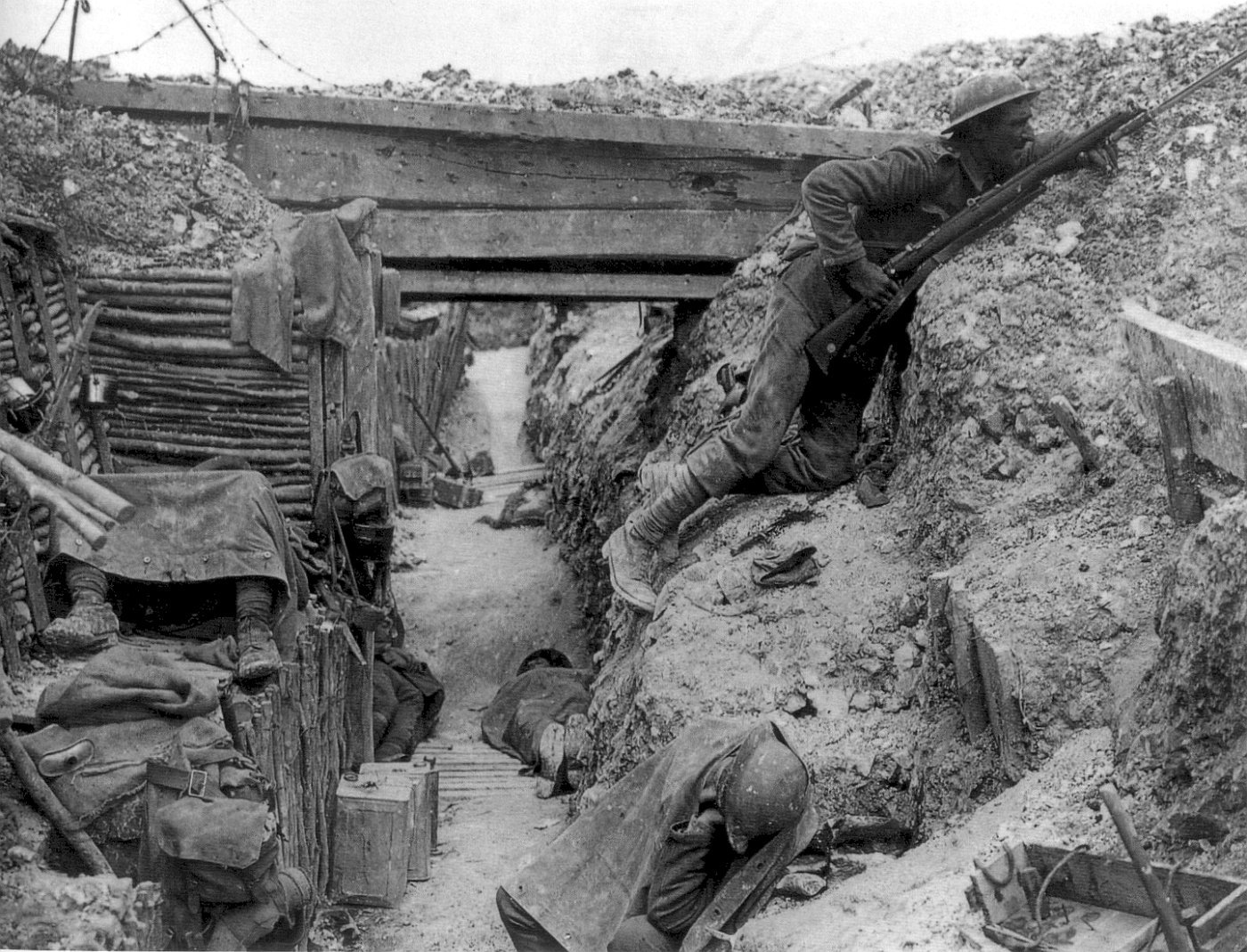
The Battle of the Somme was so deadly because the British preparatory bombardment failed to destroy enough German defenses, leaving attacking infantry exposed to machine-gun, rifle, and artillery fire. From 1 July to 18 November 1916, repeated Allied attacks and German counterattacks turned the offensive into a prolonged battle of attrition. Tanks entered combat in September but failed to produce a complete breakthrough.
Why did seven days of bombardment leave defenders able to fight? Around the Somme River in northern France, protected German positions survived an enormous expenditure of ammunition. If you follow the battle from its original objectives to its casualty totals, you can see how failed preparations, uneven advances, and repeated fighting combined.
What did the Allies hope to achieve on the Somme?
The Allied plan called for an attack across approximately 40 kilometres of German positions. It was intended to coincide with offensives by Russia and Italy. The objective was to break through the German lines, rather than conduct the prolonged struggle that followed.
Germany’s attack on Verdun on 21 February 1916 changed those preparations. The Somme offensive was brought forward to relieve pressure on French forces. French participation also became smaller than originally planned. The operation therefore carried an immediate responsibility to support an ally as well as its original ambition to achieve a breakthrough.
Douglas Haig commanded the British Empire forces, while Ferdinand Foch commanded the French. During the opening stages, Britain’s forces included Kitchener’s volunteer New Armies. Men recruited through conscription joined them during the final months. The offensive consequently stretched across a changing British force as well as changing battlefield conditions.
The outcome reflected this tension between immediate relief and territorial objectives. The Somme helped ease pressure on the French at Verdun. Yet the Allied armies had captured neither Péronne nor Bapaume when the offensive ended.
Why did the British Army suffer such heavy losses on the first day?
The British preparatory bombardment began on 24 June and lasted seven days. Its tasks were concrete: destroy German artillery, damage defensive positions, and cut the barbed wire ahead of the infantry. The attack depended on this preparation making the German position easier to cross and capture.
The National Army Museum records that two-thirds of the 1.5 million shells fired were shrapnel ammunition. These had limited effectiveness against concrete shelters. The museum also reports an estimate that approximately 30 percent of the shells failed to explode. A large number of rounds therefore did not mean an equivalent amount of effective destruction.
Think of a checklist in everyday life: marking a task as attempted does not establish that it is complete. On the Somme, seven days of firing did not establish that the German defenses had been destroyed. You need to distinguish the scale of the preparation from its actual effect.
At 07:30 on 1 July, the infantry attack began. Many British units fell behind their supporting artillery fire. German soldiers could emerge from their shelters and open fire with machine guns, rifles, and artillery. Surviving defenses and the gap behind the artillery combined to expose the advancing infantry.
British casualties that day exceeded 57,000, including 19,240 deaths. The losses were especially concentrated north of the Albert–Bapaume road. This geographical distinction matters: the terrible British total did not mean that every part of the Allied attack had the same result.
What roles did French and German forces play?
On 1 July, the French Sixth Army and the right wing of the British Fourth Army advanced against the German Second Army. Their progress contrasts with the heavy British losses farther north. The first day therefore contained both successful advances and attacks that suffered severe losses.
German defenses were built to preserve men and maintain resistance under bombardment. Shelters extended approximately six to nine metres underground, and some could accommodate 25 soldiers. These protected spaces help explain how defenders survived the preparation and returned to their weapons when the infantry approached.
German forces also launched counterattacks during the summer. Allied attacks on individual positions and German efforts to regain ground transformed the hoped-for breakthrough into attrition. The cost accumulated through repeated fighting rather than ending with the opening assault.
British attacks did sometimes produce substantial local gains. On 14 July, four divisions attacked at dawn with concentrated artillery support. They captured Longueval ridge that same morning. This success shows why the opening day alone cannot describe every operation fought during the Somme campaign.
Timeline
- 21 February 1916: Germany attacked Verdun, making relief of French forces a more urgent purpose of the Somme plan.
- 24 June 1916: The seven-day British preparatory bombardment began.
- 1 July 1916: The infantry offensive opened. British casualties exceeded 57,000, including 19,240 deaths.
- 14 July 1916: Four British divisions captured Longueval ridge.
- August 1916: Hindenburg and Ludendorff took over German command.
- 15 September 1916: British tanks entered combat for the first time during the Flers–Courcelette attack.
- 18 November 1916: Haig ended the Somme offensive in worsening weather.
How did the first use of tanks and attrition affect the outcome?
British forces introduced tanks into combat on 15 September 1916 at Flers–Courcelette. This was their first battlefield use anywhere. Their arrival added a new weapon to an offensive already shaped by repeated attacks on defended positions.
The 49 tanks available for the operation were slow and mechanically unreliable. Their crews had limited experience, and joint training with infantry had not taken place. These limitations affected how much the machines could contribute to the attack.
According to the National Army Museum, only 15 of the planned 49 tanks advanced into no man’s land when the assault began. Flers was captured, but breakdowns and enemy fire reduced the vehicles available. The attack did not achieve a complete rupture of the German front.
You can therefore separate the significance of introducing tanks from the result of this particular attack. Their first use was a major development in the campaign, but it did not end the fighting. Haig continued the offensive until 18 November, when weather conditions were deteriorating.
The value of that prolonged attrition remains disputed. On 1 August, Winston Churchill argued in criticism directed to the British Cabinet that the fighting was damaging British armies more than German forces. Historians including Gary Sheffield and William Philpott have instead interpreted the Somme as coalition warfare that inflicted lasting damage on Germany, with no strategic alternative available to Britain in 1916.
German decisions also form part of that assessment. After taking command in August, Hindenburg and Ludendorff adopted strategic defense on the Western Front for 1917 following the losses at Verdun and the Somme. The offensive failed to break through, but its consequences extended beyond the ground captured.
Why must deaths be distinguished from total casualties?
A casualty total includes the dead, wounded, and missing. It is not a death toll. On the first day, the 19,240 British deaths were included within the total of more than 57,000 casualties. Treating the larger figure as deaths would substantially misrepresent what happened.
For the full campaign, Gonville & Caius College gives 419,654 casualties for British and Commonwealth forces and 204,253 for French forces. Its German casualty figures range from 437,000 to 680,000. That range should remain visible whenever the opposing armies’ losses are compared.
Combined casualties exceeded one million, but that does not mean more than one million people died. If you remember one distinction when reading about the Somme, make it this one: deaths form part of total casualties. The uncertainty in German estimates also prevents a single precise comparison from settling the argument about attrition.
Details you won’t find in guidebooks
The mine beneath Hawthorn Ridge exploded ten minutes before the infantry assault on 1 July. This warned German forces that an attack was approaching. The timing belongs alongside failed bombardment and surviving defenses when explaining the opening assault.
German telephone cables linking the front line with artillery were buried approximately 1.8 metres underground. Along with shelters reaching six to nine metres deep, this detail shows that German preparations included protected communications as well as protected accommodation.
The tank figures also reward close reading. Forty-nine machines were planned for the September attack, but only 15 advanced into no man’s land at its start. The difference helps explain why the presence of tanks did not automatically translate into a breakthrough.
FAQ
When and where was the Battle of the Somme?
It took place from 1 July to 18 November 1916 around the Somme River in northern France.
How many British soldiers died on the first day?
British Army deaths on 1 July numbered 19,240. They formed part of a total casualty figure exceeding 57,000.
Did tanks achieve a breakthrough at the Somme?
No complete breakthrough followed their first combat use on 15 September 1916. Flers was captured, but breakdowns and enemy fire reduced the tanks available.
Did the Somme achieve any strategic purpose?
It helped relieve pressure on French forces at Verdun, although the Allies failed to break the German front or capture Péronne and Bapaume.
Sources
- National Army Museum — Battle of the Somme nam.ac.uk
- National Army Museum — Attack of the tanks nam.ac.uk
- University of Cambridge, Gonville & Caius College — The Battle of the Somme cai.cam.ac.uk
Image: Cheshire Regiment trench Somme 1916.jpg — John Warwick Brooke, Public domain