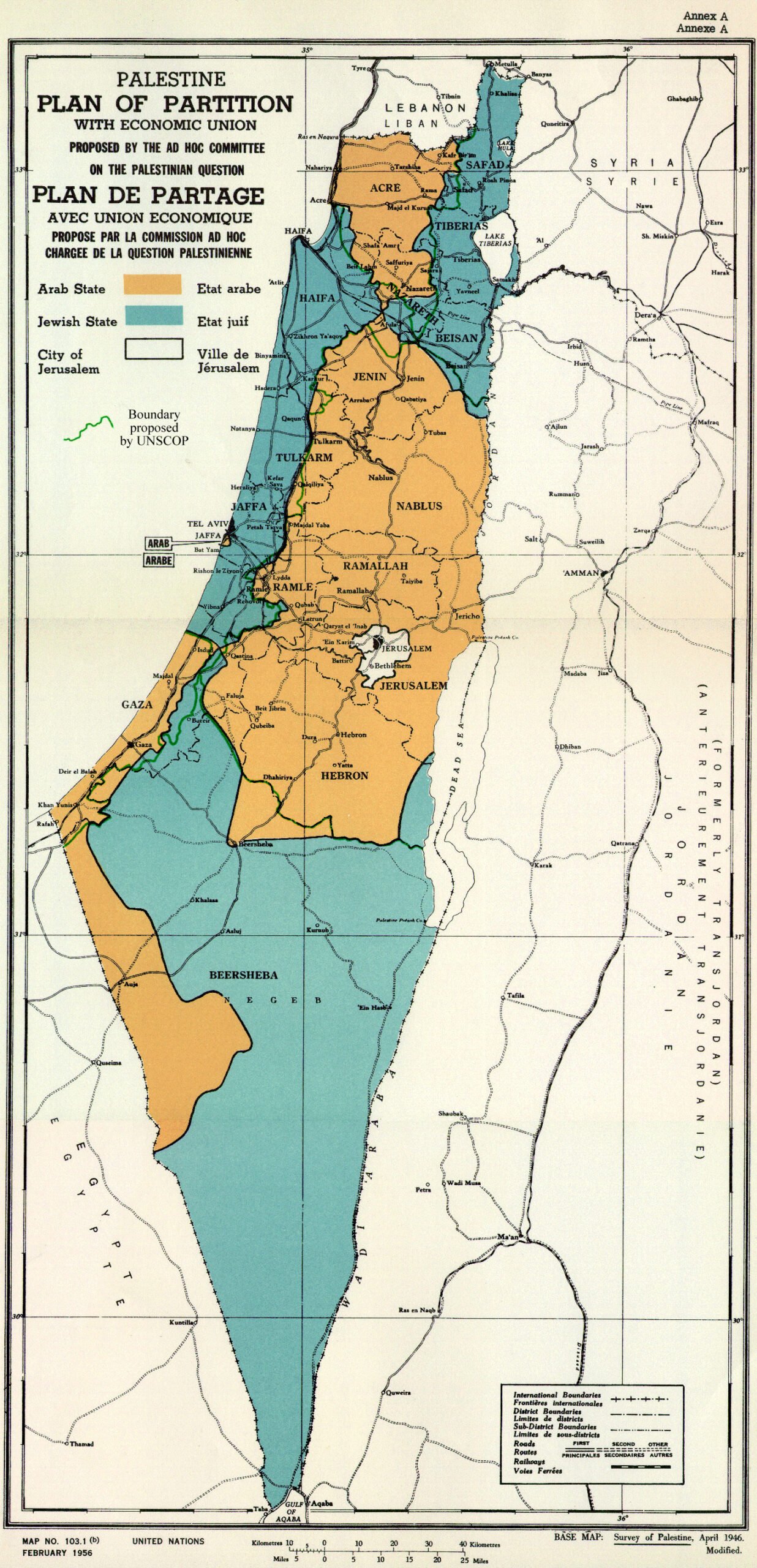
The United Nations Partition Plan for Palestine was adopted by the UN General Assembly on 29 November 1947 as Resolution 181 (II). It proposed independent Arab and Jewish states linked by economic union, with international administration for Jerusalem. Most Jewish organizations accepted it, while Palestinian Arabs and Arab states rejected it; civil war and then interstate war followed, preventing implementation as intended.
Why did a plan for two states also include shared currency arrangements, an Arab enclave, and a separate Jerusalem? These provisions reveal what the UN proposed beyond dividing territory. If you follow the committee’s work, the map, and the events through 1949, you can distinguish the resolution’s intended settlement from the control lines that emerged after war.
Why did the UN propose partition for Palestine in 1947?
Britain asked the UN to recommend a future for Palestine. On 15 May 1947, the UN established the United Nations Special Committee on Palestine, known as UNSCOP. Its membership came from 11 countries. The committee’s task placed Palestine’s future before an international body while the territory remained under the British Mandate.
UNSCOP did not reach a single position. Its report, dated 3 September 1947, recorded seven members supporting partition with economic union. India, Iran, and Yugoslavia favoured a federal solution. Australia abstained. Partition was therefore the committee majority’s proposal, while a different constitutional arrangement also received support.
Jewish organizations cooperated with UNSCOP. The Arab Higher Committee declined to participate. It objected that independence was not being addressed and that the question of Jewish refugees in Europe had not been separated from Palestine’s future. These objections concerned the framework of the inquiry itself, before the General Assembly voted on partition.
What was the primary goal of the United Nations Partition Plan?
The plan’s central goal was to replace the British Mandate with independent Arab and Jewish states. An economic union would connect them. Jerusalem would have a special international administration instead of belonging to either state. The proposal therefore combined political separation with shared economic arrangements and a separate regime for the city.
The timetable was specific. British armed forces were to withdraw by 1 August 1948 at the latest. The Arab and Jewish states, together with Jerusalem’s special regime, were to come into existence two months after the evacuation. The final deadline for their establishment was 1 October 1948.
The proposed states were also to observe protections for their populations. The plan prohibited discrimination based on race, religion, language, or sex. It guaranteed minorities education in their own languages. These provisions formed part of the proposed settlement alongside borders, independence, and economic cooperation.
What did UN Resolution 181 actually decide?
The General Assembly adopted Resolution 181 (II) on 29 November 1947. The vote was 33 in favour, 13 against, and 10 abstentions. One member did not participate. The text recommended adoption and implementation of the partition plan to Britain and the other UN members.
The resolution’s legal meaning was disputed. Oxford Bibliographies records that the UN Secretariat, the Soviet Union, and the Jewish Agency regarded it as binding. Arab states opposed it as contrary to Palestinian Arabs’ right to self-determination through the creation of a single state. These were competing legal positions concerning the same resolution.
Acceptance also differed among the communities concerned. According to the US National Archives, most Jewish organizations accepted the plan. Palestinian Arabs rejected partition because they considered it favourable to Jews and unfair to the Arab population that would remain within the proposed Jewish state. The General Assembly vote did not resolve that disagreement.
How do you read the United Nations Partition Plan map?
Start with the three proposed territorial components: the Jewish state, the Arab state, and the international Jerusalem area. The area calculation reported by English Wikipedia assigns 15,264 square kilometres to the Jewish state, 11,592 to the Arab state, and 176 to the Jerusalem area. These figures describe the proposal, rather than the territorial outcome of the war.
The proposed Jewish state included eastern Galilee, the coastal plain extending from the Haifa area, and most of the Negev Desert. The proposed Arab state included parts of central and western Galilee, the hill country of Samaria and Judea, and the southern coast containing Gaza.
Jaffa requires particular attention when you examine the coastal section. It was designated an enclave belonging to the Arab state within the Jewish state’s coastal territory. Its placement shows why reading the map requires more than identifying two broad blocks of colour.
Jerusalem and the surrounding Bethlehem area were assigned to a corpus separatum, or separate international territory. The UN Trusteeship Council would administer it. Neither proposed state would receive this area under the plan. Its status was a distinct component of the settlement, alongside the two states and their economic union.
Details you won’t find in guidebooks
For readers visiting Turkey, the voting record offers a direct connection: Turkey voted against Resolution 181. The United States and the Soviet Union voted in favour. Britain, which held the mandate, abstained. Those positions help distinguish the administering power’s vote from the votes of other states involved in the decision.
The economic provisions reach into everyday life. If you buy a rail ticket, post a letter, or exchange money, you are dealing with services covered by the proposed union. The plan included a customs union and a common currency system based on a single exchange rate. Railways, postal services, ports, and airports were to operate for the common benefit.
Jerusalem’s international arrangements included a review after the first ten years. Residents were to express their views on possible changes through a referendum. The proposal thus contained a procedure for reconsidering the city’s regime, as well as provisions for establishing it.
Resolution 181 also remained relevant after the war prevented its intended implementation. In the Lausanne Protocol of 12 May 1949, Israel, Egypt, Jordan, Lebanon, and Syria accepted it as a basis for discussing territorial questions. That later use concerned negotiations over territory; it did not mean the original plan had been carried out.
What was the result of the United Nations Partition Plan?
The November decision was followed by the 1947–1948 civil war between Arab and Jewish communities in Mandatory Palestine. The proposed transition to two states and an international Jerusalem did not proceed according to the resolution’s timetable. War prevented the settlement from being implemented as intended.
On 14 May 1948, David Ben-Gurion declared the establishment of the State of Israel. US President Harry Truman recognized the new state that same day. On 15 May, military intervention by Arab states took the conflict into an interstate phase. These events distinguish the fighting within Mandatory Palestine from the subsequent war between states.
The 1949 armistices produced control lines different from the partition map. Israel controlled some areas assigned to the proposed Arab state. Gaza remained under Egyptian control, while the West Bank remained under Jordanian control. Reading the 1947 map as a record of the postwar settlement therefore confuses a proposal with a later outcome.
The human consequences were extensive. UNHCR’s historical assessment states that approximately 750,000 Palestinians were expelled or forced to flee from areas controlled by Jewish forces during fighting before and after Israel’s establishment. Displacement belongs alongside the diplomatic decisions and territorial changes when explaining this stage of the Arab-Israeli conflict.
Timeline
- 15 May 1947: The UN established UNSCOP to investigate Palestine’s future.
- 3 September 1947: UNSCOP’s report presented majority support for partition and minority support for a federal solution.
- 29 November 1947: The General Assembly adopted Resolution 181 (II).
- 1947–1948: Fighting between Arab and Jewish communities developed into civil war.
- 14 May 1948: David Ben-Gurion declared the establishment of Israel.
- 15 May 1948: Arab states intervened militarily, taking the conflict into an interstate phase.
- 1949: Armistice agreements established control lines different from the partition map.
- 12 May 1949: The Lausanne Protocol accepted Resolution 181 as a basis for territorial negotiations.
Where can you find the partition plan PDF and check Reddit claims?
The UN’s Resolution 181 (II) document page provides a download link named ARES181.pdf. The text allows you to examine the proposed timetable, economic union, and international arrangements for Jerusalem together.
If you encounter a Reddit discussion about whether the UN partitioned Palestine, compare its wording with the resolution’s recommendation to adopt and implement the plan. Then compare the proposed map with the 1949 outcome. The recommendation, its disputed legal interpretation, and its incomplete implementation are separate issues supported by different parts of this history.
FAQ
What was the primary goal of the UN Partition Plan?
Its primary goal was to establish independent Arab and Jewish states after the British Mandate, linked by economic union, alongside a special international administration for Jerusalem.
What was the result of the UN partition vote?
Resolution 181 (II) passed on 29 November 1947 with 33 votes in favour, 13 against, and 10 abstentions. One member did not participate.
Did the 1947 partition map become the final territorial settlement?
No. War prevented implementation as intended, and the 1949 armistices left control lines different from the proposed partition boundaries.
Where can you find the UN Partition Plan PDF?
The UN document page for Resolution 181 (II) provides a download link to a PDF named ARES181.pdf.
Sources
- United Nations — General Assembly Resolution 181 (II) un.org
- Wikipedia — United Nations Special Committee on Palestine en.wikipedia.org
- Wikipedia — United Nations Partition Plan for Palestine en.wikipedia.org
- Oxford Bibliographies — The UN Partition Plan for Palestine and International Law academic.oup.com
- US National Archives — 50th Anniversary of the State of Israel archives.gov
- US Department of State, Office of the Historian — The Arab-Israeli War of 1948 history.state.gov
- US Department of State, Office of the Historian — Creation of Israel, 1948 history.state.gov
- UNHCR — The State of the World’s Refugees 2000, Chapter 1 unhcr.org
Image: UN Palestine Partition Versions 1947.jpg — Zero0000A/RES/181(II), Public domain