What does the history of Muş reveal?
The history of Muş reaches from Urartian remains at Kayalıdere to medieval mosques and Ottoman buildings. Its name also has a history of its own. Muş appears in a tenth-century geographical work, while explanations of its origin point toward either the Muški or Muşel Mamigonyan.
If you are exploring Muş, distinguish the city from the wider province. Malazgirt, the site of the 1071 battle, belongs to Muş province. Arak Church stands within Kepenek village in the central district, about 5 kilometres from the city centre. These places bring different parts of the region’s past into view.
What is the origin of the name Muş?
Before the Islamic period, sources called the Muş Plain and its surroundings Taraunitis, Taraun or Daron. During the Islamic period, Tarûn referred to both the region and the city. These recorded forms establish a naming history that extends beyond the name used today.
Muş itself appears in Makdisî’s tenth-century work, Aḥsenü’t-teḳāsîm. That reference provides documentary evidence for the name’s use. It does not, by itself, establish how the name first developed.
One explanation connects Muş with the Muški mentioned in Assyrian sources. Turkish Wikipedia presents this connection. It should be read as a theory about the name’s origin, rather than as an established derivation.
Mithat Eser’s 2014 study supports a different explanation. He proposes that Muslims may have formed the name from Muşel Mamigonyan during the eighth or ninth century. He also identifies problems in other explanations based on language or a supposed founding figure.
If you are writing about the name, keep these claims separate. The tenth-century appearance of Muş is documented. The Muški connection and Eser’s Muşel Mamigonyan explanation remain competing interpretations of its origin.
How far back does the archaeology reach?
Kayalıdere Castle supplies evidence for the region’s Urartian past. Researchers publishing its 2018–2019 rescue excavations propose dating the structure to the late ninth or early eighth century BCE. Their assessment draws on architecture and a limited set of carbon analyses.
The proposed date concerns the castle. It should not become a precise foundation date for the city of Muş. Kayalıdere’s archaeological chronology and the written history of the city’s name answer different questions.
The first scientific excavations at Kayalıdere took place in 1965. Seton Lloyd and Charles A. Burney led the team. The later rescue excavations added evidence from the site’s architecture and pottery.
How did Muş enter Seljuk and Ottoman rule?
The Battle of Malazgirt took place in 1071 at Malazgirt, within today’s Muş province. Muş entered Seljuk rule shortly afterward, during Sultan Alparslan’s reign. The city and its surroundings were assigned to Emîr Sanduk as an iqta.
Ottoman administration began in Muş in 1515. This followed the victory at Çaldıran and the removal of Safavid forces by local rulers. The date marks a later political transition, separate from the Seljuk takeover after 1071.
Muş became the centre of a province created by separation from Bitlis in 1929. For a student tracing administrative history, this date belongs alongside the medieval and Ottoman changes. It explains the city’s provincial status in the Republic period.
Timeline
- Late ninth–early eighth century BCE: Researchers propose dating Kayalıdere Castle to this period, using architectural evidence and carbon analyses.
- Tenth century: Makdisî records the name Muş in Aḥsenü’t-teḳāsîm.
- 1071: The Battle of Malazgirt takes place in what is now Muş province.
- After 1071: Muş enters Seljuk rule under Sultan Alparslan.
- Second half of the fourteenth century: Architectural features suggest this construction period for Muş Ulu Camii.
- 1515: Ottoman administration begins in Muş.
- 1571: An endowment register also names Ulu Camii as Ferhad Bey Camii.
- 1747–1748: Alaeddin Bey Camii is built, according to the inscription reported in Şehrimiz Muş.
- 1929: Muş becomes the centre of the province separated from Bitlis.
- 1965: Lloyd and Burney lead scientific excavations at Kayalıdere.
- 2020: A project begins to identify and investigate the Malazgirt battlefield.
What can the mosques tell you about the city?
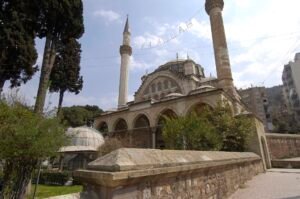
Muş Ulu Camii has a rectangular plan and rubble-stone construction. Its architectural features support a proposed date in the second half of the fourteenth century. This is an architectural assessment, so the dating should retain that qualification.
The mosque also appears under another name. A 1571 endowment register records it as Ferhad Bey Camii. Its earthquake-damaged minaret underwent repairs in 1968 and 1972, following its original form.
Hacı Şeref Camii, inside Arslanlı Han, presents a dating problem. The Provincial Directorate of Culture and Tourism assigns it to the seventeenth century. The TDV İslâm Ansiklopedisi records a prayer house with the same name in 1571. These references should not be compressed into one certain construction date.
The mosque’s additions have separate dates. Its minaret was added in 1902. The entrance prayer area followed in 1997. If you examine the building, those dates help distinguish additions from the question of its original construction.
Alaeddin Bey Camii has a more specific construction account. Şehrimiz Muş, published by the Muş Directorate of National Education, cites its inscription. It names the patron as Alaeddin Bey, son of Kasım Ağa, and dates construction to 1747–1748.
What is historical about Murat Bridge?
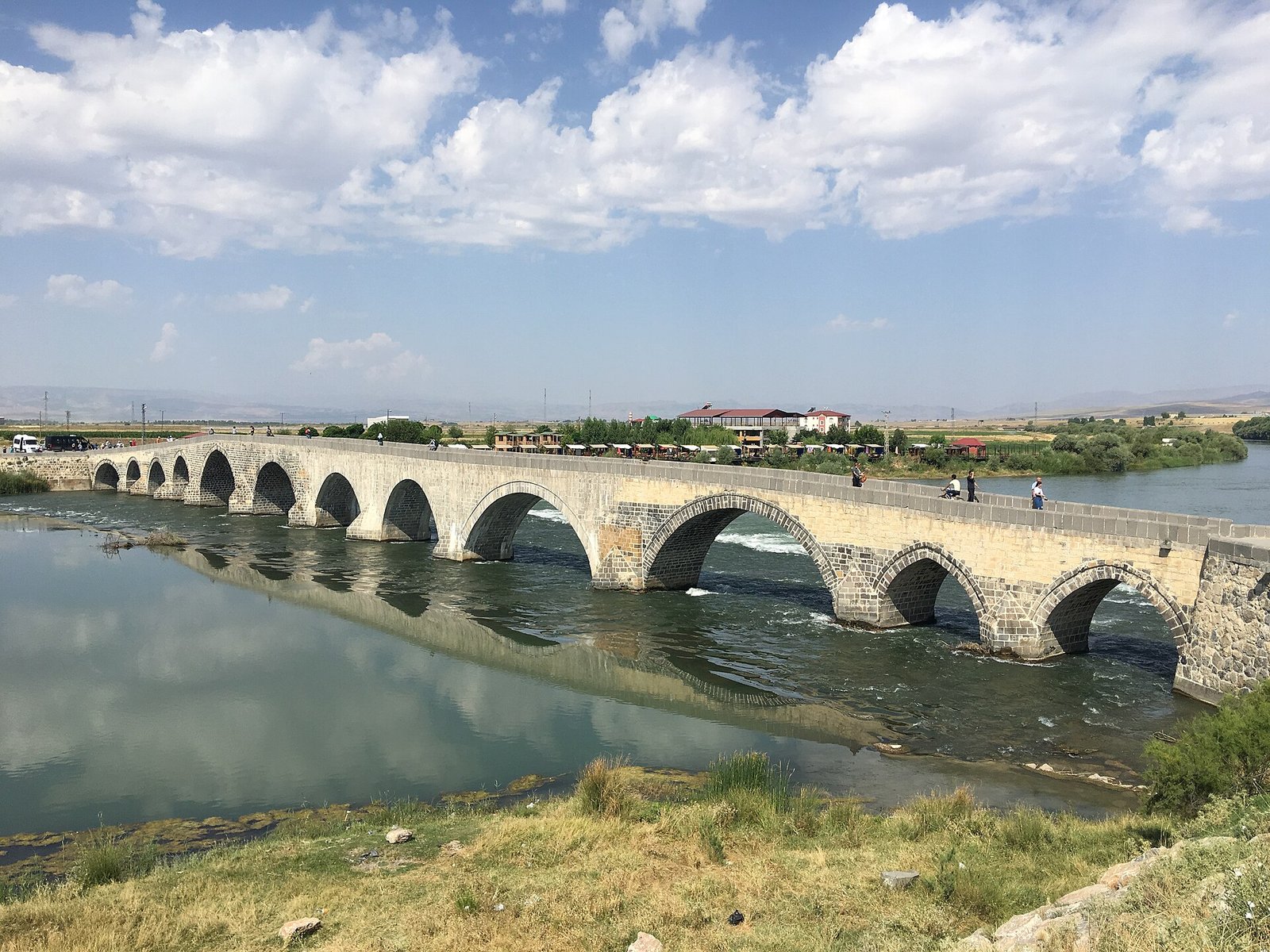
The historic Murat Bridge crosses the Murat River. The Provincial Directorate of Culture and Tourism identifies it as a Seljuk structure. Its published measurements are 143 metres in length and 4.77 metres in width, with 12 arches.
For an everyday comparison, you can picture its 4.77-metre width as the distance across the bridge while walking over it. That simple measurement gives the structure a human scale. Its 143-metre length describes a much longer crossing.
The repair inscription requires caution. The provincial tourism page reads its date as 1817. A governorate page dated 19 April 2019 reads it as 1871. Neither reading should silently replace the other in an account of the bridge.
The governorate also recounts a legend about a wealthy Armenian girl who commissioned the bridge. In the story, she buried a jar of gold in a pier. The same institution’s historical account attributes the bridge to the Seljuk period. The commissioning story therefore belongs to the bridge’s folklore.
That folklore had a physical consequence. According to the governorate, treasure hunters used explosives against the bridge’s central piers while searching for the legendary gold. The damage connects a story about buried wealth with the destruction of historic fabric.
Details you won’t find in guidebooks
Pottery from Kayalıdere’s 2018–2019 excavations carries small clues about use and marking. Pictorial signs on the vessels mostly indicate measures. Stamp impressions include horse and mountain-goat motifs. These details add another dimension to the castle’s architectural remains.
Malazgirt’s recent investigations also extend beyond the familiar battle date. A project to identify the battlefield began in 2020 with support from the Ministry of Culture and Tourism. It combines historical and archaeological surface research.
On 4 October 2023, scientific adviser Adnan Çevik reported that approximately 700 metal objects from the investigations had been handed to the Ahlat Museum Directorate. This is a reported finds total. It should not automatically become a count of objects proven to belong to the battle.
Researchers also opened 30 graves in Afşin village at Malazgirt. Samples from some graves received eleventh-century carbon-14 dates. Those results do not alone establish that the individuals died in the 1071 battle. A century-level date and an identified battle death are different conclusions.
FAQ
Where does the name Muş come from?
Two theories connect it with the Muški mentioned in Assyrian sources or with Muşel Mamigonyan. Mithat Eser argues for the latter explanation, suggesting an eighth- or ninth-century formation.
When is the name Muş documented?
The name appears in the tenth-century geographer Makdisî’s Aḥsenü’t-teḳāsîm. Earlier sources call the plain and surrounding region Taraunitis, Taraun or Daron.
When did Muş enter Seljuk and Ottoman rule?
Muş entered Seljuk rule shortly after the Battle of Malazgirt in 1071. Ottoman administration began in 1515, after local rulers expelled Safavid forces.
Was Murat Bridge built in the Seljuk period?
The Muş Provincial Directorate of Culture and Tourism identifies it as a Seljuk structure. Its repair inscription has conflicting readings: 1817 on the directorate’s page and 1871 on the governorate’s page.
Sources
- TDV İslâm Ansiklopedisi — Muş islamansiklopedisi.org.tr
- Turkish Wikipedia — Muş tr.wikipedia.org
- Mithat Eser — Muş İsminin Menşei Üzerine Bir Değerlendirme, EKEV Akademi Dergisi, 2014 dergipark.org.tr
- ARAS — Kayalıdere Kalesi 2018–2019 Yılı Kurtarma Kazıları: İlk Notlar dergipark.org.tr
- Van Yüzüncü Yıl University AVESİS — Kaylıdere Kalesi Urartu Çanak Çömleği avesis.yyu.edu.tr
- Wikipedia — Muş Province en.wikipedia.org
- Muş Provincial Directorate of Culture and Tourism — Bridges mus.ktb.gov.tr
- Muş Governorate — Historic Murat Bridge mus.gov.tr
- Muş Provincial Directorate of Culture and Tourism — Mosques mus.ktb.gov.tr
- Muş Directorate of National Education — Şehrimiz Muş, page 116 mus.meb.gov.tr
- Muş Provincial Directorate of Culture and Tourism — Muş Travel Routes mus.ktb.gov.tr
- Anadolu Ajansı — Approximately 700 Metal Objects Found in Malazgirt Battlefield Investigations aa.com.tr
Image: Sulukh Bridge 002.jpg — Ben Men Lyun, CC BY-SA 4.0