Sinop sits on a narrow strip of land on the Black Sea coast. The strip joins the Boztepe Cape to the mainland. That position made it a natural harbor town, and people have lived around it for thousands of years. This guide follows the city from its earliest settlers to its famous prison. It also explains where the name comes from, and why that question has no single answer.
Sinop history: from the first settlers to a harbor city
The story starts early. Researchers have identified settlements in the Sinop area that begin around 5500 BC, in the Chalcolithic Age. Bronze Age and Iron Age sites follow.
In antiquity the city belonged to Paphlagonia, a region on the Black Sea coast. Its oldest known name is Sinope.
Greek settlers came from Miletos. Sources disagree on when. The Turkish Culture Portal gives the seventh century BC. The TDV Islamic Encyclopedia says Milesian merchants settled in the middle of the eighth century BC. If you read two books on Sinop, expect two dates.
In 183 BC King Pharnakes of Pontus took the city. Later it became the capital of the Pontic Kingdom under Mithridates VI Eupator, who was born in Sinop. A king born in the city, and a capital built on its harbor: this is the high point of Sinop’s ancient story.
The origin of the name Sinope
There are two kinds of answers here: legends and scholarly debate.
The legends first. One says Sinope was the daughter of Asopos and a water nymph. Another says she was an Amazon. Neither proves a real founding event. Treat them as stories people told about the city, not as records.
Now the scholarly debate. Some researchers link Sinop to Sinuwa or Sinuua, a place named in Hittite texts. Others doubt this. Their main argument is that excavations in the city have not produced Hittite-period finds.
So the honest answer is short. The name Sinope is old and well attested. Its meaning and origin remain open.
You can still see the name in a small, physical form. Sinop coins from the Archaic, Classical and Hellenistic periods show the head of Sinope. They also carry the letters ΣΙΝΩ, which are accepted as an abbreviation of the city’s name. Think of it like the logo on a modern banknote: a small mark that told traders whose money they were holding.
Timeline
- From the 5500s BC Chalcolithic settlements appear around Sinop.
- 8th–7th centuries BC: Sources give different dates for the Milesian colonization.
- 183 BC Pharnakes of Pontus captures Sinop.
- Under Mithridates VI Eupator, who was born in the city, Sinop is the capital of the Pontic Kingdom.
- Late 4th–5th century AD: Parts of the Balatlar bath are turned into a church, a courtyard and a cemetery.
- 2 November 1214 Seljuk Sultan Izzeddin Keykavus I conquers Sinop.
- 1215 The date of the Arabic and Greek inscription on the city walls.
- 1461 Sinop passes to the Ottomans.
- 1560 According to the Ministry, the towers of the inner castle begin to serve as a dungeon.
- 30 November 1853 The Russian navy strikes the Ottoman fleet in Sinop.
- 1887 The inner castle is converted into a prison under Veysel Pasha.
- 12 May 1933 According to a symposium study, Sabahattin Ali is brought to the Sinop Prison.
- 1939 A building for a children’s prison is added.
- 1996–1999 The move out of the prison and its conversion into a museum are dated differently by different sources.
- 2010 Excavations begin at Balatlar.
- June 2023 Some sections of the prison museum reopen after restoration.
Seljuk and Ottoman Sinop
On 2 November 1214 Sultan Izzeddin Keykavus I of the Seljuks conquered Sinop. A trace of him is still on the walls. An inscription in Arabic and Greek, dated 1215, survives there. Two languages on one stone tell you who lived in the city at the time.
The Seljuks also used the inner castle as a shipyard. That detail matters later, because the same castle became a prison.
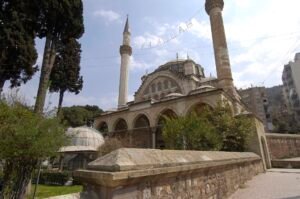
The Alaaddin Mosque is another landmark of the city. Its prayer hall measures 66 by 22 meters. The courtyard to its north measures 66 by 44 meters. Stand in that courtyard and you can feel how large the complex was.
In 1461 Mehmed the Conqueror took Sinop and its surroundings from the Candaroğlu dynasty. He did it without a battle. In the late Ottoman period Sinop was part of the Kastamonu Province.
The raid of 1853
The most dramatic day in Sinop’s modern history was 30 November 1853. On that day a Russian raid hit the Ottoman fleet in Sinop Harbor. Apart from one steamer, the fleet was destroyed. About two thousand Ottoman sailors died.
Sinop historical prison: from shipyard to museum
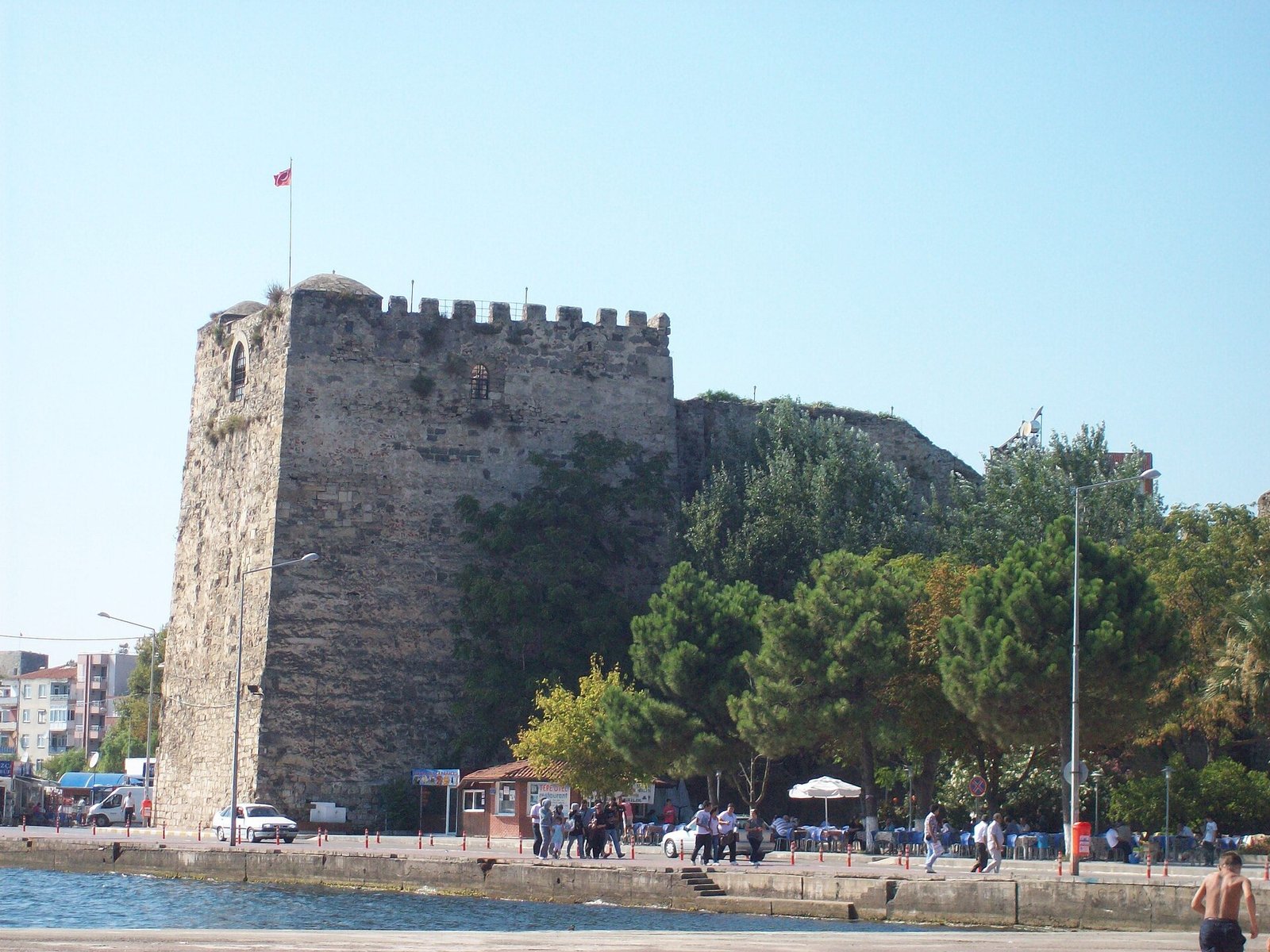
This is the part of Sinop that many visitors search for. The Historic Sinop Prison stands inside Sinop Castle. The Ministry of Culture and Tourism dates the castle to the Hellenistic period, based on archaeological evidence.
The prison grew in stages:
- Shipyard. From the Seljuk period the inner castle was used as a shipyard.
- Dungeon. According to the Ministry, its towers served as a dungeon from 1560.
- Prison. In 1887, under the district governor Veysel Pasha, new buildings and a bath were added. The inner castle became a prison.
- Children’s prison. In 1939 a separate building was added for use as a children’s prison.
The Ministry’s description of the main building is precise. It is a U-shaped structure of cut stone, divided by high courtyard walls into three sections with 28 wards.
Who was held here
The Ministry names Sabahattin Ali, Kerim Korcan, Mustafa Suphi and Eşber Yağmurdereli among the people who stayed in the Sinop Prison.
The date of Sabahattin Ali’s arrival is disputed. Promotional material says 1932. A study in the Sinop University symposium book criticizes that and gives 12 May 1933 as the transfer date.
When did it close?
Sources disagree here too. The administration of the new Sinop E-Type Prison records the move to the new institution on 28 May 1996. The Ministry’s museum page gives 1999 for the closing of the old prison and its conversion into a museum. The two dates may describe different steps, but the sources do not say so.
Visiting the Historic Sinop Prison
After restoration, some sections of the Historic Sinop Prison and Museum reopened to visitors. The news was announced on 28 June 2023 through the Anadolu Agency.
Practical details, as checked on 25 October 2026:
- Address: Kaleyazısı Neighborhood, Cumhuriyet Street, Sinop city center.
- Hours: 08.00–17.00. Last ticket sales are at 16.30. The museum is closed on Mondays.
- Tickets: The Turkish Museums site lists a standard adult ticket at 200 TL for Turkish citizens and 6 euros for foreign visitors. The Ministry page says the MüzeKart is valid for Turkish citizens.
Prices and hours change. Check the Ministry page before you go.
Details you won’t find in guidebooks
- Letters on coins. The abbreviation ΣΙΝΩ appears on Sinop coins together with the head of Sinope, across three historical periods.
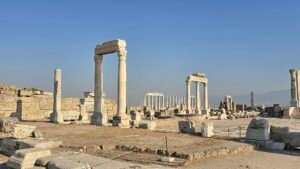
- A bath that became a graveyard. At Balatlar, long called a church, excavations that began in 2010 showed the building was first a Late Roman imperial bath. In the late fourth or the fifth century, its hot section became a church. The warm section became a courtyard, and the cold section a cemetery. It is a little like a shop that becomes a café and then a flat: one set of walls, three lives.
- Two languages on the wall. The 1215 inscription of Izzeddin Keykavus I on the city walls is written in Arabic and Greek.
- A children’s wing. A separate children’s prison building was added to the prison grounds in 1939.
- Wards in numbers. The cut-stone prison has three sections and 28 wards, separated by tall courtyard walls.
FAQ
What was Sinop called in antiquity?
Its oldest known name is Sinope. The city lay in the ancient region of Paphlagonia.
Where does the name Sinop come from?
No document settles it. One legend links Sinope to a water nymph, the daughter of Asopos. Another links it to an Amazon called Sinope. Both are alternative legends and do not prove a founding event.
When did Sinop become Ottoman?
Mehmed the Conqueror brought Sinop and its surroundings into Ottoman lands in 1461, without a fight. The Candaroğlu dynasty had ruled the area before that.
When was the Sinop Prison used, and when did it close?
The inner castle was converted into a prison in 1887. Sources disagree on the end. The prison administration records a move to a new building on 28 May 1996, and the Ministry’s museum page gives 1999 for the closure and conversion into a museum.
Can you visit the Sinop Historical Prison today?
Yes. Some sections reopened to visitors after restoration, as announced on 28 June 2023. On 25 October 2026 the Ministry page listed visiting hours of 08.00–17.00, last ticket sales at 16.30 and a Monday closure. Check the page again before you travel.
Sources
- Türkiye Kültür Portalı — Sinop kulturportali.gov.tr
- TDV İslâm Ansiklopedisi — Sinop islamansiklopedisi.org.tr
- Wikipedia — Sinop Province en.wikipedia.org
- Vikipedi — Sinop tr.wikipedia.org
- Journal of Mosaic Research — Gülgün Köroğlu and Emine Tok, Balatlar excavation dergipark.org.tr
- Türkiye Kültür Portalı — Alaaddin Cami kulturportali.gov.tr
- Kültür ve Turizm Bakanlığı — Tarihi Cezaevi muze.gov.tr
- Sinop Üniversitesi — Sinop Kültür ve Turizm Sempozyumu Bildiriler Kitabı, I. cilt sinop.edu.tr
- Sinop E Tipi Kapalı Ceza İnfaz Kurumu — Kurumumuz Hakkında sinopecik.adalet.gov.tr
- TRT Haber / Anadolu Ajansı — Sinop Tarihi Cezaevi ve Müzesi’nin bazı bölümleri ziyarete açıldı trthaber.com
- Kültür ve Turizm Bakanlığı — Turkish Museums, Sinop Tarihi Cezaevi turkishmuseums.kprod.kultur.gov.tr
Image: Sinop-Castle.jpg — Ertly, CC BY-SA 4.0