Denizli History in Short
Denizli sits in a basin in western Anatolia. Its past is much older than its name. People lived in the wider region thousands of years before anyone wrote the word “Denizli.”
The story has four broad layers. First come prehistoric mounds such as Beycesultan. Then come the Hellenistic and Roman cities of Laodikeia, Hierapolis and Tripolis. After them come Seljuk and Ottoman times. The last layer is the modern city of the Republic.
If you are visiting, keep this order in mind. It explains why a short drive can take you from a Roman theatre to an Ottoman bazaar.
Before the Cities: Beycesultan
Start about 5 kilometres southwest of Çivril, at Beycesultan Mound. Excavations between 1954 and 1959 uncovered 40 cultural layers there. They run from the Late Chalcolithic Age to the end of the Late Bronze Age.
The mound takes its name from Beyce Sultan, an Anatolian dervish whose tomb stands on top of it. So a prehistoric site carries the name of a holy man, not of an ancient people.
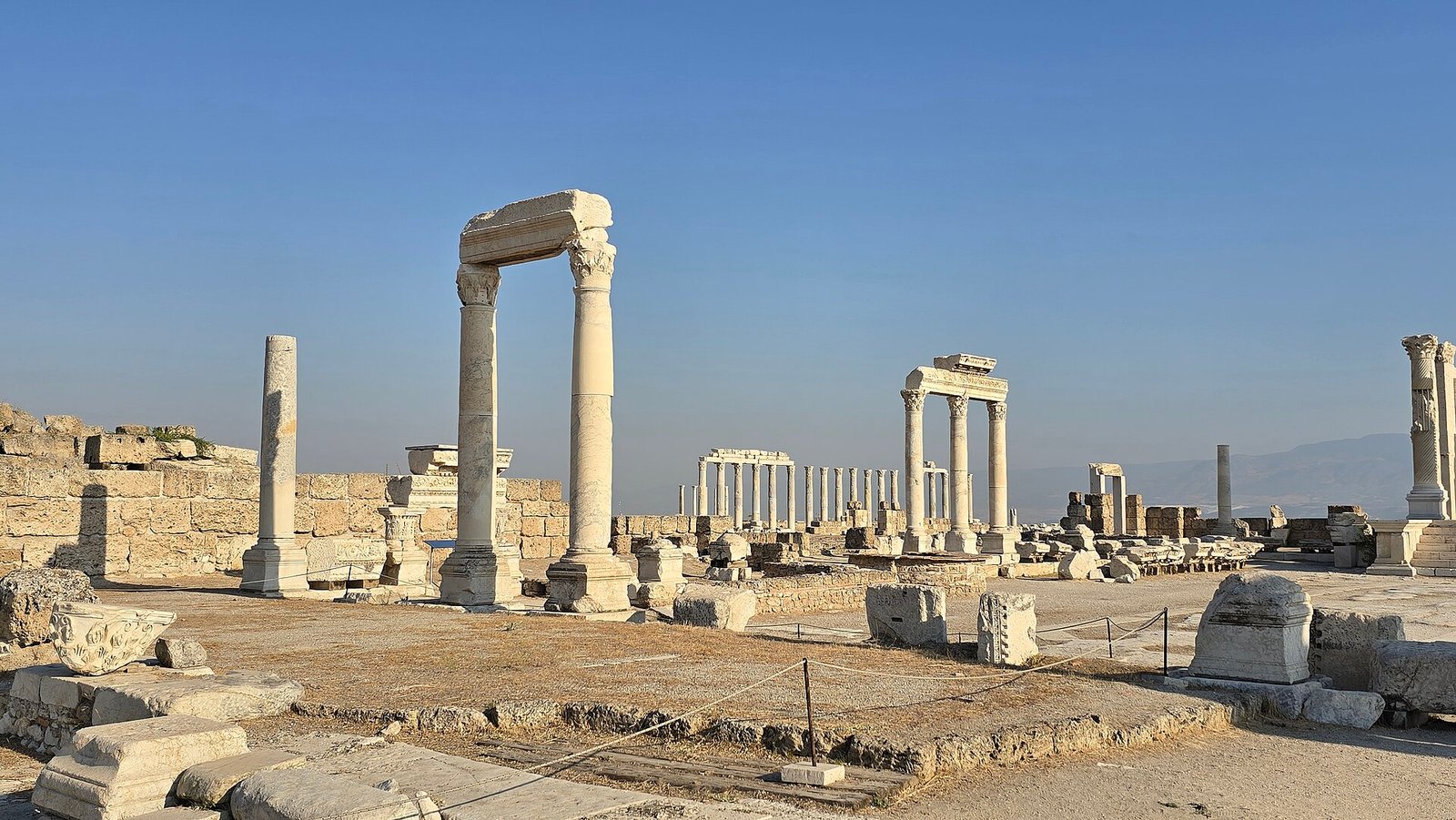
Laodikeia: The City Behind Modern Denizli
Laodikeia was founded by the Seleucid king Antiochus II Theos between 261 and 253 BC. He named it after his wife, Queen Laodike.
A few decades later it became a political stage. In 220 BC Achaios proclaimed himself king at Laodikeia and had coins struck in his own name.
The ruins lie north of Denizli’s city centre. They are about 1 kilometre north of the Eskihisar settlement. Modern Denizli grew up near ancient Laodikeia as its heir. Turkish sources used the ancient name in the forms Lâdik and Lâdıkıye.
That old name did not vanish quickly. The Ottoman state yearbook of 1856 recorded the district as “Denizli, also known as Lâdikıye.” Officials were still using the ancient name more than two thousand years after the city’s founding.
The Origin of the Name Denizli
The name did not appear in its modern shape at once. Syriac and Georgian sources of 1291 record it as Tangazlu and Thongouzalo. Sources of the 14th century give Toguzlu, Donguzlu and Tonguzlu.
According to the Pamukkale University History Department, the name began to be used in today’s form only after the second half of the 16th century.
Two explanations compete.
The “sea” theory
The Denizli Provincial Directorate of Culture and Tourism explains a link between Tengüzlü and Denizli. It starts from the Old Turkish word tengiz, which means sea. On this reading, the name points to a place rich in water.
The same office adds a caution. It says no firm verdict can be given on the origin of the name.
The “pig” theory
Tuncer Baykara disagrees. He argues that the word for pig (domuz) influenced the 13th–14th century forms of the name. He also points to a detail of old writing. The words for pig and sea looked alike in the old script, which could explain how the name drifted toward Denizli.
So the question is open. Both views start from the same early spellings. They read them differently.
Seljuk Roads and the Ottoman Takeover
Trade shaped this region in the Seljuk era. Akhan Caravanserai was built in the reign of Kaykaus II by Seyfettin Karasungur bin Abdullah. Its covered section was finished in 1253 and its courtyard in 1254.
Ottoman rule in Denizli began under Bayezid I. It was interrupted after the Battle of Ankara in 1402. In 1429 the city and its surroundings joined Ottoman lands for good.
Old Markets and Mosques You Can Still Visit
You can still walk through the past in Kaleiçi Bazaar. It is Denizli’s oldest market. People still buy textiles, shoes, and copper and iron handicrafts there. Think of it as the city’s everyday shopping street, with centuries behind it.
A plan drawn by a French topographer between 1926 and 1930, at a scale of 1/200, shows the Kaleiçi fortress as about 280 metres long and 160 metres wide.
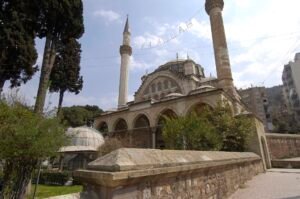
Inside the bazaar, the Arasta Mosque has an Ottoman Turkish marble inscription on its entrance façade. It reads the Hijri dates 1323 and 1325.
The Flour Market Mosque is also there. It has two floors. Shops fill the ground floor and worshippers use the upper floor.
In the districts you will find more mosques. The Çarşı Mosque in Çal town centre was built in 1716. In the Yazır neighbourhood of Acıpayam, Yazır Mosque is divided into three aisles by ten wooden supports. Its inner walls are decorated with coloured picture panels.
In Buldan, old timber houses with bay windows stand under urban conservation protection.
Hierapolis, Pamukkale and Tripolis
About 18 kilometres north of central Denizli lies Hierapolis. After a major earthquake around AD 60 it was rebuilt with the look of a Roman city and a grid plan.
The white terraces of Pamukkale are made of travertine. Calcite-rich spring water deposited the minerals on a slope that rises about 200 metres above the plain.
Hierapolis-Pamukkale joined the UNESCO World Heritage List in 1988 for its cultural and natural values. The registered area covers 1,077 hectares.
The Antique Pool in Hierapolis also has an earthquake story. According to the Denizli Culture Inventory, a 7th-century quake cracked the ground. The civic agora area collapsed into the crack, and spring water filled the hollow.
Tripolis is a quieter site. It lies at Yenicekent in Buldan district. Work there since 2012 has uncovered an agora, a colonnaded street, a monumental fountain and a residential area.
Timeline
- Late Chalcolithic–Late Bronze Age: the 40 layers documented at Beycesultan
- 261–253 BC: Antiochus II Theos founds Laodikeia in the name of Queen Laodike
- 220 BC: Achaios proclaims himself king at Laodikeia
- Around AD 60: Hierapolis is rebuilt on a Roman plan after a major earthquake
- 7th century AD: the earthquake the Denizli Culture Inventory ties to the Antique Pool
- 1253–1254: Akhan Caravanserai is completed
- 1291: the names Tangazlu and Thongouzalo appear in sources
- 1429: Denizli and its surroundings join the Ottoman state for good
- Second half of the 16th century: the name begins to be used as “Denizli”
- 1716: Çal Çarşı Mosque is built
- 1876: the first municipality is founded
- 1883: the Denizli sancak is created
- 1915: first electricity is produced in Denizli
- 15 May 1919: a mass protest rally is held against the occupation of İzmir
- 1924: Denizli becomes a province
- 1948: Gökpınar I Hydroelectric Plant starts operating
- 1954–1959: excavations at Beycesultan
- 1988: Hierapolis-Pamukkale is listed by UNESCO
From Municipality to Province
The modern administrative story begins late. Denizli’s first municipality was founded in 1876. In 1883 a sancak was formed, with the districts of Sarayköy, Buldan and Tavas attached to it.
On 15 May 1919, news of the occupation of İzmir reached Denizli. A large protest rally followed, and national resistance began to organise. In 1924 Denizli became a province.
Details You Won’t Find in Guidebooks
- A dervish’s name on a prehistoric mound. Beycesultan is named after Beyce Sultan, a dervish whose tomb stands on the mound.
- A king’s own coins. Achaios, who declared himself king at Laodikeia in 220 BC, had coins struck in his own name.
- An ancient name in an Ottoman record. The 1856 state yearbook lists the district as “Denizli, also known as Lâdikıye.”
- A shop below, prayer above. The Flour Market Mosque in Kaleiçi uses its ground floor as shops and its upper floor as the place of worship.
- Electric light came early. Denizli produced its first electricity in 1915. The Gökpınar I plant followed in 1948.
FAQ
Where does the name Denizli come from?
Nobody can say for certain. The Denizli Provincial Directorate of Culture and Tourism links it to the Old Turkish word tengiz, meaning sea, but says no firm verdict is possible. Tuncer Baykara argues that the word for pig shaped the 13th–14th century forms of the name.
Which ancient city stood near modern Denizli?
Laodikeia. Seleucid king Antiochus II Theos founded it between 261 and 253 BC and named it after his wife, Queen Laodike. Its ruins lie north of the city centre.
When did Denizli become a province?
Denizli became a province (vilayet) in 1924. It had already formed a sancak in 1883 and had its first municipality in 1876.
When did Denizli join the Ottoman state for good?
In 1429. Ottoman rule had begun under Bayezid I, was interrupted after the Battle of Ankara in 1402, and became permanent in 1429.
Sources
- Denizli Provincial Directorate of Culture and Tourism — Excavated Mounds denizli.ktb.gov.tr
- Pamukkale University — Laodikeia Excavation laodikeia.pau.edu.tr
- Wikipedia — Denizli Province en.wikipedia.org
- TDV Islamic Encyclopedia — Denizli islamansiklopedisi.org.tr
- Denizli Provincial Directorate of Culture and Tourism — History denizli.ktb.gov.tr
- Pamukkale University History Department — The Historical Journey of the City pau.edu.tr
- Merkezefendi District Governorate — Historic Kaleiçi Bazaar merkezefendi.gov.tr
- Denizli Provincial Directorate of Culture and Tourism — Historic Market Places denizli.ktb.gov.tr
- Denizli Provincial Directorate of Culture and Tourism — Mosques denizli.ktb.gov.tr
- Culture Portal — Çal Çarşı Mosque kulturportali.gov.tr
- Culture Portal — Yazır Mosque kulturportali.gov.tr
- Culture Portal — Akhan Caravanserai kulturportali.gov.tr
- Buldan District Governorate — Buldan Houses buldan.gov.tr
- Ministry of Culture and Tourism — Hierapolis Ruins muze.gov.tr
- UNESCO — Hierapolis-Pamukkale whc.unesco.org
- Denizli Culture Inventory 2014 — Antique Pool, p. 124 geka.gov.tr
- Ministry of Culture and Tourism — Denizli Tripolis Ruins muze.gov.tr
- Denizli Provincial Directorate of Culture and Tourism — Chronology denizli.ktb.gov.tr
- Turkish Academy of Sciences — Denizli in the National Struggle Period tuba.gov.tr
- Denizli Provincial Directorate of Environment, Urbanisation and Climate Change — History denizli.csb.gov.tr
- Ercan Haytoğlu — A Look at the Electricity History of Denizli, Belgi Journal dergipark.org.tr
Image: Laodicea Temple-A 20240929 090307.jpg — Rigorius, CC BY-SA 4.0