Piltdown Man was exposed in 1953 through fluorine testing, microscopic evidence of filed teeth, and the discovery of artificial staining. Kenneth Oakley, Joseph Weiner and Wilfrid Le Gros Clark established that the supposed ancestor combined human skull remains with an orangutan jaw. Scientists had been misled partly because this combination fitted expectations about human evolution and few researchers could examine the originals.
The deception lasted 41 years after its announcement in 1912, despite objections beginning in 1913. If you want to understand its survival, follow both the physical evidence and the arguments surrounding it. The altered teeth explain how the object was made; the early critics show why its acceptance was never unanimous.
Piltdown Man summary: what was the hoax?
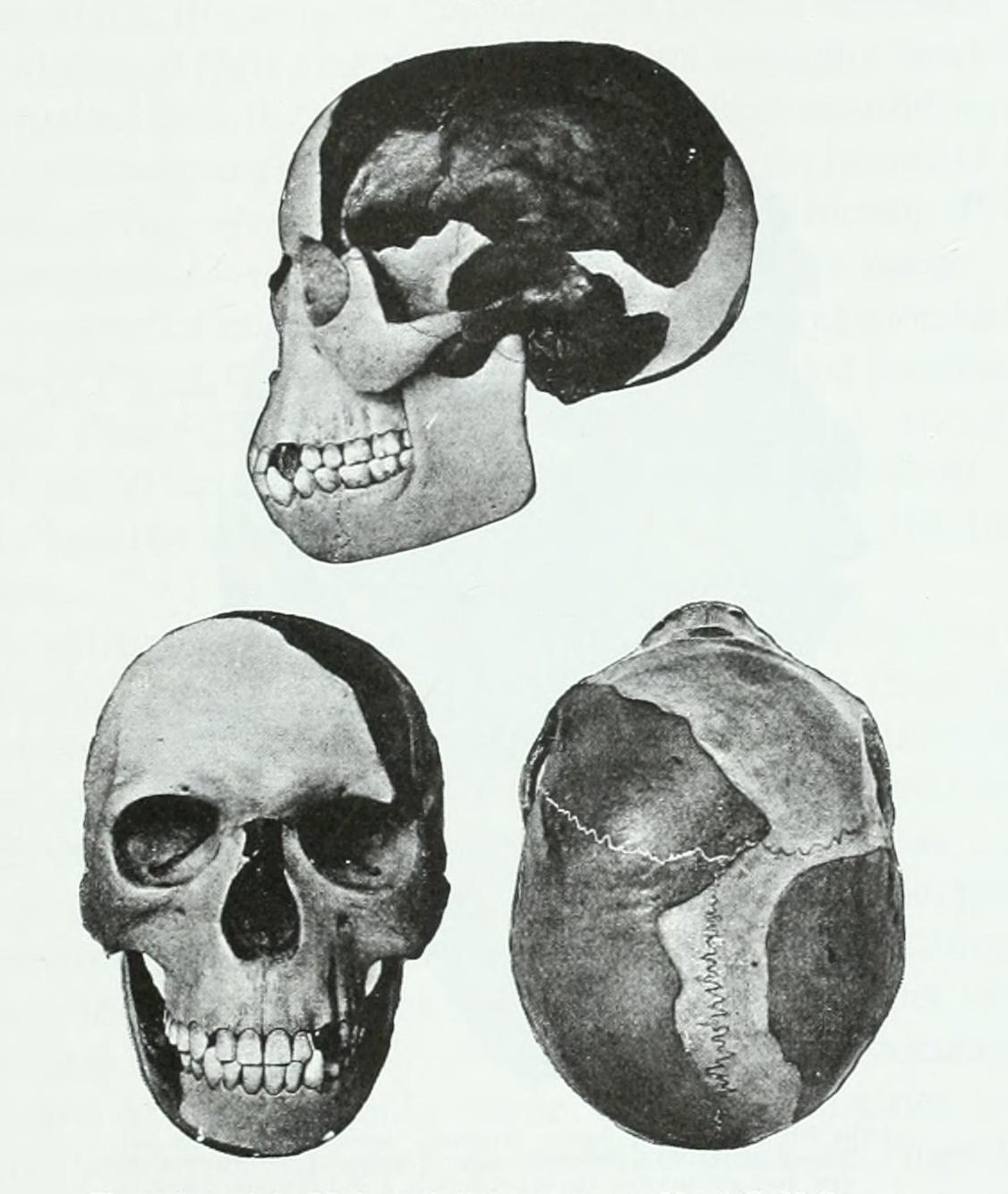
Charles Dawson announced the supposed discovery in East Sussex, England, in 1912. He and Arthur Smith Woodward presented the finds at a meeting of the Geological Society of London on 18 December that year. The material appeared to combine a human-like skull with an ape-like jaw.
The Piltdown I collection included five human skull fragments and an ape-like jaw carrying two teeth. Animal fossils and primitive stone tools accompanied them. Woodward interpreted his skull reconstruction as evidence of a human ancestor that had lived about 500,000 years earlier.
That interpretation depended on treating the skull and jaw as parts of one kind of ancient human. They actually belonged to different species. The forgery brought human remains and an altered orangutan jaw together to create the appearance of a single evolutionary form.
Piltdown Man meaning: what did its name claim?
The scientific name given to the find was Eoanthropus dawsoni, approximately meaning “Dawson’s dawn man.” The name attached Dawson to a proposed early human. Yet the skull-and-jaw combination on which that claim rested was manufactured.
Piltdown itself is a group of small settlements in East Sussex, south of Ashdown Forest. That English location became part of the find’s appeal. In Stephen Jay Gould’s interpretation, nationalism and expectations centred on Eurasia helped encourage acceptance of an apparent human ancestor found in England.
Why were scientists misled by Piltdown Man?
The skull and jaw fitted an influential expectation in England: that a large brain developed before other human features. A human-like skull above an ape-like jaw seemed compatible with that sequence. The combination therefore supported an existing theory, even though the remains did not belong together.
Chemical dating was limited in 1912. Researchers consequently relied more heavily on anatomical comparisons and expert judgments when assessing Piltdown.
Access also mattered. According to the Natural History Museum, very few scientists had the opportunity to examine the original specimens. That restriction limited independent examination of the specimens.
Dawson strengthened the apparent case in 1915 by announcing Piltdown II. A second discovery seemed to repeat the same skull-and-jaw combination. What had looked like an unusual specimen could now appear to represent a recurring anatomical pattern.
You can recognise an everyday parallel in that apparent repetition. Two matching reports can feel more convincing than one. At Piltdown, the second reported discovery strengthened acceptance, although later DNA analysis linked teeth from the two collections to probably the same orangutan.
Who questioned the Piltdown Man skull?
David Waterston argued in 1913 that the human skull and ape jaw belonged to different creatures. Marcellin Boule challenged their anatomical unity in 1915. Their objections appeared long before the fraud was conclusively exposed, so the story cannot be reduced to universal scientific agreement.
Franz Weidenreich reached an especially direct conclusion in 1923. He identified the combination as a modern human skull and an orangutan jaw with filed teeth. His explanation anticipated central features of the later demonstration of fraud.
New human ancestor fossils from Africa and Asia also made Piltdown harder to accommodate. Their anatomy did not match its combination of features. Piltdown increasingly became a difficult exception within explanations of human evolution.
How was the Piltdown Man hoax exposed?
Kenneth Oakley’s fluorine tests in 1949 undermined the great age attributed to the remains. Instead of supporting Woodward’s estimate of about 500,000 years, the results led to an upper age assessment of roughly 50,000 years. This was a major reduction, rather than a precise date for a genuine Piltdown ancestor.
Oakley then worked with Joseph Weiner and Wilfrid Le Gros Clark of Oxford University. Their investigations established that the skull and jaw came from different species. The supposed anatomical combination could no longer stand as evidence of one human ancestor.
Microscopic examination revealed filing marks on the teeth. Their surfaces had been altered to imitate human-like wear. This provided evidence of deliberate modification: the teeth had been worked to support the proposed interpretation of the jaw.
Researchers also found that most of the material had been artificially stained. The colouring made the remains resemble the local gravel. Together, the altered teeth and artificial colour explained how separate pieces had been made to look compatible with their supposed discovery setting.
The fraud was conclusively exposed in 1953. The Natural History Museum archive preserves a telegram Oakley sent to Hallam Movius at the Peabody Museum on 21 November that year, reporting that Piltdown was a forgery.
What did the 2016 investigation reveal?
Research published on 10 August 2016 applied DNA analysis, precision measurements, spectroscopy and virtual anthropology to the specimens. These methods investigated the materials and their manufacture. The study indicated that the forged fossils probably used remains from one orangutan and at least two humans.
DNA analysis connected the Piltdown I canine and the Piltdown II molar. They probably came from the same orangutan. Their closest identified affinity was with orangutans from southwestern Sarawak in Borneo, linking material presented as separate discoveries.
Shared fabrication methods pointed towards Dawson as the likely central figure. The argument for a single forger rested on those common production traces. However, the researchers did not exclude the possibility that someone else had supplied Dawson with forged material.
Details you won’t find in guidebooks
Micro-CT images revealed gravel hidden inside some bones and a tooth. Small pebbles plugged the openings. The material associated with Piltdown was therefore present inside altered specimens as well as around the reported discoveries.
The orangutan molars had been removed from the jaw for modification and then put back with dental filling material. One tooth broke during filing. The forger reassembled it using the same filling material also used to close holes in the skull.
Excavations in 1913–1914 produced another fabricated-looking object: a piece carved from an elephant thigh bone that resembled a cricket bat. The Piltdown collection thus extended beyond the skull and jaw that became the central evidence in the hoax.
After Dawson died in 1916, no new specimens were found at the Piltdown sites. His precise motive remained uncertain: the Natural History Museum’s Chris Stringer explicitly acknowledged that uncertainty in 2016.
Timeline
- 18 December 1912: Dawson and Woodward presented the Piltdown finds to the Geological Society of London.
- 1913: Waterston argued that the human skull and ape jaw belonged to different creatures.
- 1915: Dawson announced Piltdown II. Boule challenged the anatomical unity of the original find.
- 1916: Dawson died. No further specimens were subsequently found at the Piltdown sites.
- 1923: Weidenreich identified a modern human skull combined with an orangutan jaw whose teeth had been filed.
- 1949: Oakley’s fluorine tests undermined the age attributed to the remains.
- 1953: Investigations by Oakley, Weiner and Le Gros Clark established the fraud.
- 21 November 1953: Oakley sent Movius a telegram confirming the forgery.
- 10 August 2016: Research using DNA and imaging identified shared fabrication methods and supported Dawson’s likely central role.
FAQ
How was the Piltdown Man hoax exposed?
Kenneth Oakley’s 1949 fluorine tests undermined its supposed age. Further work with Joseph Weiner and Wilfrid Le Gros Clark identified remains from different species, filed teeth, and artificial staining, establishing the fraud in 1953.
Why were scientists misled by Piltdown Man?
Its human skull and ape-like jaw fitted the expectation that the brain evolved first. Limited chemical dating, reliance on expert opinion, and restricted access to the originals also helped it gain acceptance.
Did all scientists accept Piltdown Man?
No. David Waterston challenged the combination in 1913, Marcellin Boule objected in 1915, and Franz Weidenreich identified a modern human skull combined with an altered orangutan jaw in 1923.
Who probably made the Piltdown forgery?
The 2016 research identified Charles Dawson as the strongest candidate, based on shared fabrication methods. The possibility that another person supplied him with forged material was not excluded.
Sources
- Wikipedia — Piltdown Man en.wikipedia.org
- Natural History Museum — Piltdown Man hoax findings nhm.ac.uk
- Natural History Museum — Piltdown Man archive collection nhm.ac.uk
- Natural History Museum Archives — Oakley telegram, DF/PAL/116/37/1 nhm.ac.uk
- De Groote and colleagues — Royal Society Open Science, 2016 pmc.ncbi.nlm.nih.gov
- Liverpool John Moores University — Piltdown Hoax findings ljmu.ac.uk
- Wikipedia — Piltdown en.wikipedia.org
Image: Piltdown Man – McGregor reconstruction.jpg — James Howard McGregor, Public domain