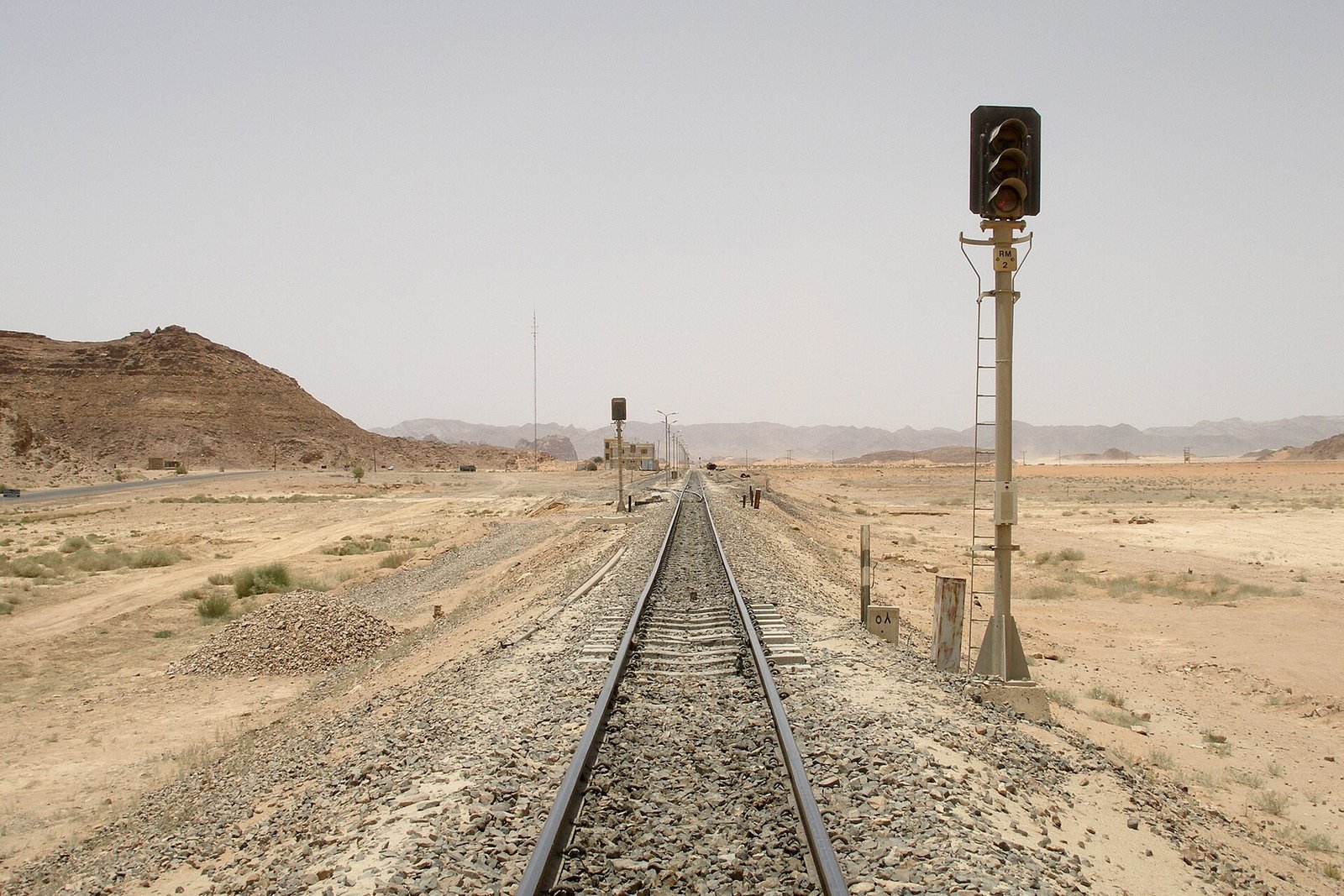
The Hejaz Railway was built between 1900 and 1908 to ease pilgrimage travel, move Ottoman troops and ammunition faster, and strengthen Ottoman control over distant provinces. Its roughly 1,320-kilometre main line connected Damascus with Medina through present-day Jordan. Wartime attacks, damage, inadequate maintenance and the division of its route between different administrations ended continuous services.
A journey that had taken about 40 days from Damascus to Medina fell to roughly five days by rail. That change helps explain the railway’s importance beyond its surviving stations. If you follow its route, you can connect the pilgrimage project with its military role, the attacks during the Arab Revolt and the restoration work continuing today.
Why was the Hejaz Railway built?
Pilgrimage was a central purpose of the railway. The Ottoman government wanted to make travel to the Hejaz easier, and the Damascus–Medina line sharply reduced journey times. Mecca was a further goal, but the historic main line never extended south of Medina.
The government also wanted faster military transport. Moving troops and ammunition towards the Hejaz and Yemen by rail would reduce dependence on transport through the Suez Canal. The railway therefore served both pilgrims and the Ottoman state’s strategic needs.
Abdülhamid II intended the project to strengthen his influence across the Islamic world. A railway supported by Muslims could bring people together around a shared undertaking. This political and religious ambition accompanied the practical work of laying track between Damascus and Medina.
How did the Hejaz Railway project begin?
Abdülhamid II ordered construction on 2 May 1900. Work began on 1 September that year. The line reached Amman in 1903 and Ma’an in 1904, extending the project southwards in stages.
The Deraa–Haifa branch was completed in 1905. It connected the Hejaz Railway with Haifa’s Mediterranean port. This branch belonged to the wider railway project, while the main north–south route continued towards Medina.
The Damascus–Medina main line officially opened on 1 September 1908. Its track gauge was 1,050 millimetres, making it a narrow-gauge railway. Between 1908 and 1913, it carried approximately 970,000 passengers.
Hejaz Railway map: where did the route go?
On a map, the main line runs from Damascus through the territories of present-day Syria, Jordan and Saudi Arabia. Its approximately 1,320 kilometres linked a chain of stations and settlements before reaching Medina.
Read the principal route from north to south as Damascus → Deraa → Mafraq → Zarqa → Amman → Ma’an → Mudawwara → Tabuk → Mada’in Salih → Al-Ula → Medina. If you are tracing the railway on a modern map, this sequence gives you the main geographical framework.
Deraa was also the junction for the branch to Haifa. Keeping that branch distinct from the Damascus–Medina route makes the network easier to understand. The Mediterranean connection and the southward pilgrimage route served different directions within the same project.
Medina was the historic main line’s southern endpoint. Although reaching Mecca was one of the project’s aims, that extension was never completed. A map showing the intended destination therefore needs to distinguish ambition from the railway that actually opened.
What was a Hejaz Railway train journey like?
The clearest measure of the railway’s effect is time. Travel between Damascus and Medina fell from approximately 40 days to about five. For an everyday comparison, think about planning time away from home: the same journey now required far fewer days in your schedule.
Religious practice also shaped travel aboard the trains. One carriage was set aside as a mosque, and departure schedules took prayer times into account. Pilgrimage influenced both the reason for building the railway and the way services operated.
The approximately 970,000 passengers carried between 1908 and 1913 show the scale of its early use. That passenger traffic existed alongside the railway’s military purpose. The line could carry travellers while also supporting Ottoman forces.
Timeline
- 2 May 1900: Abdülhamid II ordered the railway’s construction.
- 1 September 1900: Construction began.
- 1903: The line reached Amman.
- 1904: The line reached Ma’an.
- 1905: The Deraa–Haifa branch was completed.
- 1 September 1908: The Damascus–Medina main line officially opened.
- 1916–1918: The railway became a target during the Arab Revolt.
- 1917: An Ottoman military train was ambushed at Hallat Ammar.
- After 1920: The section south of today’s Jordan–Saudi Arabia border remained closed.
- 1967: The Six-Day War ended a reconstruction attempt.
- 2006: Medina’s Hejaz Railway Museum opened.
- 8 April 2015: Saudi Arabia submitted railway heritage to the UNESCO Tentative List.
- 11 September 2025: Türkiye, Syria and Jordan discussed railway rehabilitation at a technical meeting.
- 9 April 2026: TİKA reported on Amman station restoration and work on a new museum.
Hejaz Railway, Lawrence of Arabia and train attacks
During the Arab Revolt of 1916–1918, British liaison officer T. E. Lawrence worked with rebels fighting Ottoman forces. Railway attacks aimed to cut the supply connection to Ottoman troops in Medina. The line’s military value made it a target.
A 1917 ambush against an Ottoman military train at Hallat Ammar is among the attacks investigated archaeologically. For readers searching for a Hejaz Railway train wreck, this provides a documented event to examine. It connects an attack on the railway with physical evidence studied later.
Some biographers have questioned whether Lawrence exaggerated his accounts. Archaeologists who examined a Colt 1911 bullet found at Hallat Ammar regarded it as evidence supporting his narrative. They also stressed that the bullet could not be proved to have belonged to him.
That distinction matters when you read about Lawrence and the railway. The Hallat Ammar find supports an account of the attack, but it does not establish the bullet’s owner. Archaeological evidence can strengthen a narrative while leaving a specific attribution unresolved.
Why did Hejaz Railway services end?
Attacks during the Arab Revolt damaged a railway that supplied Ottoman forces in Medina. War damage and inadequate maintenance weakened the line. The section south of the present Jordan–Saudi Arabia border remained closed after 1920.
The First World War also left the route divided between different states and mandate administrations. Maintaining a shared Damascus–Medina operation became more difficult across those divisions. The end of through services therefore involved both damaged infrastructure and fragmented administration.
A reconstruction attempt in the mid-1960s did not restore the full connection. It was abandoned because of the 1967 Six-Day War. As of 10 November 2026, the historic railway is still not operated as one continuous passenger route between Damascus and Medina.
Details you won’t find in guidebooks
Donations supplied approximately one-third of the railway fund. Other revenue sources provided the remaining two-thirds. Public contributions were substantial, but they did not cover the whole project.
Nickel, silver and gold Hejaz Railway medals were issued to encourage donors. These objects linked financial support with the railway’s wider appeal as a common Muslim undertaking. They also offer a way to understand the project beyond tracks and stations.
Archaeology has examined a wider landscape than individual train attacks. Between 2006 and 2014, a project along the Ma’an–Mudawwara route identified approximately 100 sites. These included Ottoman defensive positions and camps associated with attacks on the railway.
Hejaz Railway station in Madinah: what is the museum?
The Hejaz Railway Museum in Medina, also written Madinah, opened in 2006. It occupies the restored Ottoman railway station. Its collection includes locomotives, carriages and historic sections of track.
For you as a visitor, the station connects the railway’s southern endpoint with surviving railway equipment. Medina’s museum also places the passenger journey beside the material remains of the line. The station was the endpoint actually reached, while Mecca remained an unrealised extension.
Saudi Arabia submitted Hejaz Railway heritage in the Tabuk and Medina regions to the UNESCO World Heritage Tentative List on 8 April 2015. This was a tentative-list submission. It provides another context for understanding the surviving railway as heritage.
Hejaz Railway today: trains and revival projects
The Jordan Hejaz Railway Corporation’s current programme advertises family excursion trains on Fridays and Saturdays. They run from Amman through Qasr to Jizah. These outings offer a present-day railway journey, while the full Damascus–Medina connection remains out of operation.
Revival work also concerns infrastructure. At a Türkiye–Syria–Jordan technical meeting on 11 September 2025, agreement was reached on completing 30 kilometres of missing track superstructure on the Syrian Hejaz Railways. That agreement concerns a defined section of rehabilitation.
TİKA’s statement of 9 April 2026 reported continuing restoration at Amman station and work on a new museum. It also announced the Türkiye–Syria–Jordan railway agreement. It gave no firm opening date for the complete Damascus–Medina line.
FAQ
Why was the Hejaz Railway built?
It was built to make pilgrimage travel easier, speed the movement of Ottoman troops and ammunition, and strengthen Ottoman authority in distant provinces. Abdülhamid II also intended it to unite Muslims around a shared project.
Did the Hejaz Railway reach Mecca?
No. Reaching Mecca was an aim of the project, but the historic main line ended at Medina.
Why did Hejaz Railway services end?
Wartime attacks, damage and inadequate maintenance disrupted the railway. After the First World War, its division between different states and mandate administrations made joint operation harder.
Can you ride the Hejaz Railway today?
As of 10 November 2026, there is no continuous Damascus–Medina service. The Jordan Hejaz Railway Corporation advertises family excursion trains from Amman through Qasr to Jizah on Fridays and Saturdays.
Sources
- Vikipedi — Hicaz Demiryolu tr.wikipedia.org
- Jordan Tourism Board — Railroad international.visitjordan.com
- TDV İslâm Ansiklopedisi — Hicaz Demiryolu islamansiklopedisi.org.tr
- Wikipedia — Hejaz Railway en.wikipedia.org
- University of Bristol — Bullet Indicates Lawrence of Arabia Was No Liar bristol.ac.uk
- UNESCO World Heritage Centre — Hejaz Railway whc.unesco.org
- Archaeology — Fact-Checking Lawrence of Arabia archaeology.org
- Al Hussein Bin Talal University — Great Arab Revolt Project ahu.edu.jo
- Jordan Hejaz Railway Corporation — Trips jhr.gov.jo
- Wikipedia — Hejaz Railway Museum en.wikipedia.org
- Republic of Türkiye Ministry of Transport and Infrastructure — Tarihi Hicaz Demiryolu Yeniden Canlanıyor uab.gov.tr
- TİKA — Hicaz Demiryolu Restorasyonu tika.gov.tr
Image: Wadi Rum railway track, Hejaz railway, Jordan.jpg — Vyacheslav Argenberg, CC BY 4.0