French counterattacks and the British Expeditionary Force’s advance into a gap between the German 1st and 2nd Armies stopped the German advance on Paris at the First Battle of the Marne, fought on 5–12 September 1914. The Germans withdrew and established defensive positions on the Aisne, but their armies were not destroyed and the war continued.
A symbolic image of the battle is a convoy of Paris taxis carrying soldiers toward the fighting. Yet the key to understanding the outcome lies in an exposed German flank, a gap of roughly 48 kilometres, and Allied forces moving into it. If you follow those movements, the connection between the defence of Paris and the later trench front becomes clearer.
How close had German armies come to Paris by September 1914?
On 2 September 1914, German cavalry appeared outside Meaux. The town lay approximately 25 miles, or 40 kilometres, northeast of Paris. German forces had reached the city’s vicinity, but the movements of their armies soon created an opportunity for a counterattack.
Alexander von Kluck’s 1st Army and Karl von Bülow’s 2nd Army turned southeast of Paris. Their purpose was to envelop the left wing of the retreating French forces. In making that turn, they exposed their own right flank.
The broader German strategy depended on defeating France quickly. Alfred von Schlieffen’s plan, developed in 1905, envisaged victory over France before German armies moved east against Russia. The advance near Paris therefore formed part of a strategy whose success depended on the sequence of the campaigns.
Joseph Joffre issued counterattack orders on 5 September. Maunoury’s French 6th Army was to move east from Paris. The British Expeditionary Force was directed toward Montmirail, while the French 5th Army was ordered north. These movements brought pressure against the German armies from different directions.
How did French and British forces exploit the gap in German lines?
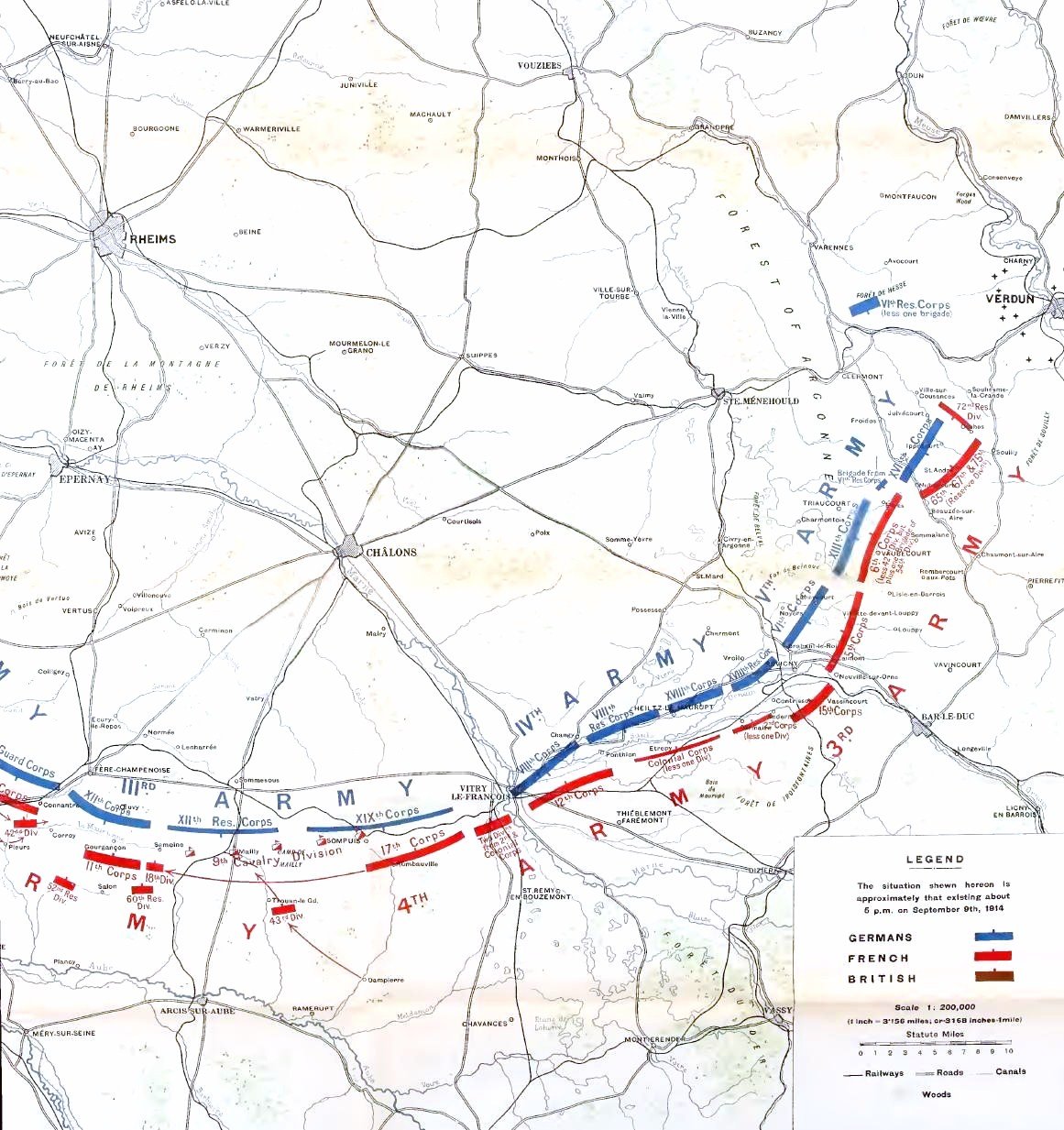
German redeployment against the French 6th Army opened a gap between the 1st and 2nd Armies. It measured approximately 30 miles, or 48 kilometres. Allied aerial patrols discovered the opening, providing information about a weakness between the German formations.
The general French counteroffensive began on 6 September. The Marne battle included fighting on the Ourcq, the two Morin rivers, and the Saint-Gond Marshes, alongside numerous smaller operations. The name covers a connected series of engagements across a broad area.
French and British forces advanced into the gap. The British Expeditionary Force moved northwest toward Kluck’s forces. Franchet d’Espèrey’s French 5th Army advanced northeast toward Bülow. Their directions of movement threatened the neighbouring German armies from within the opening.
The British crossed the Petit Morin and captured bridges over the Marne. They established a bridgehead approximately eight kilometres deep. If you picture the battle as a sequence of river crossings, these captured bridges explain how the advance gained ground beyond the initial gap.
On 9 September, Bülow ordered a withdrawal. Lieutenant Colonel Richard Hentsch, acting as Moltke’s representative, informed 1st Army headquarters that a general retreat was necessary. The exposed flank, the opening between armies, and the Allied advance had produced a German withdrawal.
Timeline
- 1905: Schlieffen developed the German war plan that envisaged defeating France before turning east against Russia.
- 26 August 1914: French troop transfers by railway began from the eastern front toward the centre and left wing.
- 2 September 1914: German cavalry were seen near Meaux, approximately 40 kilometres northeast of Paris.
- 5 September 1914: Joffre issued counterattack orders.
- 6 September 1914: Joffre’s general counteroffensive began.
- 9 September 1914: Bülow ordered a withdrawal, while Hentsch informed 1st Army headquarters that a general retreat was necessary.
- 12 September 1914: The battle ended according to the National Army Museum’s dating.
- 14 September 1914: German forces had established defensive positions on high ground north of the Aisne.
- Autumn 1914: Failed attempts to turn opposing flanks were followed by a trench front extending from the Channel coast to the Swiss border.
How important were the Paris taxis to the battle’s outcome?
Paris military governor Joseph Gallieni requisitioned taxis to reinforce Maunoury’s 6th Army. Police and Republican Guards helped carry out the requisition. Soldiers travelled in groups of four or five to Nanteuil-le-Haudouin and Silly-le-Long, near the fighting.
The Musée de l’Armée describes 630 taxis assembling at the Invalides square at 22:00. They then went to collect soldiers of the 103rd and 104th Infantry Regiments. The operation connected vehicles from Paris with the immediate need to move reinforcements toward the army.
Their military contribution was limited within the scale of the battle. According to the Musée de l’Armée, most soldiers reached the front by railway. The taxis mattered particularly as a symbol of France’s determination to stop the German advance.
For an everyday comparison, think of arranging a group journey: the cars you notice may carry only part of the group, while trains carry most people. At the Marne, the taxi convoy supplied the memorable image, but rail transport moved the majority of the troops.
Details you won’t find in guidebooks
More than 300 trains were used to transfer French troops from the eastern front to the centre and left wing between 26 August and 10 September. That movement gives the defence of Paris a wider transport context. Reinforcement involved sustained railway operations as well as the famous taxi journey.
Before the battle, Kluck’s 1st Army had moved 140 kilometres beyond its supplying railhead. That distance adds another dimension to the German advance. The army approaching Paris was also operating far from the railway endpoint through which it received supplies.
A photograph taken at Signy-Signets on 8 September shows soldiers of the 1st Battalion, The Cameronians, beside British 18-pounder guns. It offers a specific view of British troops and artillery during the battle, alongside the better-known images associated with the Paris taxis.
Why did the German retreat fail to end the war?
The Marne disrupted Germany’s strategy of quickly removing France from the war. Germany remained committed to fighting France and Russia on two fronts. This was a major strategic result, even though the battle did not destroy the German armies.
Those armies continued to occupy extensive areas of northern France and much of Belgium. Their withdrawal therefore left substantial German forces and occupied territory in place. Stopping the advance on Paris did not eliminate Germany’s ability to continue fighting.
Historians have differed over the scale of the victory. John Terraine regarded the Marne as the war’s decisive battle. Robert A. Doughty argued that an opportunity to deal the German armies a decisive blow had been missed. Their interpretations place different weight on the strategic reversal and the survival of German forces.
How did mobile warfare develop into trench warfare after the Marne?
By 14 September, German armies had halted their retreat on high ground along the Aisne’s northern bank. They began digging trenches. The withdrawal from the Marne thus led to a new defensive position where the Germans could resist further attacks.
French frontal attacks against the Aisne line were repulsed on 15–16 September. Joffre then sought to move around the German northern flank. The effort to regain movement shifted toward attempts to get beyond the enemy’s defended positions.
During the Race to the Sea, both sides tried to outflank the other’s northern wing. Those attempts failed to produce a decisive result. Mobile warfare on the Western Front increasingly gave way to fixed positions.
From autumn 1914, a dense trench system extended from the Channel coast to the Swiss border. If you want to understand why the Marne did not bring peace, follow the sequence: the German armies retreated, held the Aisne heights, and survived the subsequent attempts to turn their flank.
FAQ
When was the First Battle of the Marne?
The National Army Museum dates the battle to 5–12 September 1914. The initial fighting began toward the Ourcq on 5 September, and Joffre’s general counteroffensive began on 6 September.
How close did German forces get to Paris?
On 2 September 1914, German cavalry were seen outside Meaux, approximately 25 miles, or 40 kilometres, northeast of Paris.
Did Paris taxis win the battle?
The taxis carried reinforcements to the French 6th Army, but their contribution was limited within the battle’s overall scale. Most troops reached the front by railway, while the taxis became a symbol of French determination.
Why did the victory at the Marne not end the war?
The German armies survived and retained extensive occupied territory. They established defensive positions north of the Aisne, and subsequent attempts to outflank opposing armies failed to produce a decisive breakthrough.
Sources
- National Army Museum — First Battle of the Marne ww1.nam.ac.uk
- Deutsches Historisches Museum — Die Schlacht an der Marne 1914 dhm.de
- HISTORY — The First Battle of the Marne history.com
- Royal Hampshire Regiment Museum — 1st Hampshire at the Marne and the Aisne royalhampshireregiment.org
- Musée de l’Armée — Taxi de la Marne musee-armee.fr
- Wikipedia — First Battle of the Marne en.wikipedia.org
- History SA — First Battle of the Marne southaustraliaswar.history.sa.gov.au
Image: Battle of the Marne, east flank 1914b.jpg — Whitton, F. E., Public domain