The Philistines were communities in the southern Levant whose culture became archaeologically visible around 1200 BCE, with evidence of Aegean connections. Archaeology and ancient DNA from Ashkelon support migration into the region, but do not identify a precise homeland or establish the ancestry of every Philistine city.
The evidence takes you from painted pottery to infants buried beneath houses. These finds answer different parts of the origins question: objects reveal cultural connections, while DNA provides evidence that people moved. Food remains, graves and temple plants then show how varied life within Philistine communities could be.
Where were the Philistine cities and when did they flourish?
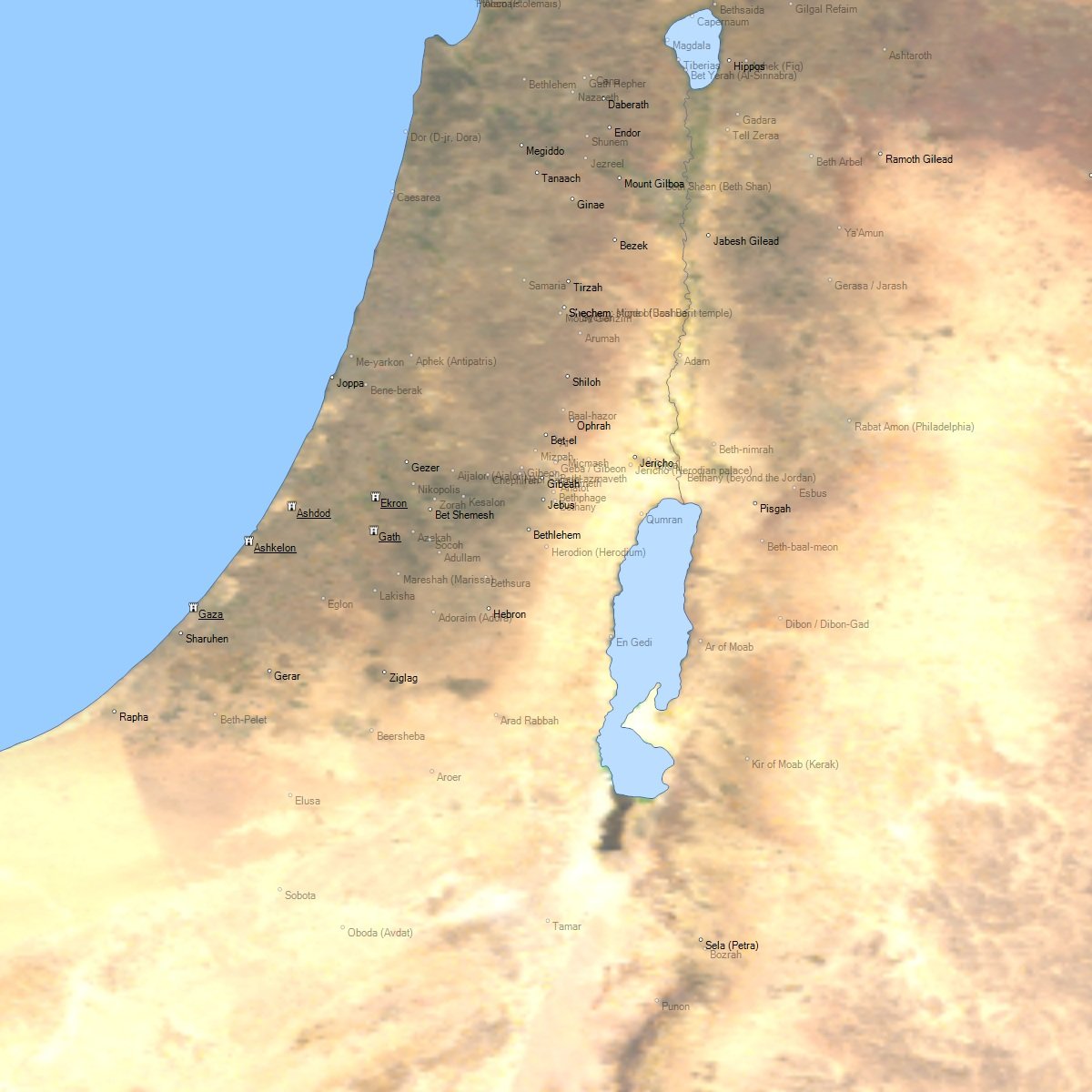
The five principal Philistine cities were Gaza, Ashkelon, Ashdod, Gath and Ekron. They occupied the Mediterranean coastal plain of the southern Levant and nearby inland areas. Archaeological and geographical evidence identifies Gath with Tell es-Safi. Ekron’s excavation site is Tel Miqne.
The main archaeological span of Philistine culture runs from approximately 1200 to 604 BCE. At Ashkelon, excavators date the beginning of Philistine settlement to around 1170 BCE. That settlement developed above a Canaanite city previously under Egyptian rule. The sequence places the newcomers within an existing urban landscape.
Ashkelon continued international maritime trade during the twelfth and eleventh centuries BCE. Its Philistine settlement therefore belonged to a coastal world with continuing overseas connections. In 604 BCE, Nebuchadnezzar II destroyed Ashkelon, marking the end of the city’s Philistine Iron Age settlement.
The Leon Levy Expedition excavated Ashkelon between 1985 and 2016. Its Iron Age I report evaluates evidence for new communities from the west through pottery, architecture, diet, production technology, decoration and writing traditions. If you want to understand the argument for migration, this range of evidence matters: the interpretation extends beyond a single pottery style.
What evidence connects them with the Sea Peoples and the Aegean world?
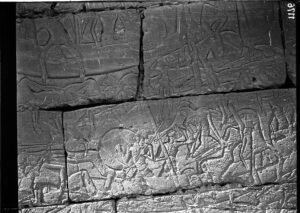
The Medinet Habu inscriptions name the Peleset among the Sea Peoples coalition that Ramesses III reported defeating in his eighth regnal year. These texts form part of the discussion of Philistine origins. They do not, however, resolve how settlement on the Canaanite coast took place.
One theory proposes that Egypt settled the Peleset there. Another argues for independent settlement. The locations of the fortresses mentioned in the Harris Papyrus remain uncertain. That uncertainty limits attempts to turn the Egyptian accounts into a precise map of settlement.
Pottery provides a separate connection with the Aegean. Early Philistine assemblages include locally made versions of Late Helladic IIIC vessels. These were followed by bichrome pottery with red and black decoration over a white slip. Local manufacture is a concrete part of the evidence: Aegean connections appeared in objects produced in the southern Levant.
Gloria London, Shlomo Bunimovitz and other researchers have challenged the assumption that Aegean-style vessels necessarily demonstrate migration. Trade, transferred technology and local production could also spread pottery traditions. A pot’s decoration can therefore support a cultural connection without identifying its maker’s birthplace.
Amos 9:7 associates Philistine origins with Caphtor. The Max Planck research announcement describes this as a later memory of origins associated with Crete. That tradition belongs alongside the archaeological discussion, but the Ashkelon DNA results do not establish Crete as the migrants’ precise homeland.
What did the Ashkelon ancient DNA study find and what are its sampling limitations?
Published in Science Advances on 3 July 2019, the Ashkelon study obtained sufficient human DNA from only 10 individuals after examining 108 skeletal elements. Its sample comprised three Bronze Age individuals, four early Iron Age infants and three later Iron Age individuals. Those figures define the study’s scale.
In all three chronological groups, most ancestry was related to the local Levantine genetic pool. The early Iron Age individuals also carried European-related ancestry that was not detected in the preceding Bronze Age samples. This additional component supported migration into Ashkelon around the transition between the Bronze and Iron Ages.
A southern European source was presented as a plausible explanation. Researchers nevertheless said that identifying the migrants’ exact source population required additional ancient samples. You can read the finding as evidence for incoming people while keeping the question of their precise departure point open.
The additional European-related signal became indistinguishable in the Ashkelon samples from no more than about two centuries later. Researchers explained this through mixing with local Levantine communities. The result describes changing ancestry within the sampled population, rather than a permanent genetic boundary around Philistine identity.
The sampling limits are substantial. Ten individuals from one city cannot directly measure the population composition of all five Philistine cities. They also cannot establish the total proportion of migrants across Philistine communities. Even within the study, the four early Iron Age individuals were infants, rather than a broad sample of ages.
What do pottery, food remains and burials reveal about everyday life?
Pottery connects the origins debate with household objects. Locally produced Aegean-style vessels and later red-and-black bichrome wares show changes in ceramic traditions. Think of the crockery you use at home: the Philistine material concerns vessels used within communities, even when their decoration also helps archaeologists trace wider connections.
Animal remains complicate any single picture of a Philistine diet. The Radiocarbon study of Iron Age pigs found differences in pork consumption between urban centres and rural settlements in Philistia. A pattern identified in a city therefore cannot automatically describe meals throughout its surrounding countryside.
Researchers also examined the theory that the Sea Peoples brought European domestic pigs as a meat supply. Their discussion stresses economic factors in the adoption and abandonment of pork consumption. Food remains can contribute to arguments about identity, but their interpretation must also account for those economic choices.
Ashkelon’s cemetery provides another view of community practices. Most people were buried in individual pits, although some graves later received additional bodies. Small jugs thought to have contained scented oil, jewellery and weapons appeared in graves. Most of the dead, however, had no personal objects buried with them.
Plant remains reveal practices beyond the household. Plant remains from Gath’s D3 temple were examined in a 2024 study. Their botanical evidence adds ritual activity to the picture provided by pottery, animal bones and human burials.
Details you won’t find in guidebooks
The four early Iron Age infants in the DNA study came from burials beneath Ashkelon houses dated to the late twelfth century BCE. Their burial setting ties the genetic evidence to a specific residential context.
Philistine identity also outlasted the distinguishable European-related genetic signal. First-millennium BCE texts continued to call Ashkelon’s people Philistines after that additional ancestry component could no longer be separated in the sampled individuals. The name and the detectable genetic pattern followed different timelines.
At Gath’s D3 temple, approximately 100 chaste-tree fruits occurred with offerings. The 2024 researchers interpreted this concentration as evidence of deliberate use of the plant within the temple. The finding rests on a particular plant in a particular ritual setting.
The researchers proposed a connection between the chaste-tree remains and the cult of Hera on Samos. They also stressed that the written sources used for comparison were later. The comparison therefore remained a proposal, rather than a secure identification of the Gath ritual.
Why is directly equating ancient Philistine communities with modern identities problematic?
The Ashkelon study followed ancestry across three ancient groups from one city. Its evidence does not provide a direct equation between those people and a modern population. The continued use of the Philistine name after the European-related signal became indistinguishable already shows that ancestry and community identity did not move together in a simple way.
In the EMBO Reports discussion of the modern controversy, David Reich stressed that both Palestinians and Jews carry substantial ancestry from populations genetically similar to early Canaanites. He also stated that the Ashkelon findings cannot justify denying modern Palestinians’ connections to the region or supporting present-day territorial claims.
Timeline
- Around 1200 BCE: The main archaeological period of Philistine culture begins in the southern Levant.
- Eighth regnal year of Ramesses III: The Medinet Habu inscriptions name the Peleset among the Sea Peoples coalition he reported defeating.
- Around 1170 BCE: Philistine settlement begins at Ashkelon, according to the excavators’ dating.
- Twelfth–eleventh centuries BCE: Philistine Ashkelon continues international maritime trade.
- 604 BCE: Nebuchadnezzar II destroys Ashkelon.
- 1985–2016: The Leon Levy Expedition excavates Ashkelon.
- 3 July 2019: Science Advances publishes the Ashkelon ancient DNA study.
- 2024: Researchers interpret chaste-tree fruits at Gath’s D3 temple as evidence of deliberate use of the plant in ritual.
FAQ
Who were the Philistines?
The Philistines were communities established in the southern Levant from around 1200 BCE. Their culture combined Aegean connections with local Canaanite traditions.
Did ancient DNA prove that the Philistines came from Crete?
No. Early Iron Age samples from Ashkelon contained European-related ancestry, and a southern European source was considered plausible. The study did not identify a precise source population.
How many people were included in the Ashkelon DNA study?
Researchers obtained sufficient human DNA from 10 individuals: three from the Bronze Age, four early Iron Age infants and three later Iron Age individuals.
Can Philistine DNA establish modern territorial claims?
No. David Reich stated that the Ashkelon findings do not justify denying modern Palestinians’ connections to the region or supporting present-day territorial claims.
Sources
- Wikipedia — Antik Filistinliler tr.wikipedia.org
- Wikipedia — Philistines en.wikipedia.org
- Wikipedia — Ascalon en.wikipedia.org
- Harvard Museum of the Ancient Near East — Ashkelon 7: The Iron Age I hmane.harvard.edu
- Boston University Environmental Archaeology Laboratory — Ashkelon sites.bu.edu
- Feldman and colleagues, Science Advances, 2019 — Ancient DNA sheds light on the genetic origins of early Iron Age Philistines pmc.ncbi.nlm.nih.gov
- Max Planck Society — Ancient DNA sheds light on the origins of the Biblical Philistines mpg.de
- Sapir-Hen, Meiri and Finkelstein, Radiocarbon — Iron Age Pigs cambridge.org
- Baylor University — Baylor Professor Helps Discover The Secrets Of The Philistines news.web.baylor.edu
- Scientific Reports, 2024 — Plant-related Philistine ritual practices at biblical Gath nature.com
- Howard Wolinsky, EMBO Reports — Ancient DNA and contemporary politics pmc.ncbi.nlm.nih.gov
Image: Philistines pentapolis allsites.jpg — Cush, CC0