Who Was Kul Tigin?
Kul Tigin was a prince and army commander of the Second Göktürk Khaganate. He belonged to the Ashina dynasty. His father was İlteriş Kutlug Khagan, the founder of that khaganate. His mother was İlbilge Hatun. His elder brother was Bilge Khagan.
The name itself carries information. Tigin is an Old Turkic title. It meant a prince, or a son of the khagan. So when people ask “Kul Tigin kimdir?” or “Kul Tigin kim?”, the short answer is this: a royal son who became a battlefield commander.
The first half of the name is less certain. Scholars read it as Kül or as Köl. Thomsen and Radloff adopted the Kül reading. Other researchers have defended Köl, and several theories exist about what the word means. You will see both spellings in books, and both point to the same man.
His birth year is also disputed. Turkish and English Wikipedia give 684. Erhan Aydın counts back from the inscription’s note that Kul Tigin was seven years old when his father died, and he arrives at 685.
The Warrior: What We Know of His Campaigns
The inscription describes his military life. Line 31 of the east face covers his activity at the age of sixteen. It also describes a battle at Idok Bash against the army of a Chinese commander named Ong Totok.
A second source gives another detail. In 705, Kul Tigin commanded a unit in the war against Shazha Chongyi. He lost three horses during the fighting. Losing three horses in one fight is a plain, physical fact about how hard the fighting was.
He also played a part in a succession struggle. After the death of Kapgan Khagan, a fight for power broke out. Kul Tigin killed İnel in that struggle. This cleared the way for his elder brother Bilge Khagan to take the throne.
The Kul Tigin Inscription (Kul Tigin Yazıtı, Kul Tigin Bitigi)
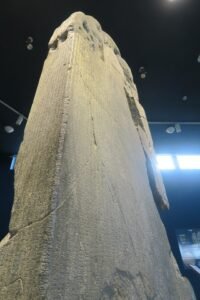
The Kul Tigin inscription is a memorial text. Bilge Khagan had it set up in 732 in memory of his brother. The Turkish narrative is told in Bilge Khagan’s voice. The person who cut it into the stone was Yollug Tigin.
The monument uses two languages. The south, east and north faces carry Turkish texts in Göktürk letters. The west face carries a Chinese text issued by the Tang emperor Xuanzong. One stone therefore holds the voices of two states.
Think of a family member writing a eulogy for a sibling. Bilge Khagan’s text works much the same way. It is personal and proud, and it is also public, because it was meant to be read by everyone who came to the site.
Kul Tigin’s Death and the Funeral Rites
The inscription states that Kul Tigin died at the age of 47. It does not say why. The date comes from the text’s “sheep year” notation. Using the generally accepted calendar conversion, scholars calculate 27 February 731.
The yuğ, the funeral ceremony held for him, took place on 1 November 731 by the same conversion. The stone itself followed a year later, in 732.
Kul Tigin and Religion
People search “Kul Tigin religion” because the text mentions sacred figures. The inscription is not a religious treatise. It does contain clear traces of traditional Turkic belief. In line 31 of the east face, Kul Tigin’s mother is compared to Umay. This is one concrete example of the older belief world visible on the monument.
One line is still debated. On line 10 of the north face, the verb can be read as aysar or yasar. The choice changes the meaning. One reading makes the sentence about the command of Tengri (Heaven). The other makes it about living out one’s time. The monument is clear in most places, but not in every line.
The Kul Tigin Monument: What Stands in the Orkhon Valley
The complex is at Khoshoo-Tsaidam in the Orkhon Valley, in Mongolia’s Arkhangai region. The stele is not the only piece. The site also has a tomb structure, a ceremonial path, human statues, an altar stone and balbals (standing stones).
The site sits close to a second monument. The Kul Tigin and Bilge Khagan inscriptions stand about one kilometre apart. The Tonyukuk inscription is a different case. It lies about 360 kilometres east of the Orkhon River.
The original Kul Tigin stele was moved to the Orkhon Museum at Khoshoo-Tsaidam. Its broken pieces were joined and the stone was set up again there.
Timeline
- 684–685: Alternative birth years given in the sources.
- 705: Kul Tigin commands a unit in the war against Shazha Chongyi.
- 27 February 731: Date of death by the generally accepted conversion.
- 1 November 731: The yuğ funeral ceremony.
- 732: Bilge Khagan has the inscription set up.
- 1889: Yadrintsev introduces the inscription to the scholarly world.
- 1893: Thomsen deciphers the Göktürk script.
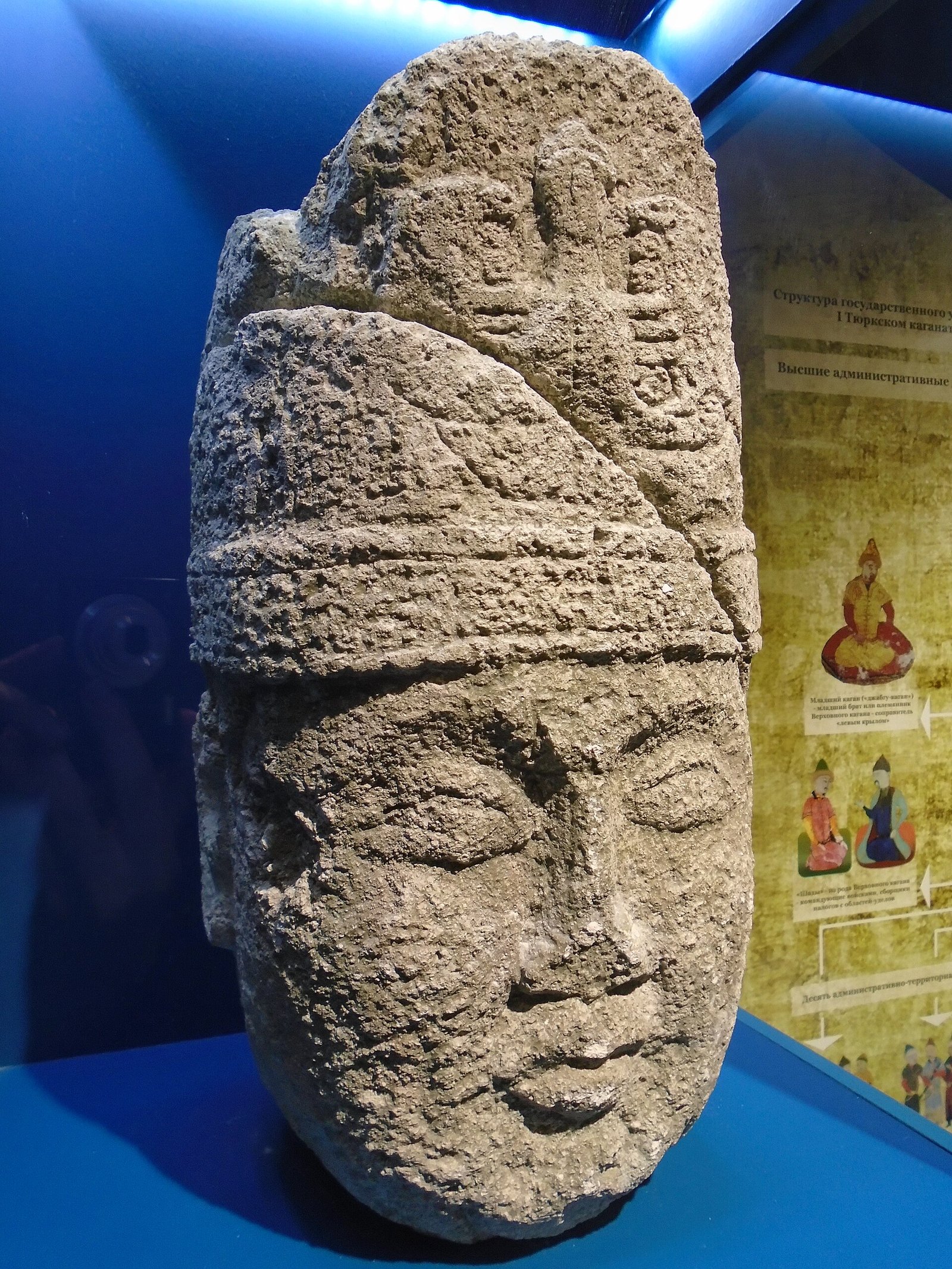
- 1958: Excavations at the site find statue heads attributed to Kul Tigin and his wife.
- 2004: The Orkhon Valley Cultural Landscape joins the UNESCO World Heritage List.
Details You Won’t Find in Guidebooks
- Twenty days. Yollug Tigin recorded that he wrote the Kul Tigin inscription in twenty days.
- Six artists from China. Six decorative artists were brought from China to build the monument.
- A replaced base. The stele originally stood on a tortoise-shaped base. The base was smashed, so in 1911 the stone was placed on a block of granite cut from the altar stone.
- A text almost lost. The tortoise base carries its own separate Turkish text of eight lines. Only seven or eight words can be read.
- Heads found in 1958. Statue heads said to belong to Kul Tigin and his wife were found during excavations in 1958.
How the Stone Was Read Again
The script had to be deciphered before anyone could read the inscription. Nikolay Yadrintsev made the discovery that introduced the Kul Tigin inscription to scholars in 1889. In 1893 the Danish linguist Vilhelm Thomsen deciphered the script used on both the Kul Tigin and Bilge Khagan inscriptions.
Scholars still work on the text today. Talât Tekin’s study of the Orkhon inscriptions has a Korean edition. In it, the transcription of the Kul Tigin inscription runs on pages 527–542, and the Göktürk-letter text on pages 575–587. If you want to check a line yourself, an edition like this is where to start.
The wider landscape is protected as well. The Orkhon Valley Cultural Landscape, which includes the Kul Tigin site, was added to the UNESCO World Heritage List in 2004.
FAQ
Who was Kul Tigin?
He was a prince and army commander of the Second Göktürk Khaganate, from the Ashina dynasty. He was the son of İlteriş Kutlug Khagan and the younger brother of Bilge Khagan.
Where is the Kul Tigin monument?
The complex is at Khoshoo-Tsaidam in the Orkhon Valley, in Mongolia’s Arkhangai region. The original stele is now kept in the Orkhon Museum at Khoshoo-Tsaidam.
Who wrote the Kul Tigin inscription?
The Turkic text is told in the voice of Bilge Khagan. Yollug Tigin is the person who wrote it on the stone, and he recorded that he did so in twenty days.
How did Kul Tigin die?
The inscription says he died at the age of 47 but gives no cause of death. The date is calculated as 27 February 731.
Who deciphered the Orkhon script?
The Danish linguist Vilhelm Thomsen deciphered the script used on the Kul Tigin and Bilge Khagan inscriptions in 1893. Nikolay Yadrintsev had introduced the Kul Tigin inscription to the scholarly world in 1889.
Sources
- Wikipedia — Kul Tigin en.wikipedia.org
- Türk Dünyası Ansiklopedisi — Köl Tigin turkdunyasiansiklopedisi.gov.tr
- Türk Edebiyatı Eserler Sözlüğü — Köl Tegin Yazıtı tees.yesevi.edu.tr
- Nurdin Useev — Köl Tigin Kişi Adı ve Manas’ın Ayköl Epiteti dergipark.org.tr
- Tuba Yalınkılıç — Kül Tigin Yazıtının Çince Metni ve Tercümesi dergipark.org.tr
- UNESCO — Orkhon Valley Cultural Landscape nomination file whc.unesco.org
- TDV İslâm Ansiklopedisi — Orhon Yazıtları islamansiklopedisi.org.tr
- Mahsun Atsız — Kül Tégin Yazıtının Kuzey Yüzünde Geçen Y1S1R1 Kelimesi Üzerine dergipark.org.tr
- Mehmet Ölmez — review of the Korean edition of Talât Tekin’s Orkhon inscriptions study tdkbelleten.gov.tr
Image: Kul-tegin head (2023-03-07) 02.jpg — Vyacheslav Kirillin, CC BY-SA 4.0