A caravan, a governor and an empire
In 1218 a caravan reached the city of Otrar. It had come from Genghis Khan’s lands to trade. In the account of the historian Cüveynî, it held 450 Muslim merchants. The governor of Otrar, İnalcık, had the merchants arrested. He seized their goods and had them killed.
That single act pulled the Khwarazmian Empire into a war it did not survive. The empire stretched across a huge area. Thirteen years later the dynasty was gone.
This article follows the story from the empire’s origins to its end. It also answers the questions people ask most: the flag, the map, the capital, the religion and the timeline.
Where did the Khwarazmian Empire come from?
The Khwarazmian state grew out of the region of Khwarazm (Harezm). That land lies south of the Aral Sea along the Ceyhun River.
The founder of the line was Anuş Tegin. He was of Turkic origin, but scholars cannot say for certain which tribe he belonged to. According to the TDV İslâm Ansiklopedisi, the dynasty began when Anuş Tegin’s son Kutbüddin Muhammed was appointed governor of Khwarazm in 1097.
Sources disagree on the start date. English Wikipedia counts from about 1077. The Turkish Wikipedia and the TDV encyclopedia use 1097. You will see both dates in books, so check which one an author means.
Khwarazmian Empire religion and culture
The Khwarazmians were Sunni Muslims. Their Turkic-origin dynasties had adopted Persian culture. Persian was also the official language of government.
This mix was typical of the region. The rulers spoke a Turkic heritage, but the paperwork of the state was written in Persian.
Khwarazmian Empire flag
There was no modern national flag. What existed were the symbols of rule: a banner and a ceremonial parasol called the çetr. The Khwarazmshahs used black for both, just as the Great Seljuks did.
If you see a reconstruction with another colour, treat it with caution.
Khwarazmian Empire capital
The first and main capital was Gürgenç. Today it is the Köhne Ürgenç archaeological site in Turkmenistan.
The capital moved later. After the empire collapsed, Celâleddin took Tabriz in 1225 and made it his capital. From there he kept the Khwarazmian state going with Azerbaijan as its centre.
Khwarazmian Empire map
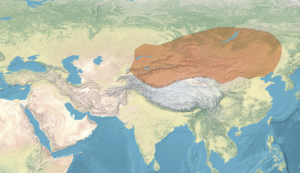
The English Wikipedia map dated about 1215 shows the empire just before the Mongol invasion. It covers large parts of today’s Central Asia, Iran and Afghanistan.
The empire grew in part through war in Iran. In 1194 Alâeddin Tekiş defeated Tuğrul III, the last Iraq Seljuk ruler. That victory widened his control in Iran. His son Alâeddin Muhammed became Khwarazmshah when Tekiş died in 1200.
What happened at Otrar?
The facts are clear on the main points. In 1218 a caravan from Genghis Khan’s country was killed in Otrar. The governor İnalcık arrested the merchants, took their goods and had them put to death.
One detail is disputed. The claim is that İnalcık accused the caravan of spying. Historians disagree on whether the charge was true. They also disagree on how far Sultan Muhammed himself took part in the massacre.
Genghis Khan did not attack at once. He sent an embassy. It demanded that the guilty be handed over and that the caravan’s goods be paid for.
The embassy failed, and the sources disagree about how. English Wikipedia says one envoy was killed and the other two were humiliated. Iranica’s article on Alâeddin Muhammed says three envoys were killed. Either way, the envoys were attacked.
Think of a courier company that loses your parcel. You complain and ask for a refund. If the company then attacks the person you sent to ask, a small dispute becomes a feud. Otrar was that, at the scale of two states.
Khwarazmian Empire vs Mongols: why the defence failed
Genghis Khan’s armies entered Khwarazmian lands toward the end of 1219. Sultan Muhammed chose a defensive plan. He split his forces among the garrisons of major cities such as Samarkand, Merv and Nishapur.
The siege of Otrar began in 1219. Afterwards the Mongols tore down the city walls and the inner citadel. They deported a large part of the population. They executed İnalcık.
Khwarazmian Empire Mongol invasion: the collapse
The Mongols plundered Bukhara and Samarkand in 1220. They took most of Mâverâünnehir, the region between the great rivers of Central Asia.
Sultan Muhammed fled before the Mongols. In December 1220 he died on one of the Abeskun islands in the Caspian Sea. Gürgenç, the capital, held on longer. It fell in April 1221 after a four-month siege.
Celâleddin: the last fighter
The sultan’s death did not end resistance. His son Celâleddin fought on.
In 1221 he defeated a Mongol army at Parvan. It was led by Şiki Kutugu Noyan. The victory was real, but it did not last. On 26 November 1221 Genghis Khan defeated Celâleddin on the bank of the Indus (Sind) River. Celâleddin crossed the river and took refuge in India.
He returned. In 1225 he captured Tabriz and made it his capital.
Khwarazmian Empire fall
The end came slowly. The Khwarazmshahs weakened after their defeat at Yassıçemen in 1230. Celâleddin was killed in 1231, and with his death the Khwarazmian state came to an end.
Khwarazmian Empire timeline
- 1097: Kutbüddin Muhammed is appointed governor of Khwarazm. This is the start date the TDV accepts for the dynasty.
- 1194: Alâeddin Tekiş defeats Tuğrul III.
- 1200: Alâeddin Muhammed takes the throne.
- 1218: The trading caravan is killed at Otrar. The envoys sent afterwards are attacked.
- 1219: The Mongol invasion and the siege of Otrar begin.
- 1220: Bukhara and Samarkand fall.
- December 1220: Alâeddin Muhammed dies on a Caspian island.
- April 1221: The Mongols capture Gürgenç.
- 1221: Celâleddin defeats the Mongols at Parvan.
- 26 November 1221: Battle at the Indus; Celâleddin crosses into India.
- 1225: Celâleddin takes Tabriz and makes it his capital.
- 1230: The Khwarazmshahs are defeated at Yassıçemen.
- 1231: Celâleddin is killed. The state ends.
How long did the Khwarazmian state last?
It depends on the start date. From 1097 to 1231 is about 134 years. From about 1077 it is about 154 years.
The real power of the empire was shorter. After 1220 the heartland was lost, and only Celâleddin’s campaigns kept the name alive.
Khwarazmian Empire now: what you can see today
The capital Gürgenç survives as the Köhne Ürgenç ruins in Turkmenistan. If you plan a trip to Central Asia, that is the place to see the first capital.
Otrar sits at the centre of an oasis of about 200 square kilometres. Finds from the site are displayed in the state archaeology museum in the nearby town of Shauldir. The museum also works as a research centre.
Details you won’t find in guidebooks
- One of the leaders of the murdered merchants is recorded under the name Hâce Ömer Otrârî.
- Otrar did not die in 1219. The city recovered after the Mongol destruction, and Timur died there in 1405.
- A University College London archaeological record says people lived at Otrar from at least the 5th century until its final abandonment in the 18th century.
- Systematic excavation grew out of the Otrar Comprehensive Archaeological Expedition, which began in 1969.
- Not everyone blames the Mongols for the oasis’s decline. A 2021 research summary by Toonen and colleagues dates abandoned irrigation channels. It stresses that drought and river changes began before the invasion.
FAQ
What caused the Mongol invasion of the Khwarazmian Empire?
In 1218 a trading caravan sent from Genghis Khan’s lands was killed at Otrar. Genghis Khan then sent envoys to demand the culprits and compensation, and they were attacked. His armies entered Khwarazmian territory in late 1219.
Where was the Khwarazmian capital?
The first and main capital was Gürgenç, today the Köhne Ürgenç ruins in Turkmenistan. Celâleddin later made Tabriz his capital in 1225.
What religion did the Khwarazmians follow?
They were Sunni Muslims. Their Turkic-origin dynasties had adopted Persian culture, and Persian was the official administrative language.
How do you pronounce Khwarazmian?
Wikipedia gives /kwəˈræzmiən/. Say it as kwuh-RAZ-mee-un.
How long did the Khwarazmian state last?
If you count from 1097, as the TDV İslâm Ansiklopedisi does, it lasted about 134 years until 1231. If you count from about 1077, as English Wikipedia does, it lasted about 154 years.
Sources
- Türk Dünyası Ansiklopedisi, “Hârizmşahlar Devleti” turkdunyasiansiklopedisi.gov.tr
- TDV İslâm Ansiklopedisi, “Hârizmşahlar” (Aydın Taneri, vol. 16, 1997, pp. 228–231) islamansiklopedisi.org.tr
- TDV İslâm Ansiklopedisi, “Celâleddin Hârizmşah” islamansiklopedisi.org.tr
- Wikipedia, “Khwarazmian Empire” en.wikipedia.org
- Wikipedia, “Mongol invasion of the Khwarazmian Empire” en.wikipedia.org
- Vikipedi, “Harezmşahlar Devleti” tr.wikipedia.org
- Encyclopaedia Iranica, “Otrār” iranicaonline.org
- Encyclopaedia Iranica, “ʿAlāʾ-al-Dīn Moḥammad” iranicaonline.org
- University College London, “Otrar archaeological site” dataset rdr.ucl.ac.uk
- European Geosciences Union, Toonen et al., EGU21-8647 meetingorganizer.copernicus.org
Image: Ala Al-Din Muhammad Khwarazmshah gold coin.jpg — M.samei, CC BY-SA 4.0