Aeneas was a Trojan hero in Greek and Roman mythology, the son of Anchises and the goddess Aphrodite, known to Romans as Venus. His legendary journey to Italy entered Rome’s origin story through a family line linking him to Lavinium, Alba Longa and, much later, Romulus, Rome’s founder.
Why does a warrior from Troy belong in a story about Rome? If you follow Aeneas from Homer’s battlefield to Virgil’s Italy, the connection emerges through prophecy, family duty and ancestry. Coins, sculptures and a burial monument then show how Romans pictured and used that connection.
How do Homer and Virgil portray Aeneas?
In Homer’s Iliad, Aeneas is a war leader from a younger branch of Troy’s royal family. Divine intervention saves him in encounters with Diomedes and Achilles. His survival matters within the Trojan story before it becomes part of Rome’s ancestry.
In Book 20, Poseidon declares that Aeneas and his children will rule over the Trojans. The prophecy does not directly announce Rome’s foundation. If you encounter it as a prediction of Rome, keep that distinction in mind: Homer’s stated future concerns the Trojans.
Virgil gives Aeneas a journey whose destination prepares the origins of the Roman people. He wrote the twelve-book Latin Aeneid between 29 and 19 BCE. Its first six books cover the journey from Troy to Italy. The final six concern the Trojans’ wars in Italy.
Virgil’s central quality for Aeneas is pietas. The word includes respect for the gods, loyalty to family and homeland, a sense of duty and good leadership. Translating it simply as religious devotion leaves out much of what the poem asks of its hero.
Roman art makes family duty visible. In the escape from Troy, Aeneas carries his father Anchises and holds his son Ascanius by the hand. You can connect this image with an everyday responsibility: helping an older relative while keeping a child close. The scene places three generations within one act of care.
The poem’s ending complicates the dutiful image. Aeneas kills Turnus. Some scholars interpret this as questioning Roman and Augustan ideals. Others read the killing as the necessary cost of establishing peace. The same final action therefore supports contrasting interpretations of his leadership.
How does his journey from Troy to Italy connect with Rome’s origins?
The route based on the Aeneid takes Aeneas and his companions through Mount Ida to Antandros. There they build ships and begin their Mediterranean voyage. For travelers in Turkey, this gives the Italian foundation story a departure point connected with the Trojan landscape.
A report assessing the Aeneas Route in 2020 describes an itinerary linking Turkey, Greece, Albania, Tunisia and Italy. It follows Virgil’s literary narrative. Its geographical reach helps you follow the poem across the Mediterranean, while its basis remains a work of literature.
After reaching Italy’s western coast in the Aeneid, Aeneas descends into the underworld. His dead father Anchises shows him the future of his descendants and Roman history. The encounter explicitly connects the Trojan traveler’s family with Rome’s future.
Arrival also leads to conflict. The prospect of Aeneas marrying Lavinia, daughter of Latinus, lies at the center of his war with Turnus. Turnus wants to marry the same woman. Aeneas’s Italian future therefore develops through warfare as well as movement across the sea.
In the tradition recorded by Livy, Aeneas marries Lavinia and founds Lavinium, naming the city after her. Lavinium supplies the first city in the chain that connects his arrival with Rome. The legend gives him a foundation of his own before Romulus appears.
How does the legend establish a lineage between Aeneas and Romulus?
The sequence of cities is Lavinium, Alba Longa and Rome. Aeneas belongs to Lavinium. His son Ascanius, also called Iulus, settles at Alba Longa. Much later, Romulus founds Rome. The geographical sequence accompanies a family succession extending beyond Aeneas’s lifetime.
In the familiar Alba Longa genealogy, generations of kings follow Aeneas. The line eventually reaches Numitor and his daughter Rhea Silvia. She bears Romulus and Remus by Mars. Through this sequence, the Trojan ancestor becomes connected with the brothers in Rome’s foundation legend.
Ancient versions did not agree on the number of intervening generations. Accounts associated with Naevius and Ennius made Romulus Aeneas’s grandson. The tradition familiar through Virgil inserts the generations of Alba Longa. Calling Romulus a descendant of Aeneas accommodates this distinction more carefully than calling him his grandson without qualification.
Why did his image become important under Caesar and Augustus?
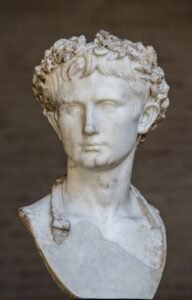
Julius Caesar traced his ancestry to Aeneas, the son of Venus. This claim joined his family’s divine origin to the legendary ancestor of the Roman people. Aeneas thus connected a particular family’s ancestry with a much broader Roman origin story.
A silver denarius dated to 47–46 BCE shows Aeneas carrying Anchises and the Palladium away from Troy. The image placed the ancestral claim on a coin. Its combination of family rescue and a sacred Trojan object compressed several elements of the legend into one scene.
Augustus also used Aeneas’s escape from Troy in imperial propaganda. He sought to present himself as a descendant of Rome’s legendary founders. The carrying scene gave that claim a recognizable image, bringing ancestry and family duty into the representation of political authority.
A marble group at the Museo Nacional de Arte Romano in Mérida dates to the first century CE. Its surviving pieces include part of Aeneas’s armor, a bust of the elderly Anchises with his head covered, and a young Ascanius missing his head. These fragments preserve the three-generation composition in sculptural form.
Timeline
- Seventh century BCE: The first burial takes place in the Lavinium mound later called the Heroon of Aeneas.
- Sixth century BCE: Greek vases found in Etruria depict Aeneas carrying Anchises.
- Late fourth century BCE: The Lavinium mound becomes a monumental heroon. Its early association with an Aeneas cult remains disputed.
- 47–46 BCE: Caesar’s denarius depicts Aeneas, Anchises and the Palladium.
- 29–19 BCE: Virgil works on the Aeneid.
- First century CE: The marble Aeneas group represented by fragments at Mérida is produced.
- Approximately 25–75 CE: The terracotta lamp showing Anchises with the Palladium is produced.
Details you won’t find in guidebooks
The carrying scene predates Virgil by centuries. Sixth-century BCE Greek vases found in Etruria already show Aeneas bearing his father. Virgil’s poem therefore belongs to a tradition whose visual expression had a much earlier history.
A terracotta lamp dated by the British Museum to approximately 25–75 CE adds a revealing detail. Anchises carries the Palladium, Troy’s statue of Athena, instead of household gods. Looking closely at what he holds reveals a variation within the familiar escape scene.
In Book 3 of the Aeneid, Buthrotum, today’s Butrint in Albania, appears as a small Troy. Its names and buildings imitate those of the lost city. The journey includes a place where Trojan surroundings are reproduced far from Troy itself.
The original arrangement of Mérida’s broken marble group can be understood with help from lamps and jewelry depicting the same escape. These smaller objects help explain how the surviving sculptural pieces belonged together.
The seventh-century BCE grave goods from the so-called Heroon of Aeneas at Lavinium include a bronze grater. It was used for grating goat’s cheese into wine in the Greek manner. This small utensil supplies a concrete detail of the burial assemblage beneath the monument’s legendary identification.
How should literary tradition be distinguished from historical and archaeological evidence?
Troy is identified with the archaeological site of Hisarlık in present-day Çanakkale. Its settlement remains and excavated objects establish a real place. They do not establish that Aeneas personally made the journey described in the literary tradition.
Lavinium requires the same care. Italy’s Ministry of Culture describes its Aeneas Heroon as a seventh-century BCE burial mound about eighteen meters across. It attributes the identification with Aeneas’s tomb to legend. The monument’s date and dimensions are different kinds of claims from the name attached to it.
The original burial belonged to a wealthy local figure, probably an aristocrat or king. The mound became a monumental heroon in the late fourth century BCE. Claims that excavation establishes an Aeneas cult from that early period remain disputed; the Oxford Classical Dictionary does not accept the early dating as proven.
Vases, coins, lamps and sculptures document the circulation and use of Aeneas’s story. The Lavinium monument documents a burial and its later transformation. Together, these materials help explain the legend’s place in Roman culture without directly verifying the hero’s life or voyage.
FAQ
Who were Aeneas’s parents?
In Greek and Roman mythology, Aeneas was the son of the Trojan Anchises and the goddess Aphrodite, whose Roman counterpart was Venus.
Did Aeneas found Rome?
The tradition assigns Rome’s foundation to Romulus. Aeneas founded Lavinium, while his son Ascanius, also called Iulus, connects the family story to Alba Longa.
Was Romulus Aeneas’s grandson?
Ancient accounts associated with Naevius and Ennius made Romulus Aeneas’s grandson. The tradition familiar through Virgil places generations of Alba Longa rulers between them.
Does archaeology prove Aeneas’s journey?
No. Objects and monuments document the legend’s circulation and use, but they do not directly verify Aeneas’s life or personal journey.
Sources
- Wikipedia — Aeneas tr.wikipedia.org
- Stephen J. Harrison, Oxford Classical Dictionary — Aeneas academic.oup.com
- Treccani — Eneide treccani.it
- Wikipedia — Aeneid en.wikipedia.org
- The Open University — Introducing Virgil’s Aeneid open.edu
- British Museum — Troy: Large Print Guide, page 79 britishmuseum.org
- Ayşegül Yılmaz — Aeneas Route: Independent Expert Evaluation Report rm.coe.int
- University of Notre Dame — The Legend of Aeneas butrint.nd.edu
- Wikipedia — Aeneas en.wikipedia.org
- The Open University — Book 12 of the Aeneid open.edu
- Peter Mountford, University of Melbourne — Aeneas: An Etruscan Foundation Legend ascs.org.au
- Museo Nacional de Arte Romano — Aeneas Group cultura.gob.es
- Italian Ministry of Culture — Ancient Lavinium Archaeological Area cultura.gov.it
- Archaeological Superintendency for the Rome Metropolitan Area — Heroon of Aeneas: Technical Report sabap-met-rm.cultura.gov.it
- Province of Rome Cultural Heritage Portal — Lavinium Archaeological Museum beni-culturali.provincia.roma.it
- Wikipedia — Troy en.wikipedia.org
Image: Terrain in the Aeneas Valley WA.jpg — A. Balet, CC BY 3.0