Charles Darwin’s On the Origin of Species, published on 24 November 1859, changed the history of science by explaining biological diversity through common ancestry and natural selection. Scientists broadly accepted branching evolution within about twenty years, while natural selection gained acceptance more slowly and was later combined with Mendelian genetics.
How did specimens collected aboard HMS Beagle become an argument about the origins of species? The route runs through Darwin’s pigeon experiments, Alfred Russel Wallace’s independent discovery, and a manuscript begun in Sandown. Following those connections helps you understand both the book’s explanation and the debates that followed publication.
Who wrote On the Origin of Species?
The English naturalist Charles Darwin wrote On the Origin of Species. His evidence included organisms, fossils, and field notes collected during the HMS Beagle voyage of 1831–1836. Those collections and observations helped form the evidential foundation of his evolutionary theory.
Darwin also connected Thomas Robert Malthus’s thinking about population growth and limited resources with the struggle for life in nature. This relationship helped him frame a central problem: reproduction takes place under conditions where resources are limited. Natural selection offered an explanation for how inherited differences could spread under those conditions.
On the Origin of Species summary: common ancestry and natural selection
The book argued that species arose through divergence from common ancestors. Biological diversity therefore had a branching history. Different species could be understood through their connections to ancestral forms and the changes accumulated along separate lines of descent.
Natural selection supplied a mechanism for that change. Individuals carrying inherited characteristics suited to their environment could reproduce more successfully. Across generations, those characteristics could become more widespread. The explanation connected differences between individuals with changes in populations over time.
If you want to follow Darwin’s argument, keep common ancestry and natural selection distinct. Common ancestry concerns the historical relationships between species. Natural selection concerns how inherited characteristics spread through differential reproduction. The later reception of the book shows why that distinction matters: scientists accepted these propositions at different rates.
Darwin’s pigeon breeding supplied an everyday-life connection. Breeders selected birds with particular characteristics for reproduction. Darwin used this artificial selection to explain an analogy with natural selection. You can approach the argument through that concrete activity: selecting which animals reproduce can influence the characteristics found in later generations.
On the Origin of Species by Means of Natural Selection: the full title
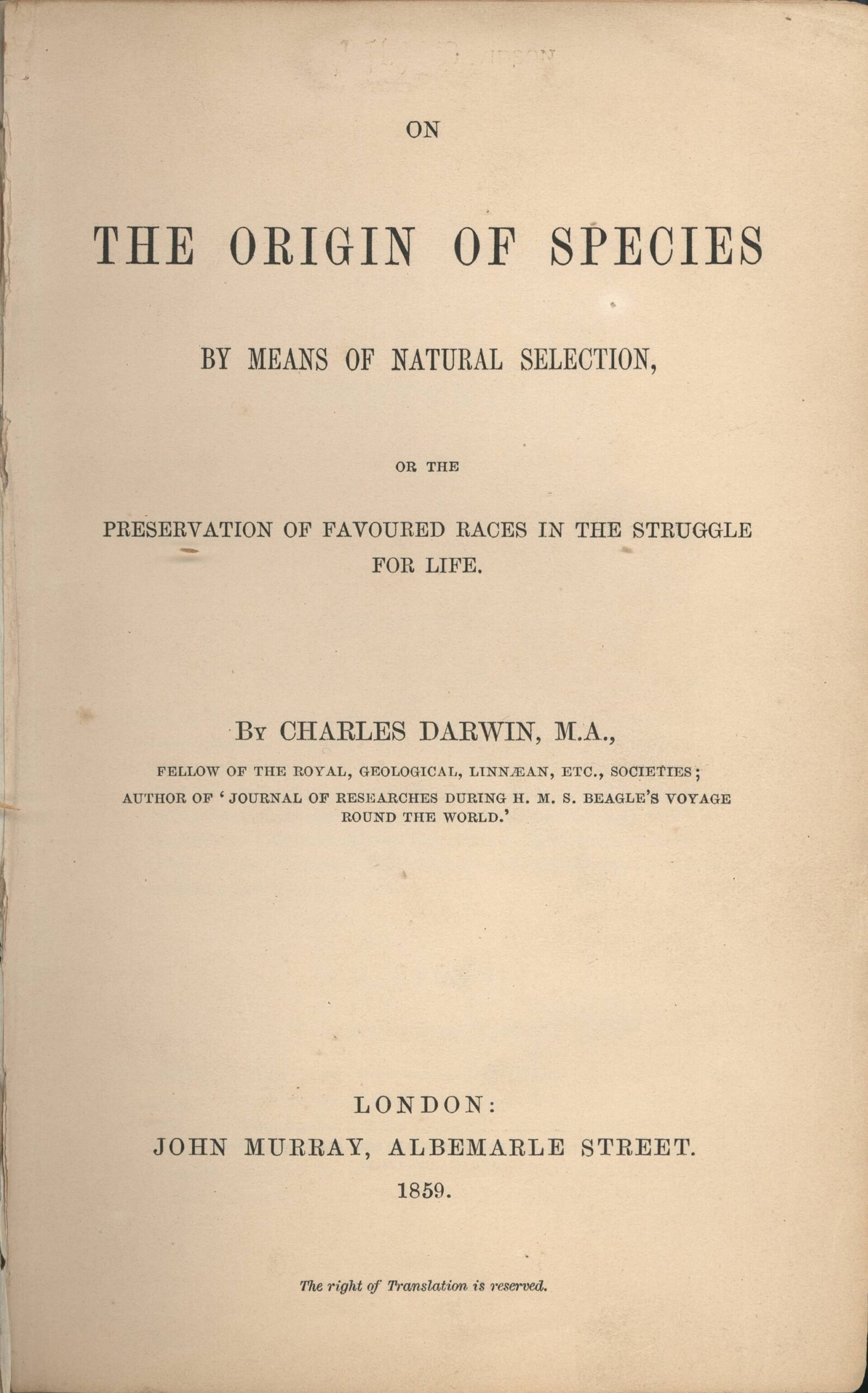
The full English title of the 1859 edition was On the Origin of Species by Means of Natural Selection, or the Preservation of Favoured Races in the Struggle for Life. Its wording placed natural selection and the struggle for life directly on the title page.
That title connects the book’s subject with its proposed explanation. The origin of species was the question; natural selection was the mechanism Darwin presented. His discussion of inherited differences, reproduction, and limited resources developed the relationship announced in those opening words.
Where was On the Origin of Species written?
Darwin began the shortened work that became On the Origin of Species on 20 July 1858. He started it in Sandown, on the Isle of Wight. This gives the manuscript a specific starting place and date within the wider history of his research.
Down House was another central location. Darwin moved there in 1842, continued his natural selection research there, and wrote the book there. The house stands in Downe village, within London’s borough of Bromley. Sandown and Down House thus belong to different parts of the same writing history.
Wallace and the announcement before the book
On 18 June 1858, Darwin received a letter from Alfred Russel Wallace. It included a paper independently explaining natural selection. Wallace’s work placed a parallel discovery alongside the theory Darwin had developed from his observations and experiments.
Charles Lyell and Joseph Dalton Hooker arranged a joint announcement of Darwin’s and Wallace’s work. It was read at a meeting of the Linnean Society in London on 1 July 1858. The announcement therefore preceded both Darwin’s start on the shortened manuscript and the book’s publication.
Where was On the Origin of Species published? The first edition
John Murray published the first edition in London in 1859. Publication took place on 24 November, and Murray had 1,250 copies printed. These details distinguish the original edition from the revised editions that followed.
The main pagination of the 1859 English edition runs to 502 pages. ETH-Bibliothek’s catalog record also identifies nine pages of preliminary material and a separate 32-page section. If you compare digital copies, those additional sections help explain why the main page count does not describe every page in the volume.
Timeline
- 1831–1836: Darwin collected organisms, fossils, and field notes during the HMS Beagle voyage.
- 1842: He moved to Down House, a center of his research and writing.
- 18 June 1858: He received Wallace’s work on natural selection.
- 1 July 1858: Darwin’s and Wallace’s work was presented jointly at the Linnean Society.
- 20 July 1858: Darwin began the shortened manuscript in Sandown.
- 24 November 1859: The first edition of On the Origin of Species appeared.
- 1869: The fifth edition introduced the phrase “survival of the fittest.”
- 1871: Darwin published his extensive treatment of human evolution in The Descent of Man.
- 1872: The sixth edition of On the Origin of Species appeared.
- 1930s–1940s: The modern evolutionary synthesis combined natural selection with Mendelian genetics.
Details you won’t find in guidebooks
Darwin’s pigeon experiments left physical specimens behind. After his experiments, 120 pigeon specimens that he gave to the museum entered the Natural History Museum’s bird collection at Tring. The breeding analogy in his argument therefore connects with a surviving museum collection.
Neither Darwin nor Wallace attended the joint announcement on 1 July 1858. Darwin was ill and mourning his son. Wallace was in the Maluku Islands of Indonesia. The public presentation of their work happened while both authors were absent.
The first edition’s first-day sellout needs a precise explanation. It meant that the book trade had taken the copies allocated for sale by the publisher. It did not mean that individual readers had already purchased every copy. That distinction changes how you should understand the familiar publication story.
The first edition contained a single folding diagram. Prepared by William West, it illustrated evolutionary branching and was placed opposite page 117. Its location offers a specific point to examine when browsing a digitized original edition.
Two familiar expressions also have an edition history. Herbert Spencer’s phrase “survival of the fittest” entered the book in the fifth edition of 1869. The word “evolution” first appeared in the sixth edition of 1872, although “evolved” had already appeared in the final sentence of earlier editions.
How Darwin’s theory changed scientific debate
Darwin addressed objections within the book itself. In Chapter VI of the 1859 edition, he considered why intermediate forms were not commonly observed. His defense of natural selection drew on competition and the extinction of intermediate forms.
Acceptance developed unevenly. During roughly the twenty years after 1859, a broad scientific consensus emerged around evolution through branching descent from common ancestors. The view that natural selection was the principal mechanism did not gain agreement at the same speed.
Religious interpretation also produced disagreement. In 1874, Charles Hodge treated an interpretation of Darwinism that rejected design as atheism. The botanist Asa Gray argued that this claim misrepresented Darwin’s text. Their disagreement shows that the book’s religious implications were themselves disputed.
The relationship between selection and inheritance took a later form in the modern evolutionary synthesis. During the 1930s and 1940s, researchers including Ronald A. Fisher, Sewall Wright, and J. B. S. Haldane combined Darwinian selection with Mendelian genetics. This development belongs to the book’s scientific legacy, decades after its first publication.
On the Origin of Species PDF and original edition
Darwin Online lists the 1859 first edition under catalog number F373. It offers the text, page images, and a PDF. These formats let you read the argument or examine the appearance of the original printed pages.
ETH-Bibliothek also provides page images and a downloadable digital copy through e-rara, identified as public domain. Its catalog records the publisher, place, date, full title, and pagination. Those details provide practical reference points when selecting a first-edition scan.
FAQ
Who wrote On the Origin of Species?
The English naturalist Charles Darwin wrote On the Origin of Species. John Murray published its first edition in London on 24 November 1859.
What is the full title of On the Origin of Species?
The 1859 title is On the Origin of Species by Means of Natural Selection, or the Preservation of Favoured Races in the Struggle for Life.
Where was On the Origin of Species written?
Darwin began the shortened manuscript in Sandown on the Isle of Wight on 20 July 1858. Down House was also a center of his research and the writing of the book.
Where can you find an On the Origin of Species PDF?
Darwin Online lists the 1859 first edition as F373, with text, page images, and a PDF. ETH-Bibliothek also provides page images and a downloadable public-domain copy through e-rara.
Sources
- Wikipedia — Türlerin Kökeni tr.wikipedia.org
- ETH-Bibliothek — On the Origin of Species, 1859 edition e-rara.ch
- Darwin Online — Darwin’s Publications darwin-online.org.uk
- Natural History Museum — Charles Darwin nhm.ac.uk
- The Linnean Society — Anniversary of the Darwin–Wallace Presentation linnean.org
- Darwin Online — R. B. Freeman’s Bibliographical Introduction darwin-online.org.uk
- English Heritage — History of Down House english-heritage.org.uk
- Wikipedia — Down House en.wikipedia.org
- Wikipedia — On the Origin of Species en.wikipedia.org
Image: Origin of Species title page.jpg — John Murray, Publisher, Public domain