Izumo no Okuni was a female dancer and performer associated with the beginnings of Kabuki through her performances in Kyoto around 1603. In 1629, the Edo shogunate banned women from Kabuki because it regarded prostitution associated with female troupes and disputes among spectators as threats to public morality and order.
The woman associated with Kabuki’s beginnings had reportedly retired around 1610, before that prohibition. If you follow the story from her Kyoto performances to the restrictions on her successors, a striking sequence emerges: women established the form, young men followed them, and adult men eventually gained prominence. The dates also explain why Okuni’s career and the ban should be considered separately.
Who was Izumo no Okuni?
Okuni’s birth is usually placed around 1578, although the date is uncertain. Traditional accounts describe her as a miko, a female shrine attendant, at Izumo Grand Shrine before her performances in Kyoto. Kyoto National Museum identifies the Izumo province from which her troupe came with present-day Shimane Prefecture.
Her death date is also disputed. Different claims place it in 1610, 1613, or 1640. You can therefore identify her place in Kabuki’s beginnings more confidently than you can reconstruct the full span of her life. Her association with the performances of 1603 provides a firmer point of reference than either endpoint of her biography.
The Japan Arts Council identifies a record of Okuni performing kabuki-odori in Kyoto in 1603. Her position in Kabuki’s history rests on those performances and on the women’s troupes that followed her success.
How did her Kyoto performances become Kabuki?
Among Okuni’s performance locations around 1603 was Shijōgawara, the dry riverbed of Kyoto’s Kamo River. Kyoto National Museum also places her troupe on the Noh stage at Kitano Shrine in 1603. Kabuki’s beginnings thus connect both a riverbed performance area and a shrine stage.
Okuni’s appearance could be as striking as her choice of role. In Chaya Asobi, she portrayed a kabukimono, a young male character who wore showy clothes and carried a large sword. A woman playing this conspicuous male figure was part of the early performance itself.
Think of how you use clothing in everyday life to signal an attitude or try out a different identity. Okuni’s showy costume and sword offer a concrete theatrical example. Her performance joined dress, behaviour, and a male character in a single stage appearance.
Kokugakuin University presents an etymological theory linking the name Kabuki to kabuita, a word associated with Okuni’s unconventional clothing and behaviour. This is a proposed explanation of the name. It also draws attention to the conspicuous appearance associated with her performances.
After Okuni became famous in 1603, other women imitated her. They presented onna-kabuki, or women’s Kabuki, in Kyoto’s Shijōgawara district and Edo’s Yoshiwara district. The Japan Arts Council places the strongest period of women’s Kabuki between 1615 and 1629.
Why were women banned from Kabuki in 1629?
The Edo shogunate prohibited women from appearing in Kabuki in 1629, during the rule of the third Tokugawa shogun, Iemitsu. Its stated justification concerned public morality. The prohibition came at the end of the period that the Japan Arts Council identifies as women’s Kabuki’s flourishing years.
Prostitution was central to that justification. The Web Japan account published by the Japanese embassy explains that it provided an important source of additional income for women’s Kabuki troupes. The authorities treated this connection between performance and prostitution as grounds for restricting the stage.
Concerns also extended to male spectators. Fights could arise between men seeking the attention of performers. The reasoning behind the ban therefore involved both the activities associated with the troupes and disorder among their audiences.
These details explain the specific setting of the prohibition. Women were excluded from Kabuki through a policy framed around morality and public order. Their role in establishing the theatre did not protect later female performers from that decision.
Okuni herself reportedly withdrew from performing around 1610. The prohibition followed in 1629, after her stage career. When you encounter Okuni’s story, that distinction matters: the ban affected the female performance tradition that developed after her success.
What happened when young men replaced women?
After women’s troupes were banned, wakashū-kabuki, performed by young men, became widespread. The change in performers did not end the authorities’ concerns. In 1652, wakashū-kabuki was also prohibited because of the perceived effect of young male actors’ prostitution on public morality.
Adult male performance, called yarō-kabuki, was subsequently permitted under restrictions. Performers were required to avoid erotic displays and follow the more realistic conventions of kyōgen theatre. Permission to perform therefore came with expectations about how the theatre should operate onstage.
Male actors who play female roles in Kabuki are called onnagata or oyama. The sequence of prohibitions helps explain how adult male performers and this tradition gained prominence. Women had played male characters in Okuni’s early performances; male actors would become associated with performing women’s roles.
Details you won’t find in guidebooks
An onna-kabuki performance could include 50–60 prostitutes dancing together in male clothing. This detail gives the women’s theatre a concrete scale: the stage could hold a large group whose coordinated appearance included male dress.
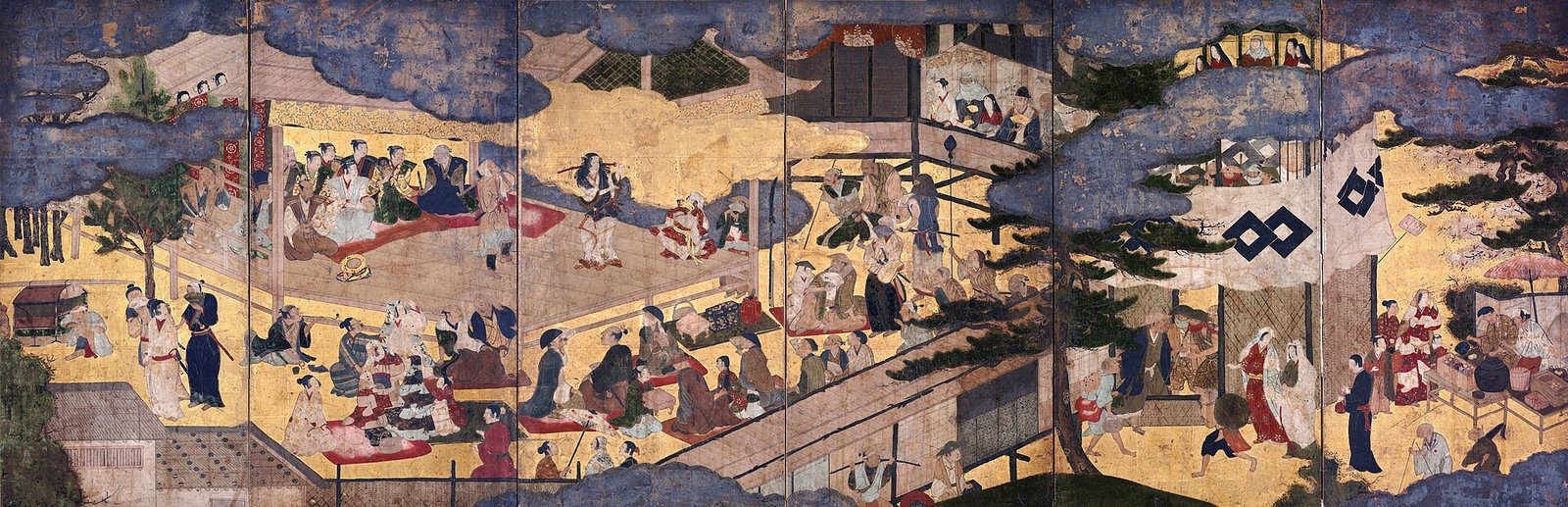
Music also distinguishes Okuni’s performances from those of her successors. In Kyoto National Museum’s Okuni Kabuki screen, the musicians play flutes and drums, with no shamisen shown. The later women’s troupes used the shamisen, a new instrument of the period.
The museum’s screen is itself a substantial object. Catalogued as AK546, it is a seventeenth-century work on gold-leaf paper. The six-panel screen measures 88 × 268 centimetres. Those physical details accompany its depiction of early Kabuki performers and musicians.
Women also continued performing during their exclusion from major licensed Kabuki theatres. They performed in private residences, travelling troupes, and small temporary theatres during the Edo period. The prohibition restricted women’s access to the principal licensed stages, while these other settings remained part of their performance history.
Timeline
- Around 1578: Okuni’s approximate, uncertain birth date.
- 1603: Okuni performs kabuki-odori in Kyoto. Her troupe also appears on Kitano Shrine’s Noh stage.
- Around 1610: Okuni reportedly retires from performing.
- 1615–1629: Women’s Kabuki reaches its strongest period, according to the Japan Arts Council.
- 1629: Women are banned from Kabuki under Tokugawa Iemitsu.
- 1652: Young men’s wakashū-kabuki is also banned.
- 1877: The formal prohibition on women’s Kabuki acting ends in Samuel L. Leiter’s chronology.
- 2005: UNESCO proclaims Kabuki.
- 2008: UNESCO inscribes Kabuki on the Representative List of the Intangible Cultural Heritage of Humanity.
How long did the exclusion last?
In his 1999 academic article, Samuel L. Leiter dates the formal prohibition on women’s Kabuki acting to 1629–1877. That chronology concerns the official restriction. Alongside it, the record of women performing in homes, travelling companies, and temporary theatres shows continued activity beyond the major licensed venues.
Kabuki later received UNESCO recognition, with its 2005 proclamation followed by inscription on the Representative List in 2008. Its history includes both that recognition and the earlier restrictions on performers. Okuni’s place at its beginning keeps a woman central to the account of a theatre in which adult male actors gained prominence.
FAQ
Who was Izumo no Okuni?
Izumo no Okuni was a female dancer and performer credited with founding Kabuki through performances in Kyoto around 1603. Traditional accounts describe her as a former miko, or female shrine attendant, at Izumo Grand Shrine.
Why were women banned from Kabuki?
The Edo shogunate banned women from Kabuki in 1629 on grounds of public morality. The concerns included prostitution associated with women’s troupes and fights between male spectators seeking performers’ attention.
Was Okuni herself removed from the stage by the ban?
Okuni reportedly retired around 1610, before the 1629 prohibition. The ban therefore belongs to the history of the women’s troupes that followed her.
Did women stop performing after 1629?
Women continued performing in private homes, travelling troupes, and small temporary theatres despite their exclusion from major licensed Kabuki theatres. Samuel L. Leiter dates the formal prohibition on women’s Kabuki acting to 1629–1877.
What are onnagata?
Onnagata, also called oyama, are male actors who perform female roles in Kabuki. Adult male Kabuki gained prominence after prohibitions affecting women and young male performers.
Sources
- Wikipedia — Izumo no Okuni en.wikipedia.org
- Kyoto National Museum — Okuni Kabuki Screen kyohaku.go.jp
- Japan Arts Council — Kabuki-Odori www2.ntj.jac.go.jp
- Japan Arts Council — Onna-Kabuki www2.ntj.jac.go.jp
- Kokugakuin University — Female kabuki performers barred by Edo shogunate kokugakuin.ac.jp
- Web Japan / Embassy of Japan — Kabuki az.emb-japan.go.jp
- Nippon.com — The Origins of Kabuki nippon.com
- Samuel L. Leiter, Comparative Drama / Western Michigan University — From Gay to Gei scholarworks.wmich.edu
- UNESCO — Kabuki theatre ich.unesco.org
Image: Okuni kabuki byobu-zu.jpg — Unknown authorUnknown author (probably an artist of the Hase, Public domain