Rosa Parks was a civil rights activist whose refusal to leave a bus seat helped spark the Montgomery Bus Boycott. On December 1, 1955, she was arrested after remaining seated when a driver ordered her to move for white passengers. She was 42 and had already spent years working for Black Americans’ rights.
If you know Parks through that single bus journey, her wider story adds essential context. It includes attempts to register to vote, work as an organizational secretary, and decades of public service after Montgomery. Her arrest became a turning point through a sustained boycott and a separate legal challenge to bus segregation.
Where was Rosa Parks from?
Rosa Parks was born in Tuskegee, Alabama, on February 4, 1913. Her birth name was Rosa Louise McCauley. Her mother, Leona, was a teacher. Her father, James, was a carpenter.
In December 1943, Parks was elected secretary of the Montgomery branch of the NAACP, an organization defending Black Americans’ rights. That election came years before the bus protest. It places her refusal within an established record of civil rights work.
Her efforts also included securing her own right to vote. Beginning in 1943, she applied three times to overcome Alabama’s voter registration barriers. She finally registered in 1945. The woman arrested on the bus had already experienced how persistence could be necessary to exercise a basic right.
Who was Rosa Parks’s husband?
Rosa McCauley married Raymond Parks on December 18, 1932. Raymond was a barber and a civil rights activist. Their marriage therefore belongs to the story of her life before the Montgomery boycott, as well as the years that followed it.
In 1957, Rosa moved to Detroit, Michigan, with Raymond and her mother. Decades later, the names Rosa and Raymond Parks appeared together in the institute she founded for young people. Its establishment extended her work beyond the protest for which she became known.
Rosa Parks’s bus protest: where did it happen?
The protest happened on a municipal bus in Montgomery, Alabama. On December 1, 1955, Parks boarded after working at the Montgomery Fair department store, where she was a seamstress. She was traveling home.
The first 10 seats on Montgomery buses were reserved for white passengers. Parks sat in the first row immediately behind those seats. This detail helps you understand the dispute: her seat was behind the section already set aside for white riders.
Driver James Blake ordered four Black passengers in her row to stand so white passengers could sit. Three obeyed. Parks stayed seated. Her refusal to follow that instruction led to her arrest that day.
The police record described the charge as failing to obey the bus driver’s orders. That wording connects the arrest to the authority exercised over passengers during an ordinary journey. For an everyday-life connection, think about your commute: Parks was returning from work when a seating order turned her trip home into a confrontation over racial discrimination.
Why did Rosa Parks refuse to move?
Parks later rejected the explanation that physical exhaustion caused her refusal. In her 1992 book, Rosa Parks: My Story, she explained that what she was tired of was giving in. Her own account challenges a version of the event centered only on a tiring workday.
Her earlier activism gives that explanation context. She had served as the NAACP branch secretary since 1943 and had persisted through three voter registration applications. The bus refusal followed years of encounters with racial barriers.
There was also an earlier encounter with the same driver. In 1943, Parks had confronted James F. Blake over his demand that she reboard a bus through the rear door. Their confrontation in 1955 therefore had a history reaching back to that earlier journey.
Why did her bus protest make history?
After Parks’s arrest, the Women’s Political Council distributed leaflets in Montgomery. They called on people to avoid buses on December 5, 1955, the day of her trial. Her individual refusal became the focus of organized action involving other passengers.
The Montgomery Improvement Association formed on December 5. Martin Luther King Jr. was elected its president. The boycott helped bring the 26-year-old King to national attention, linking Parks’s arrest with the emergence of another widely recognized civil rights leader.
Participants kept away from municipal buses by walking, sharing vehicles, and finding other ways to travel. Those practical arrangements mattered throughout a boycott that the National Archives describes as lasting 381 days. Refusing bus travel required repeated decisions about how to make everyday journeys.
A separate court case, Browder v. Gayle, challenged compulsory racial segregation on buses. It was distinct from Parks’s appeal against her own conviction. Keeping these proceedings separate helps you follow how the protest and the legal fight contributed to the same struggle.
On November 13, 1956, the United States Supreme Court upheld the ruling against compulsory bus segregation in Browder v. Gayle. After the court order ending segregation reached Montgomery, King called for the boycott to end on December 20.
On the morning of December 21, King boarded a desegregated Montgomery bus with Ralph Abernathy, E. D. Nixon, and Glenn Smiley. Parks’s refusal had helped set a sustained campaign in motion. Organized participation and the separate court case carried that campaign toward changes on the buses themselves.
Timeline
- February 4, 1913: Rosa Louise McCauley was born in Tuskegee, Alabama.
- December 18, 1932: She married Raymond Parks, a barber and civil rights activist.
- December 1943: She became secretary of the NAACP’s Montgomery branch.
- 1945: She registered to vote after three applications.
- December 1, 1955: She was arrested after refusing to leave her Montgomery bus seat.
- December 5, 1955: The Montgomery Improvement Association formed.
- November 13, 1956: The United States Supreme Court upheld the ruling in Browder v. Gayle.
- December 20, 1956: King called for the boycott to end after the court order reached Montgomery.
- December 21, 1956: King boarded a desegregated Montgomery bus with Ralph Abernathy, E. D. Nixon, and Glenn Smiley.
- 1957: Parks moved to Detroit with her husband and mother.
- 1965–1988: She worked in Congressman John Conyers’s office.
- February 1987: She cofounded the Rosa and Raymond Parks Institute for Self Development.
- December 1, 2000: The Rosa Parks Library and Museum opened in Montgomery.
- October 24, 2005: Parks died at her Detroit home, aged 92.
Details you won’t find in guidebooks
Parks’s voice reached radio audiences while the boycott was still underway. An interview she gave Sidney Rogers aired on Pacifica radio stations in 1956. It belongs to the period of the campaign itself, before the boycott had ended.
The boycott also brought personal costs. Parks lost her seamstress job and received death threats. Her move to Detroit in 1957 followed those consequences, adding a difficult chapter to the account of the Montgomery campaign.
Her later work included helping homeless people find housing. She did this while employed in Congressman John Conyers’s office between 1965 and 1988. That long period of service shows how much of her working life came after the bus protest.
In February 1987, Parks and Elaine Eason Steele founded the Rosa and Raymond Parks Institute for Self Development. The institute focused on young people. It added another form of organized work to a life that had already included voter registration efforts, the NAACP, and housing assistance.
Where is the Rosa Parks museum?
Troy University established the Rosa Parks Library and Museum in Montgomery at the site of her arrest. It opened on December 1, 2000, with Parks attending. The location connects the institution directly to the event it commemorates.
If you are placing Parks’s story on a map, distinguish three places. Tuskegee was her birthplace. Montgomery was the setting of her bus refusal and the boycott. Detroit became her home after the move in 1957 and remained the city where she died.
Rosa Parks’s death and public remembrance
Rosa Parks died of natural causes at her home in Detroit on October 24, 2005. She was 92. Her life had continued for decades beyond the Montgomery protest, including her congressional office work and the creation of her institute.
On October 30–31, 2005, her body lay in the rotunda of the United States Capitol in Washington for public viewing. This public remembrance followed a life whose best-known moment remained her refusal to leave a Montgomery bus seat.
Is there a Rosa Parks movie?
Angela Bassett portrayed Parks in the 2002 film The Rosa Parks Story, directed by Julie Dash.
FAQ
Where was Rosa Parks from?
Rosa Parks was born Rosa Louise McCauley in Tuskegee, Alabama, on February 4, 1913.
Where did Rosa Parks refuse to leave her bus seat?
She refused to leave her seat on a municipal bus in Montgomery, Alabama, on December 1, 1955.
Who was Rosa Parks’s husband?
Her husband was Raymond Parks, a barber and civil rights activist. They married on December 18, 1932.
When and how did Rosa Parks die?
Rosa Parks died of natural causes at her home in Detroit on October 24, 2005. She was 92.
Sources
- National Park Service — Rosa Parks nps.gov
- Rosa and Raymond Parks Institute — Biography rosaparks.org
- National Archives — An Act of Courage archives.gov
- Troy University — About Rosa Parks troy.edu
- Stanford University — Montgomery Bus Boycott kinginstitute.stanford.edu
- Stanford University — To Homer Greene kinginstitute.stanford.edu
- Wikipedia — Rosa Parks en.wikipedia.org
- Vikipedi — Rosa Parks tr.wikipedia.org
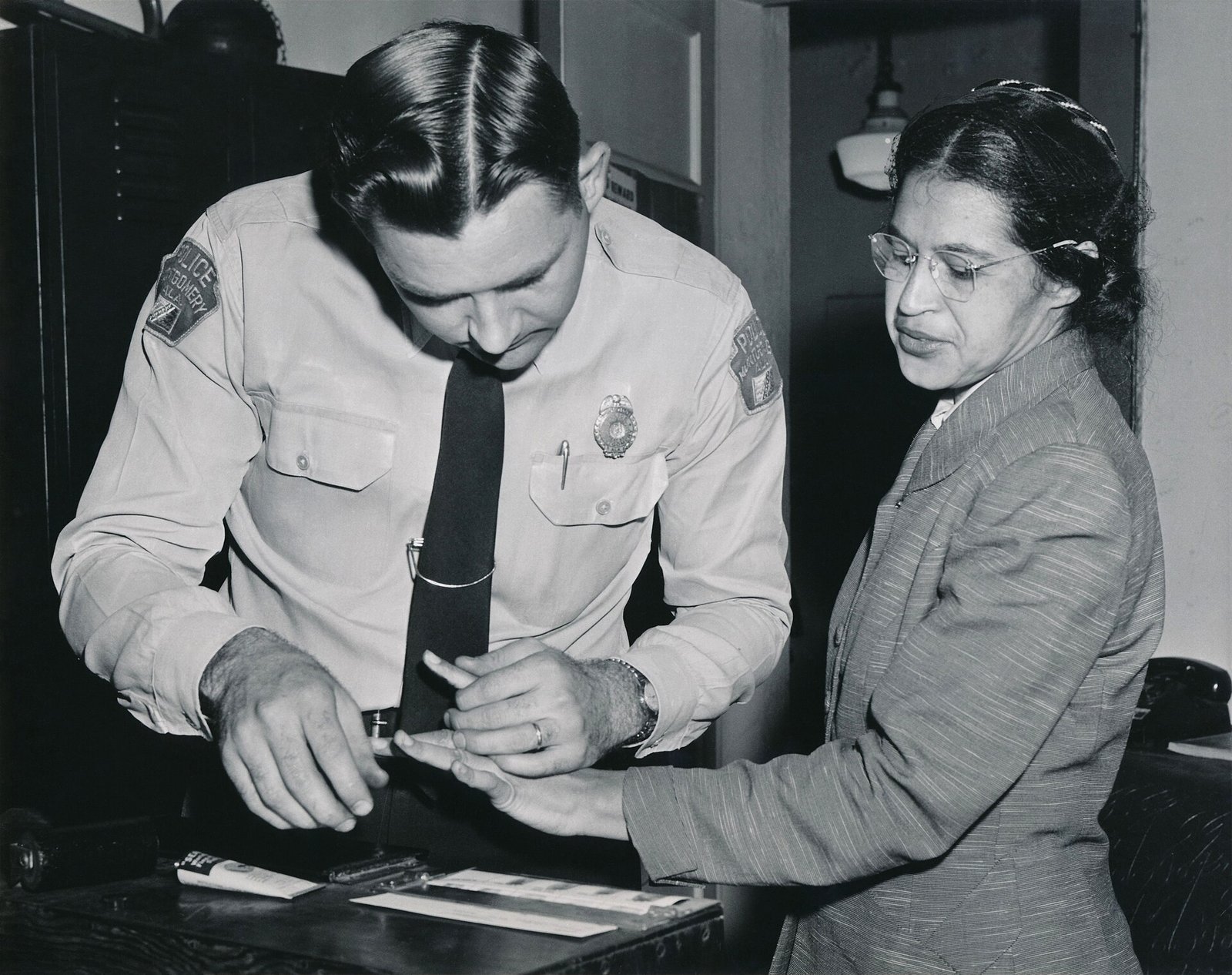
Image: Rosa Parks being fingerprinted by Deputy Sheriff D.H. Lackey after being arrested on February 22, 1956, during the Montgomery bus boycott.jpg — Gene Herrick for the Associated Press; restored by Adam Cuer, Public domain