Bali remained predominantly Hindu because an established Hindu-Buddhist and local religious culture continued through independent Hindu kingdoms, temple communities and agricultural institutions. Court circles arriving from Java during Majapahit’s collapse strengthened traditions already present for centuries. Modern religious reforms and organization later secured Hinduism’s recognition within Indonesia.
Why did temples matter alongside kings? Bali’s subak irrigation system connects religious institutions with the water needed for rice cultivation. To understand how Hinduism survived, you need to follow that connection, the island’s relationships with Muslim neighbors, and the reforms that reshaped Hindu identity in the twentieth century.
Where is Bali located in Indonesia?
Bali lies in Indonesia’s Lesser Sunda Islands, between Java to the west and Lombok to the east. Its administrative center is Denpasar. This position places Java, whose courts strongly influenced Balinese history, directly beside the island.
BPS population registration figures for 2024 recorded 4,375,263 residents in Bali province. Of these, 3,780,272 were Hindu and 449,805 were Muslim. That represents approximately 86.4 percent Hindu and 10.3 percent Muslim. Bali’s Hindu majority therefore coexists with a Muslim population within the province itself.
How early did Hinduism reach Bali?
Hinduism was present in Bali long before Majapahit’s collapse in the early sixteenth century. Early inscriptions show Buddhism and Shiva-centered Hindu worship existing together by the beginning of the tenth century. The island’s religious history already involved several traditions.
The Blanjong pillar inscription, dated to around 914 during the reign of Sri Kesari Warmadewa, records Bali’s name as Vāli-dvīpa. It is an early documentary marker of the island’s history. Together with evidence of Hindu and Buddhist worship, it places Bali’s religious past centuries before Majapahit established control.
Around 989, the Javanese princess Mahendradatta married the Balinese ruler Udayana Warmadewa. Their marriage strengthened Hindu and Javanese cultural influences on Bali. Connections with Java thus developed well before the later arrival of court officials seeking refuge.
Yale eHRAF describes Balinese Hinduism as taking shape upon a local Malayo-Polynesian cultural foundation influenced by Hinduism and Buddhism. If you picture it simply as a religion transferred from Java, you miss the local traditions involved in its formation.
What did Majapahit change in Bali?
The Hindu-Buddhist Majapahit Empire, based in eastern Java, established control over Bali in 1343. Its conquest added another layer of Javanese political and cultural influence to an island where Hindu worship already existed.
During Majapahit’s dissolution in the early sixteenth century, court officials took refuge in Balinese kingdoms. They strengthened Indian-influenced literary and administrative traditions. Their arrival mattered because they brought court practices into an existing religious and cultural setting.
After Majapahit’s breakup, Bali became a political landscape of independent Hindu kingdoms. These kingdoms were among the institutions that sustained Hindu religious life. The survival of Hinduism therefore involved continuing political structures as well as the movement of people from Java.
Anthropologist Thomas Reuter challenges genealogical accounts that attribute Balinese civilization mainly to Majapahit’s fourteenth-century conquerors. He emphasizes the older local heritage of Bali Aga communities and their objections to those accounts. Majapahit’s influence was substantial, but it does not explain every strand of Balinese tradition.
Why did Islam spread in Java while Hindu kingdoms continued in Bali?
Archaeologist Muhammad Chawari traces Islam’s spread into Majapahit territory through ports on eastern Java’s northern coast. Muslim merchants’ importance in port commerce supported that spread. Trade was therefore part of the religious changes taking place in Majapahit’s world.
Bali’s subsequent history included independent Hindu kingdoms, but those kingdoms were not detached from Muslim states. Historian Adrian Vickers describes warfare, accommodation and cultural synthesis between Bali and its Muslim neighbors from the early sixteenth century until the Dutch conquest.
This evidence complicates the picture of Bali as an isolated Hindu refuge. Hindu political institutions continued while relationships with Muslim neighbors included both conflict and exchange. The Dutch conquest, carried out in stages between 1846 and 1908, marked the later boundary of the period examined by Vickers.
How did water temples help Hinduism survive?
UNESCO dates the origins of subak, Bali’s communal irrigation system organized around temples, to the ninth century. This places its beginnings before Majapahit’s rule. Religious institutions were already connected to the organization of agricultural water.
Since the eleventh century, networks of water temples have managed rice-terrace ecology across entire river basins. Their role extended beyond individual fields. The temple network linked religious life to the shared management of water needed for cultivation.
Here is the everyday-life connection: rice cultivation depended on irrigation, and subak organized that irrigation around temples. When you consider how religious traditions endure, this link matters. Balinese Hindu life was connected to the practical work of maintaining an agricultural landscape.
The philosophy associated with subak, Tri Hita Karana, emphasizes harmony among the spiritual world, people and nature. These relationships connect religious ideas with communal and environmental responsibilities. They help explain why temples belong within the history of irrigation as well as worship.
UNESCO identifies several traditions behind Bali’s water temples: Shaivasiddhanta and Samkhya Hinduism, Vajrayana Buddhism and Austronesian cosmology. The temples preserve a history of interacting religious traditions. Bali’s five-component subak cultural landscape, covering 19,519.9 hectares, entered the World Heritage List in 2012.
How did Hinduism gain recognition in modern Indonesia?
Continuity did not remove the need for modern religious organization. According to research published in Religions, Bali’s ritual-centered belief system was classified in 1952 as adat, or local custom, rather than an official religion. It was placed in the category belum beragama.
Balinese reformers responded to the state’s requirement for a single supreme God by emphasizing Sang Hyang Widhi Wasa. They also systematized doctrine, sacred texts and worship. Religious survival in this period included changing how Balinese belief was defined and presented institutionally.
In 1958, mobilization by local religious organizations and support from President Sukarno helped establish a unit for Balinese Hinduism within Indonesia’s Ministry of Religious Affairs. On 23 February 1959, Bali’s political and religious elites founded Parisada Dharma Hindu Bali.
In 1963, the ministry unit became the Bureau of Balinese Hindu Religious Affairs. The historical account published by Gadjah Mada University describes this institutional stage as consolidating official recognition. Recognition developed through successive organizational changes.
At its 1964 congress, Parisada Dharma Hindu Bali changed its name to Parisada Hindu Dharma to include Hindu communities outside Bali. The explanation accompanying PNPS Regulation No. 1 of 1965 used Agama Hindu rather than a specifically Balinese designation. Hindu identity was thus framed beyond the island.
Timeline
- Ninth century: Origins of subak irrigation, according to UNESCO’s dating.
- Around 914: The Blanjong inscription records Bali as Vāli-dvīpa.
- Around 989: Mahendradatta marries Udayana Warmadewa.
- 1071–1072: Inscriptions mention kasuwakan and Subak Rawas.
- 1343: Majapahit establishes control over Bali.
- Early sixteenth century: Court circles seek refuge as Majapahit dissolves; independent Hindu kingdoms continue in Bali.
- 1846–1908: The Dutch conquer Bali in stages.
- 1952: Balinese beliefs face classification as local custom rather than an official religion.
- 1958–1959: A ministry unit is established, followed by Parisada Dharma Hindu Bali.
- 1963–1965: Institutional recognition strengthens; Parisada broadens its name; Agama Hindu appears in the regulation’s explanation.
- 2012: The subak cultural landscape enters UNESCO’s World Heritage List.
- 2024: Population registration records approximately 86.4 percent of Bali province’s residents as Hindu.
Details you won’t find in guidebooks
Reuter records members of southern Balinese dynasties who claim Majapahit ancestry attending ceremonies at mountain temples held by Bali Aga communities. These include Pucak Penulisan, Balingkang and Batur. Their participation shows the continuing importance of local sacred institutions within relationships shaped by competing ancestry accounts.
Irrigation also left precise documentary traces. The Pandak Badung inscription of 1071 contains the term kasuwakan. The Klungkung inscription of 1072 names Subak Rawas. These references give the history of communal irrigation specific textual anchors.
The standardized Puja Tri Sandhya prayer spread through teaching schoolchildren during the 1950s and 1960s. Something now perceived as an old tradition was also shaped by modern religious education. From 2001, many banjar communities began broadcasting it through loudspeakers at 06:00, 12:00 and 18:00.
FAQ
Why is Bali Hindu?
Hinduism had deep roots in Bali before Majapahit’s collapse. Independent Hindu kingdoms, temple-linked irrigation communities and later religious reforms helped sustain it.
Where is Bali located?
Bali is an Indonesian island in the Lesser Sunda Islands, between Java to the west and Lombok to the east. Its administrative center is Denpasar.
Did Hinduism reach Bali after Majapahit collapsed?
No. Early inscriptions show Buddhism and Shiva-centered Hindu worship in Bali by the early tenth century. Court officials arriving during Majapahit’s dissolution strengthened existing traditions.
What percentage of Bali is Hindu?
BPS population registration figures for 2024 recorded 3,780,272 Hindus among Bali province’s 4,375,263 residents, approximately 86.4 percent.
Sources
- Turkish Wikipedia — Bali tr.wikipedia.org
- BPS Bali — Population by Religion and Regency/City, 2024–2025 bali.bps.go.id
- English Wikipedia — Bali en.wikipedia.org
- Yale eHRAF World Cultures — Balinese ehrafworldcultures.yale.edu
- Muhammad Chawari, Berkala Arkeologi — Pengaruh Islam sebagai Salah Satu Penyebab Mundurnya Kerajaan Majapahit ejournal.brin.go.id
- Thomas Reuter, ANU Press — Origin and Precedence press-files.anu.edu.au
- Adrian Vickers, Cornell eCommons — Hinduism and Islam in Indonesia: Bali and the Pasisir World ecommons.cornell.edu
- UNESCO — Cultural Landscape of Bali Province whc.unesco.org
- Bali Provincial Agriculture and Food Security Department — The Origin of the Balinese Subak System distanpangan.baliprov.go.id
- Religions — A Balinese ‘Call to Prayer’ mdpi.com
- Gadjah Mada University CRCS — Agama Hindu dan Adat Bali: Rekognisi dan Kontestasi crcs.ugm.ac.id
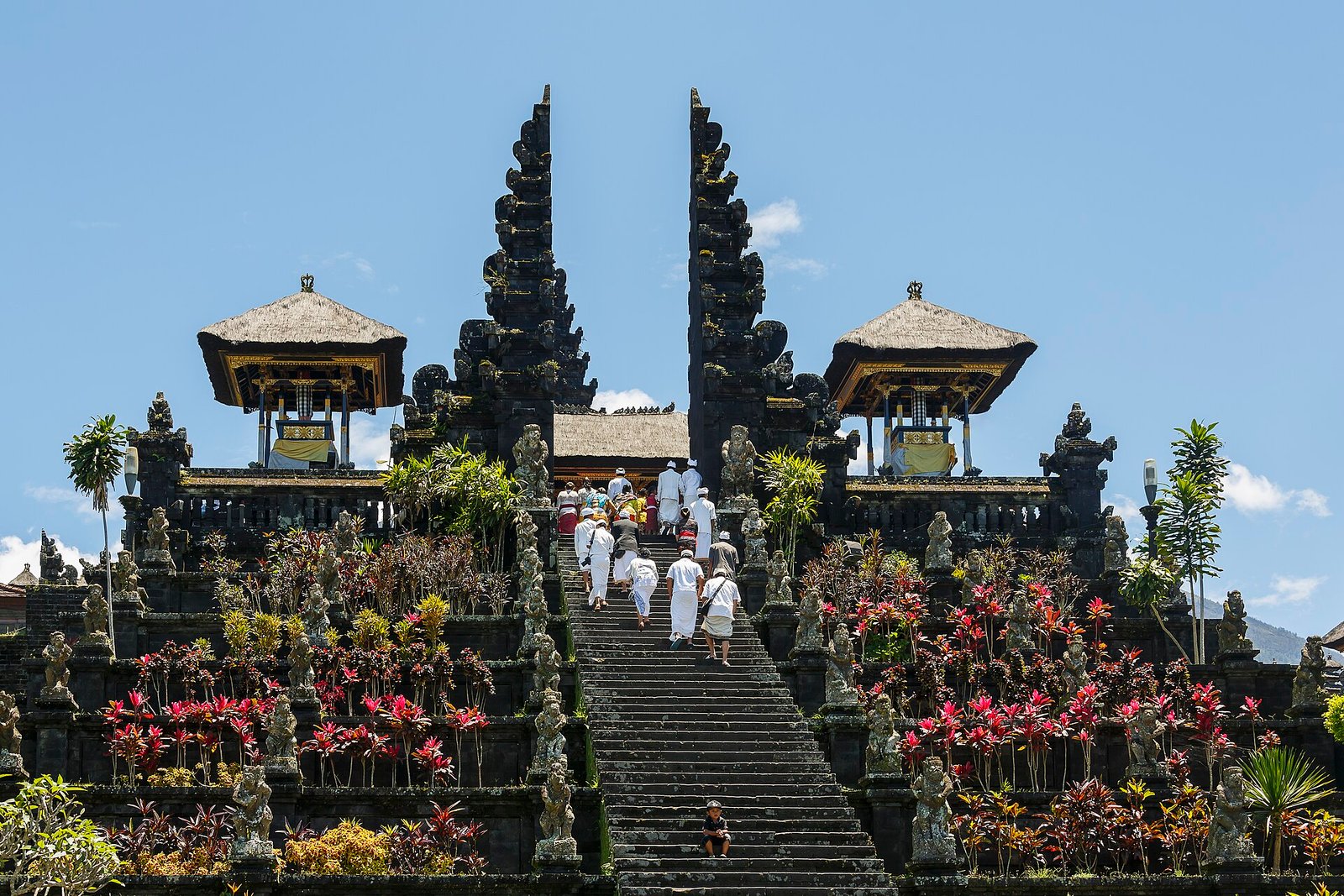
Image: Besakih Bali Indonesia Pura-Besakih-02.jpg — CEphoto, Uwe Aranas, CC BY-SA 3.0