Mussolini invaded Ethiopia to avenge Italy’s defeat at Adwa in 1896, expand its colonial empire and obtain resources, settlement land and markets. He used the December 1934 Walwal border clash as a justification. The invasion began on 3 October 1935 and ended in Italian victory in May 1936, although Ethiopian resistance continued.
How did a border confrontation become a conquest involving mustard gas and attacks on hospitals? If you follow the campaign from Eritrea and Italian Somaliland to Addis Ababa, you can see how economic ambitions, military advantages and ineffective sanctions connected. The consequences extended beyond the capture of the Ethiopian capital.
Why did the Second Italo-Ethiopian War start?
Italy’s defeat at Adwa on 1 March 1896 formed part of the background to Mussolini’s decision. Ethiopia had defeated the Italian army. The desire to erase that defeat’s legacy combined with the ambition to enlarge Italy’s colonial possessions. Revenge and expansion reinforced each other.
Mussolini also expected material gains. Ethiopia would provide access to natural resources, land for Italian settlers and a larger market for Italian goods. These expectations made conquest an economic project as well as a military one. The intended benefits included both territory and customers.
Diplomacy created an opening in 1934–1935. Britain and France needed Italy to help balance Hitler. That need gave Mussolini an opportunity to pursue expansion in Africa. Their interest in Italy’s European role formed part of the setting in which he targeted Ethiopia.
The immediate justification came from Walwal. In December 1934, a border clash occurred between Ethiopia and Italian Somaliland. Mussolini used it as grounds for intervention. The clash supplied a pretext for an invasion whose background included Adwa, colonial expansion and economic expectations.
Second Italo-Ethiopian War map: where did Italy attack?
To understand a map of the war, start with two directions. On 3 October 1935, Emilio De Bono’s forces invaded from Eritrea in the north. Rodolfo Graziani’s forces attacked from Italian Somaliland in the southeast. Ethiopia therefore faced advances from separate colonial territories.
Italy’s main axis of advance targeted Ethiopia’s central high plateau. Its temperate climate and agricultural importance made it a significant objective. If you trace the campaign geographically, keep that plateau in view alongside the two invasion routes. The direction of advance connected military operations with territory valued for agriculture.
Addis Ababa became the decisive political destination. Italian troops captured the capital on 5 May 1936. Yet a map showing the capital under Italian control cannot, by itself, explain the war’s outcome. Fighting continued after Italian forces entered the city.
Second Italo-Ethiopian War weapons: what gave Italy an advantage?
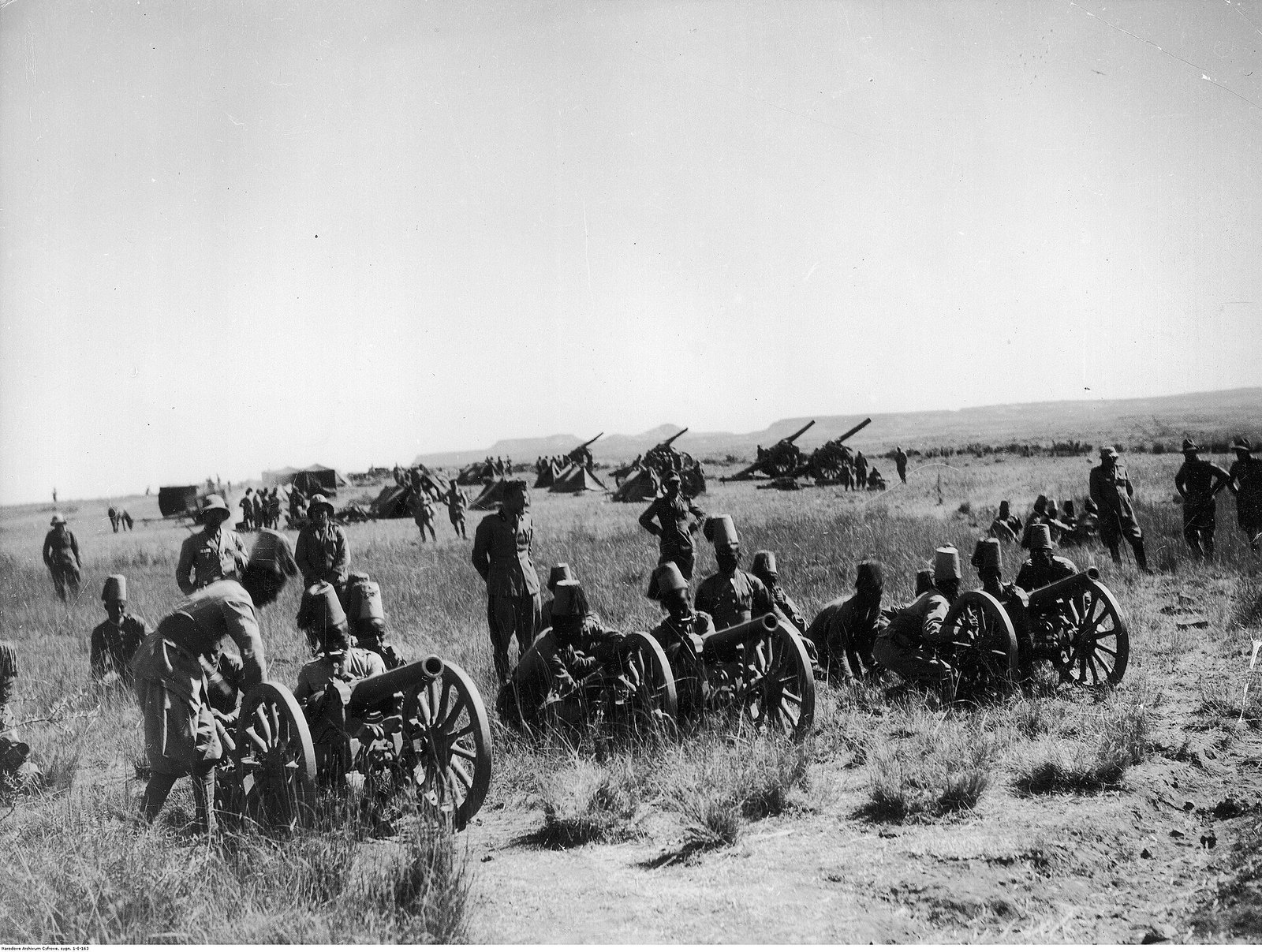
Italy deployed more modern military equipment, tanks and a more developed air force against Ethiopian forces. The Turkish Wikipedia strength table lists 595 Italian aircraft against 13 Ethiopian aircraft. Those figures illustrate the scale of the air imbalance, alongside Italy’s other equipment advantages.
From December 1935, Italy also used chemical weapons. Mustard gas was delivered through aerial bombs and later through spraying equipment. Chemical warfare became part of the campaign that carried Italian forces toward victory. It must therefore remain central to any explanation of how the invasion unfolded.
The effects reached medical care. Two representatives sent to Ethiopia by the International Committee of the Red Cross witnessed Italian aircraft using mustard gas and bombing hospitals. Their observations connect the air campaign directly with attacks affecting places where wounded people received treatment.
Rainer Baudendistel’s account identifies 17 attack incidents involving Red Cross medical facilities. Seven were direct bombings. These incidents show why an account limited to troop movements and captured territory leaves out a substantial part of the war’s violence.
Second Italo-Ethiopian War battles: how did the campaign unfold?
Ethiopian forces disrupted the invasion during the Christmas Offensive in December 1935. They temporarily cut some Italian communications and supply lines. This interruption matters when you assess the campaign: Italy’s equipment advantage did not prevent Ethiopian forces from obstructing its advance.
The Battle of Shire took place from 29 February to 2 March 1936. It was among the engagements in which Italy used chemical weapons. Shire links the sequence of battles with the broader use of mustard gas during the campaign.
At Maychew on 31 March 1936, Ethiopian forces launched an offensive under Haile Selassie’s direction. Italian forces stopped it. The defeat preceded the capture of Addis Ababa in May, placing Maychew near the end of the campaign’s principal sequence of fighting.
Why did League of Nations sanctions fail to stop Italy?
League of Nations economic sanctions against Italy took effect on 18 November 1935. They followed the October invasion but failed to stop the conquest. Their limits are essential to understanding why international action did not prevent Italy from taking Addis Ababa.
The sanctions did not cover oil. Britain also kept the Suez Canal open to Italian shipping. Economic penalties therefore coexisted with these significant exceptions. The invasion continued, including the use of chemical weapons from December 1935 and the advance into the capital the following May.
Haile Selassie addressed the League of Nations General Assembly on 30 June 1936. He condemned the Italian attack after Addis Ababa had fallen and Italian East Africa had been established. His speech followed the failure of sanctions to prevent the conquest.
Timeline
- 1 March 1896: Ethiopia defeated the Italian army at Adwa.
- 1928: Italy and Ethiopia signed a friendship treaty.
- December 1934: The Walwal border clash occurred.
- 3 October 1935: Italy invaded from Eritrea and Italian Somaliland.
- 18 November 1935: League of Nations economic sanctions took effect.
- December 1935: Ethiopia launched the Christmas Offensive; Italy began using chemical weapons.
- 29 February–2 March 1936: The Battle of Shire took place.
- 31 March 1936: Italian forces defeated the Ethiopian offensive at Maychew.
- 5 May 1936: Italian troops captured Addis Ababa.
- 9 May 1936: Mussolini proclaimed the Italian Empire.
- 1 June 1936: Italian East Africa was established.
- 30 June 1936: Haile Selassie addressed the League of Nations.
Second Italo-Ethiopian War casualties: why are the figures disputed?
An Italian estimate placed Ethiopian battle deaths at 70,000. Ethiopia’s 1946 submission gave 275,000. Angelo Del Boca considered the second figure exaggerated. These are disputed estimates, so presenting either as an uncontested total would conceal the disagreement.
The period being counted also matters. Deaths during the occupation require separate accounting from battle deaths in the 1935–1936 campaign. Since fighting continued after the capture of Addis Ababa, the campaign’s conventional endpoint does not provide a complete boundary for the conflict’s human cost.
Details you won’t find in guidebooks
The invasion violated the 1928 Italy–Ethiopia Friendship Treaty. That agreement had provided for at least 20 years of peace between the countries. The October 1935 attack therefore broke an existing commitment, as well as beginning the military campaign.
In 1936, some mobile medical units removed their protective Red Cross markings. They believed the markings made them targets for Italian aircraft. Alongside the recorded attacks on medical facilities, this decision reveals how those providing care assessed the danger from above.
The Ethiopian Red Cross requested gas masks and protection instructions on 23 March 1936. The request was discussed in the British House of Commons on 25 May. Those dates place the appeal during the fighting and the parliamentary discussion after Addis Ababa’s capture.
For readers interested in Turkey, Vehip Pasha provides a direct connection. The Ottoman commander served in the Ethiopian army during the 1935–1936 war. His involvement increased the Turkish press’s interest in the conflict.
Who won the Second Italo-Ethiopian War, and what followed?
Italy won the October 1935–May 1936 campaign. On 9 May 1936, Mussolini proclaimed the Italian Empire from the balcony of Palazzo Venezia in Rome. On 1 June, Ethiopia, Eritrea and Italian Somaliland were combined as Italian East Africa.
The empire also demanded substantial spending. Expenditure directed toward Italian East Africa during 1935–1940 is estimated at about 20–25 percent of Italian public spending. If you compare the project with an everyday household budget, set the promised gains beside the cost: Mussolini sought resources, land and markets, while the empire absorbed public money.
Victory did not end Ethiopian resistance. Ivan Arreguín-Toft’s study stresses that Italy’s entry into Addis Ababa in May 1936 did not end the fighting. The capture of the capital, the declaration of empire and the continuation of conflict belong together in any summary of the consequences.
FAQ
Why did the Second Italo-Ethiopian War start?
Mussolini wanted colonial expansion, resources, land for Italian settlers and markets for Italian goods. Italy’s defeat at Adwa in 1896 also shaped the decision. He used the December 1934 Walwal border clash as a justification for intervention.
Who won the Second Italo-Ethiopian War?
Italy won the October 1935–May 1936 campaign and captured Addis Ababa on 5 May 1936. However, the capture of the capital did not end Ethiopian resistance.
What weapons did Italy use in Ethiopia?
Italy used more modern military equipment, tanks and a more developed air force. From December 1935, it also used chemical weapons, delivering mustard gas through aerial bombs and later spraying equipment.
How many Ethiopians died in the war?
The figures are disputed. An Italian estimate gave 70,000 Ethiopian battle deaths, while Ethiopia’s 1946 submission gave 275,000. Angelo Del Boca considered the latter figure exaggerated. Deaths during the occupation require separate accounting.
Sources
- Vikipedi — II. İtalya-Habeşistan Savaşı tr.wikipedia.org
- SIPRI — The use of chemical weapons in the 1935–36 Italo-Ethiopian War sipri.org
- Business History Review — Radical Mercantilism and Fascist Italy’s East African Empire cambridge.org
- Wikipedia — Second Italo-Ethiopian War en.wikipedia.org
- ICRC — 1919–1939: consolidation among crises icrc.org
- International Review of the Red Cross — Medical care in armed conflict: Perpetrator discourse in historical perspective international-review.icrc.org
- Yüksel Nizamoğlu — İtalya-Habeşistan Savaşı, Vehip Paşa ve Türkiye dergipark.org.tr
- Hansard — Italy and Abyssinia, 25 May 1936 api.parliament.uk
- Cambridge University Press — Italy in Ethiopia: the Italo-Ethiopian War, 1935–1940 cambridge.org
Image: Italian artillery during the Second Italo-Ethiopian War.jpg — Unknown authorUnknown author, Public domain