Thirty Years’ War summary: why did it begin?
The Thirty Years’ War began in 1618 because religious divisions and struggles over political rights erupted into rebellion in Bohemia. It expanded as the Habsburgs and rival European powers pursued their own interests. Fighting continued until the Peace of Westphalia in 1648. Most of the war took place within the Holy Roman Empire.
Religion mattered, but it cannot explain every alliance. Catholic France supported Protestant Sweden and later declared war on Spain. If you follow both religious disputes and political rivalry, the conflict becomes easier to understand. Its causes involved faith, authority, property, and competition between ruling houses.
Why did religious and political tensions become war?
The Peace of Augsburg of 1555 recognized Catholicism and Lutheranism. It excluded Calvinism. Growing Calvinist communities therefore remained outside that religious settlement. This legal gap added to tensions over which confessions could hold a recognized place within the empire.
Around 1600, religious divisions and political conflicts intensified. The German Historical Museum identifies both as causes of the war. Foreign powers subsequently intervened for their own political interests. A dispute within the empire thus became connected to wider European competition.
In Bohemia, opposition focused on Ferdinand, a supporter of the Counter-Reformation whose kingship was at issue in 1617. The removal of Protestants from office sharpened the conflict. Religious allegiance and access to political authority were closely connected in the crisis that followed.
Where did the Thirty Years’ War begin?
The immediate starting point was Prague Castle in Bohemia. On 23 May 1618, Protestant nobles threw two Habsburg governors and their secretary from a window. This act triggered the Bohemian rebellion and the beginning of the war.
The rebellion suffered a decisive defeat in November 1620. Imperial and Catholic League armies defeated the Bohemian rebels at White Mountain, near Prague. The uprising collapsed. Yet the defeat did not end the wider conflict, which continued to draw in other powers.
The Thirty Years’ War in Europe, 1618–1648
The principal participants included the Habsburg emperors, Spain, and Catholic forces led by Bavaria. Their opponents included the Bohemian rebels and various German principalities. Denmark, Sweden, and France intervened at different stages. These changing participants explain why the war is best understood as a series of connected conflicts.
Denmark’s Christian IV fought against the Holy Roman Empire between 1625 and 1629. In March 1629, Emperor Ferdinand II issued the Edict of Restitution. It demanded the return of property taken from the Catholic Church after 1555. The decree deepened disputes over religion and ownership.
There is an everyday-life connection here: think of a dispute over who owns a property and who receives its income. Ferdinand’s edict made those questions part of the religious struggle. Westphalia later addressed religious property and revenues by choosing a specific reference date.
Sweden intervened directly in 1630. Gustavus Adolphus landed in Pomerania with about 18,000 soldiers. In September 1631, the Swedish army defeated Tilly’s army at Breitenfeld. That victory changed the military balance. Gustavus Adolphus was killed at Lützen in 1632.
France declared war on Spain in May 1635. This intervention expanded the conflict around French-Habsburg rivalry. You can see why describing the whole war as a simple contest between Catholics and Protestants misses a central feature: Catholic France opposed Habsburg power.
Thirty Years’ War map: where to place the conflict
Start a map of the war with Bohemia and Prague. Add White Mountain near Prague, then Pomerania, where the Swedish army landed. Breitenfeld and Lützen mark major events in the Swedish intervention. The Holy Roman Empire forms the main geographical setting for these connected campaigns.
A map of the peace needs different places. Münster and Osnabrück were the locations of its two principal treaties. Pomerania, Magdeburg, and Alsace help explain the territorial settlement. These places connect the military struggle to the distribution of territory and rights in 1648.
Thirty Years’ War timeline
- 1555: The Peace of Augsburg recognized Catholicism and Lutheranism.
- 23 May 1618: Habsburg officials were thrown from a window in Prague, triggering the Bohemian rebellion.
- November 1620: The Bohemian rebels lost the Battle of White Mountain.
- 1625–1629: Christian IV of Denmark fought against the empire.
- March 1629: Ferdinand II issued the Edict of Restitution.
- 1630: Gustavus Adolphus landed in Pomerania with the Swedish army.
- September 1631: Sweden won at Breitenfeld.
- 1632: Gustavus Adolphus died at Lützen.
- May 1635: France declared war on Spain.
- 30 January 1648: Spain and the Dutch Republic signed their separate Treaty of Münster.
- 24 October 1648: The Peace of Westphalia ended the Thirty Years’ War.
- 1649–1650: Negotiations at Nuremberg addressed military and financial implementation.
- 1659: The Treaty of the Pyrenees ended the French-Spanish war.
The Thirty Years’ War outside Europe
The connected Dutch-Portuguese struggle extended beyond Europe. In 1624, Dutch forces captured Salvador, a port in Brazil. The attack targeted the Atlantic revenues of the Iberian powers. It shows how conflicts associated with the European wars also involved overseas resources.
Salvador belongs within this wider setting, while the Thirty Years’ War itself was fought mainly in the Holy Roman Empire. Keeping that distinction helps you connect events across the Atlantic without losing sight of the war’s principal theatre.
What was the Thirty Years’ War death toll?
An estimated 4.5–8 million civilians and soldiers died through battle, famine, and disease. The total is uncertain. This range includes deaths beyond the battlefield, so military losses alone cannot describe the human cost.
Evidence from Lützen offers a smaller, physical record. A mass grave discovered in 2011 contained 47 dead people. A study published in 2017 placed their ages between 15 and 50. Firearm injuries predominated among the wounds identified.
Which treaties made the Peace of Westphalia?
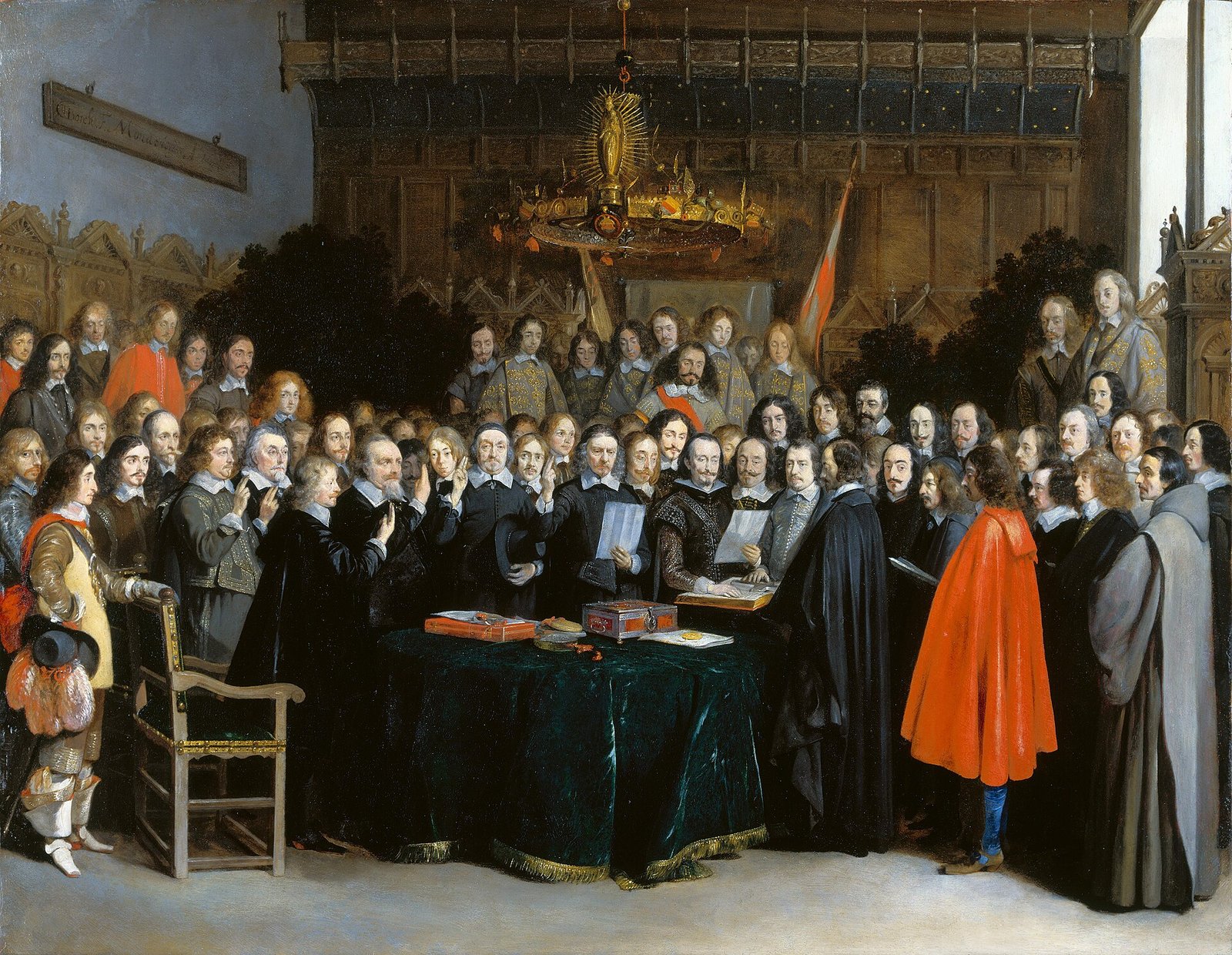
The two principal Westphalian treaties were dated 24 October 1648. One involved the empire and Sweden at Osnabrück. The other involved the empire and France at Münster. The settlement ended the Thirty Years’ War and addressed religious rights, political authority, and territory.
A separate Treaty of Münster had already been signed by Spain and the Dutch Republic on 30 January 1648. It ended the Eighty Years’ War. Spain recognized Dutch independence through that agreement. The shared place name should not obscure the different parties and conflicts involved.
Westphalia recognized the Calvinist Reformed faith alongside Catholicism and Lutheranism. This addressed the exclusion left by Augsburg. For religious property and revenues, the settlement used 1 January 1624 as its reference date. That provision gave disputes over ownership a defined historical benchmark.
Article VIII of the Osnabrück treaty recognized the imperial estates’ right to make foreign alliances. It also imposed limits. Such alliances could not oppose the emperor, the empire, or the peace. The settlement therefore combined recognized political rights with explicit conditions.
How did Westphalia change Europe’s territories?
Sweden received part of Pomerania and other northern German territories. Brandenburg gained the other part of Pomerania and rights over Magdeburg. France acquired Habsburg territories and rights in Alsace. Provisions concerning imperial cities there remained open to later disputes over interpretation.
The peace also confirmed the Swiss Confederation’s legal independence from the Holy Roman Empire. Bavaria retained its electoral title. A new electorate was created for the exiled heir of the Palatine dynasty. These arrangements show how the settlement addressed both territorial claims and dynastic standing.
Details you won’t find in guidebooks
All three officials thrown from the Prague Castle window in 1618 survived. The two governors later rose to higher positions in Bohemia’s administration. The incident began a rebellion, yet it did not end their political careers.
Under Cardinal Richelieu, Catholic France agreed to subsidize Protestant Sweden through the Treaty of Bärwalde in 1631. The promised support was 400,000 Reichstaler annually. This financial arrangement gives a concrete measure of cooperation across confessional boundaries.
Signing peace did not settle every practical issue. Disarmament and compensation required further talks at Nuremberg in 1649. Those implementation negotiations concluded in 1650. France and Spain continued fighting until the Treaty of the Pyrenees in 1659.
Did Westphalia create the modern sovereign state system?
Daniel Philpott represents the interpretation that treats Westphalia as a founding turning point in the consolidation of sovereign states. Andreas Osiander challenged that account in a 2001 study. He criticized the idea that 1648 created the modern sovereignty-based system as a Westphalian myth.
The treaty’s alliance provisions help explain the debate. Imperial estates gained recognized rights, but their alliances remained subject to conditions protecting the emperor, empire, and peace. Westphalia’s political significance is substantial; the claim that it created the modern system remains contested.
A Thirty Years’ War book for further reading
Peter H. Wilson’s The Thirty Years War: Europe’s Tragedy examines the conflict’s political, social, and dynastic causes. Belknap Press published it in 2009. Its scope follows the same central problem raised by the war: religious conflict became intertwined with struggles over authority and ruling houses.
FAQ
Why did the Thirty Years’ War begin?
Religious divisions and disputes over political authority produced a rebellion in Bohemia. Opposition to Ferdinand and the removal of Protestants from office helped trigger the crisis of 1618.
Where did the Thirty Years’ War begin?
It began in Bohemia. On 23 May 1618, Protestant nobles threw two Habsburg governors and their secretary from a window at Prague Castle.
How many people died in the Thirty Years’ War?
An estimated 4.5–8 million civilians and soldiers died through battle, famine, and disease. The total remains uncertain.
Which treaty ended the Thirty Years’ War?
The Peace of Westphalia ended the war in 1648. Its two principal treaties, dated 24 October, involved the empire and Sweden at Osnabrück, and the empire and France at Münster.
Did Westphalia end the fighting between France and Spain?
No. France and Spain continued their war until the Treaty of the Pyrenees in 1659.
Sources
- Vikipedi — Otuz Yıl Savaşı tr.wikipedia.org
- Deutsches Historisches Museum — Reformation and the Thirty Years’ War dhm.de
- Die Welt der Habsburger — Governors thrown out of window habsburger.net
- Wikipedia — Thirty Years’ War en.wikipedia.org
- PLOS ONE — The face of war: Trauma analysis of a mass grave from the Battle of Lützen (1632) journals.plos.org
- German History in Documents and Images — Peace Treaties of Westphalia germanhistorydocs.org
- LWL — Konrad Repgen, Negotiating the Peace of Westphalia lwl.org
- Oxford Bibliographies — Anuschka Tischer, Peace of Westphalia (1648) academic.oup.com
- German History in Documents and Images — Europe in 1648: The Peace of Westphalia germanhistorydocs.org
- Colmar and Region Tourist Office — 1648: The Treaties of Westphalia tourisme-colmar.com
- Deutschlandmuseum — The Peace of Westphalia deutschlandmuseum.de
- Stanford Encyclopedia of Philosophy — Sovereignty plato.stanford.edu
- Cambridge University Press — Sovereignty, International Relations, and the Westphalian Myth cambridge.org
- JSTOR — The Thirty Years War: Europe’s Tragedy jstor.org
Image: Westfaelischer Friede in Muenster (Gerard Terborch 1648).jpg — Gerard ter Borch, Public domain