Thucydides was an Athenian historian and commander, born around 460 BCE, who wrote about the Peloponnesian War between Athens and its associated cities and the alliance led by Sparta. He helped change historical writing through critical scrutiny of testimony, an explicit account of how he reconstructed speeches, and explanations of conflict rooted in power, fear and political decisions.
His strongest claims about evidence sit beside a difficult admission: witnesses to the same event could disagree because of memory and loyalty. If you follow that tension through his account, the Athenian plague and the Melian Dialogue become more than famous episodes. They show both the reach of his method and the limits of his perspective.
Who was Thucydides, and why did he write about this war?
Thucydides came from Halimous, an Athenian deme around present-day Alimos. He was both a historian and a military commander. Those roles placed him within the conflict he investigated, rather than at a distance from its decisions and consequences.
The Peloponnesian War lasted from 431 to 404 BCE. It set Athens and its associated cities against an alliance led by Sparta. Thucydides says that he began his investigation when the fighting started because he expected the conflict to exceed earlier wars in scale.
His stated purpose extended beyond pleasing an immediate audience. In I.22, he presents his work as something of lasting value for people seeking to understand past events and similar situations in the future. That ambition helps explain his attention to decisions, explanations and recurring pressures.
In I.23, he distinguishes the disputes publicly advanced by the opposing sides from his own explanation of the deeper cause. He identifies the growth of Athenian power and the fear it produced in Sparta. His analysis therefore asks you to separate the reasons people announce from the pressures shaping their actions.
Which events of the Peloponnesian War did Thucydides witness?
The Athenian plague provides unusually direct evidence of his personal experience. In II.48, Thucydides states that he contracted the illness himself and observed other sufferers. The epidemic began in 430 BCE. His account combines the experience of a patient with observation of people around him.
His military service supplies another firm point of contact with events. In 424 BCE, he was serving as a strategos around Thasos when Brasidas captured Amphipolis. Thucydides brought assistance but could not prevent the city’s surrender. His involvement was practical and consequential, rather than simply observational.
In V.26, he reports twenty years of exile following his command at Amphipolis. He also says that he lived through the entire twenty-seven-year war. Living through it, however, did not mean seeing every campaign or hearing every exchange that appears in his narrative.
Polly Low’s introduction to the Cambridge Companion stresses that he did not personally witness all or most of the events he described. You should therefore distinguish his direct experiences from episodes reconstructed through other people’s testimony. His account depends on both.
How did he use speeches and eyewitness accounts?
In I.22, Thucydides says that he did not accept the first report he encountered. He examined his own observations and other people’s testimony as carefully as possible. His method makes the checking of evidence part of the historian’s declared responsibility.
He also explains why that checking was difficult. People who witnessed the same event supplied conflicting accounts. Their memories could fail, and their attachments could affect what they reported. An eyewitness had access to an event, but that access did not guarantee an accurate account.
The everyday connection is familiar: when you hear conflicting accounts of the same argument, memory and loyalty can shape each version. Thucydides identifies those same problems in testimony about war. His response was to test accounts rather than assume that personal presence settled every question.
Speeches required a different kind of reconstruction. Thucydides admits that exact wording was difficult to remember, both for himself and for those reporting to him. He says that he supplied expressions appropriate to the circumstances while remaining close to the general meaning of what was actually said.
That explanation matters when reading Pericles’ Funeral Oration. Delivered for the war dead at the end of 431 BCE, the speech in his narrative praises Athenian culture, democracy and sacrifice for the city. Its presentation gives political ideals a prominent place within the history of the fighting.
How closely that text preserves Pericles’ actual speech remains disputed. Bristol University’s discussion describes interpretations ranging from close reporting to paraphrase and a greater role for invention. The speech must therefore be read alongside Thucydides’ own warning about recovering spoken words.
How did he organize the war and change historical writing?
Thucydides states in V.26 that he arranged events by summers and winters. He also treats the fighting after the Peace of Nicias as part of the same twenty-seven-year war. His chronology expresses an argument about the conflict’s continuity, as well as providing its sequence.
His methodological contribution brings several practices together. He explains the difficulties of evidence, distinguishes public disputes from deeper causes, and discloses his reconstruction of speeches. These choices let readers examine how the historical account was made, alongside the events it describes.
Calling him perfectly objective, or simply the first modern historian, goes beyond those practices. Bristol University’s research sets such influential interpretations beside readings that emphasize rhetoric, political attachments and historical context. His careful method remains important without requiring the assumption that he escaped perspective altogether.
Timeline
- Around 460 BCE: Thucydides was born in Halimous, an Athenian deme.
- 431 BCE: The Peloponnesian War began; Thucydides says he started his investigation.
- Late 431 BCE: Pericles delivered the Funeral Oration for the first year’s war dead.
- 430 BCE: The Athenian plague began.
- 424 BCE: He brought assistance to Amphipolis but failed to prevent its surrender.
- After 424 BCE: His reported twenty-year period of exile began.
- 416 BCE: Athens’ expedition against Melos supplied the setting for the Melian Dialogue.
- 411 BCE: The events covered by the surviving narrative stop here.
- 404 BCE: The war ended with Athens’ defeat; Thucydides says he lived through its conclusion.
What do the Athenian plague and Melian Dialogue reveal, and what are his account’s limitations?
In II.48, Thucydides leaves speculation about the plague’s origins to others. He instead records its symptoms so that people might recognize it if it returned. His stated aim connects close observation to future usefulness, matching the broader purpose he gives his history.
The epidemic also exposes the breakdown of social practices. In II.52–53, funeral customs collapse, and people burn their dead on pyres prepared by others. Fear of legal punishment weakens when people expect death before any penalty can reach them. Disease becomes part of the history of social order.
The Melian Dialogue examines pressure through a confrontation over submission. Set during the expedition of 416 BCE, V.84–116 places Athens’ demands against the Melians’ appeals to independence, justice and expected help from Sparta. The exchange makes competing arguments about power directly visible.
The claim in V.89 that justice operates between parties of equal strength belongs to the Athenian envoys. That attribution matters. Treating a speaker’s argument as Thucydides’ personal instruction would erase the distinction between the historian and the voices he presents.
The narrative then records what followed Melos’ surrender. Captured adult men were killed. Women and children were enslaved. Five hundred Athenian settlers were sent to the island. Those consequences give the preceding arguments a concrete human outcome.
Oxford Bibliographies places the disastrous Sicilian expedition in Books VI–VII alongside the idealized Athens of Pericles and the imperial violence at Melos as major political narratives. Read together, these episodes place civic praise, coercion and catastrophe within the same account of Athenian power.
The work’s limits are substantial. Its surviving narrative ends in 411 BCE, leaving the final seven years undescribed. Low also emphasizes its perspective as the work of an elite Athenian man, with little space given to women. It remains the only surviving continuous contemporary narrative of this war, which makes those limits especially consequential.
Details you won’t find in guidebooks
Exile was also a research opportunity. In V.26, Thucydides says it allowed him to examine both sides closely, especially the Peloponnesians. His exclusion from Athens therefore shaped the access available to him while he investigated the conflict.
In II.51, he reports that survivors of the plague cared for sufferers with greater confidence. He also records that a second illness was not observed to be fatal. This is an observation within his epidemic narrative, grounded in the behavior and experiences he describes.
Memory appears again in II.54. People disputed whether an old prophecy referred to famine or plague. Thucydides remarks that they adjusted their recollections to fit the disaster they were experiencing. The episode gives a concrete example of the unstable memory discussed in his method.
The Melos negotiations took place before officials and a restricted group, rather than a public assembly. In V.84–85, the Athenian envoys propose proceeding through objections and replies instead of long speeches. The dialogue’s setting and format are therefore part of its political meaning.
FAQ
Who was Thucydides?
Thucydides was an Athenian historian and commander, born around 460 BCE in Halimous. He wrote an account of the Peloponnesian War using his own observations and critically examined testimony.
Did Thucydides witness the whole Peloponnesian War?
He said that he lived through the entire war, but he did not personally witness all or most of the events he described. He experienced the Athenian plague and served as a commander during the Amphipolis campaign.
Are the speeches in Thucydides exact quotations?
Thucydides acknowledged that exact wording was difficult to remember. He reconstructed speeches to suit their circumstances while seeking to preserve the general meaning of what was actually said.
Does his history describe the end of the war?
No. The surviving narrative stops in 411 BCE, seven years before the war ended with Athens’ defeat in 404 BCE.
Sources
- Vikipedi — Thukididis tr.wikipedia.org
- Oxford Bibliographies — Jeffrey S. Rusten, Thucydides academic.oup.com
- Wikipedia — Thucydides en.wikipedia.org
- MIT Internet Classics Archive — Thucydides, Book II classics.mit.edu
- Tufts University Perseus — Thucydides, V.26 beta.perseus.tufts.edu
- Cambridge University Press — Polly Low, Introduction assets.cambridge.org
- Tufts University Perseus — Thucydides, I.22 beta.perseus.tufts.edu
- Tufts University Perseus — Thucydides, I.23 beta.perseus.tufts.edu
- University of Bristol — II.43: Context and Meaning bristol.ac.uk
- MIT Internet Classics Archive — Thucydides, Book V classics.mit.edu
- University of Bristol — Thucydides: Reception, Reinterpretation and Influence bristol.ac.uk
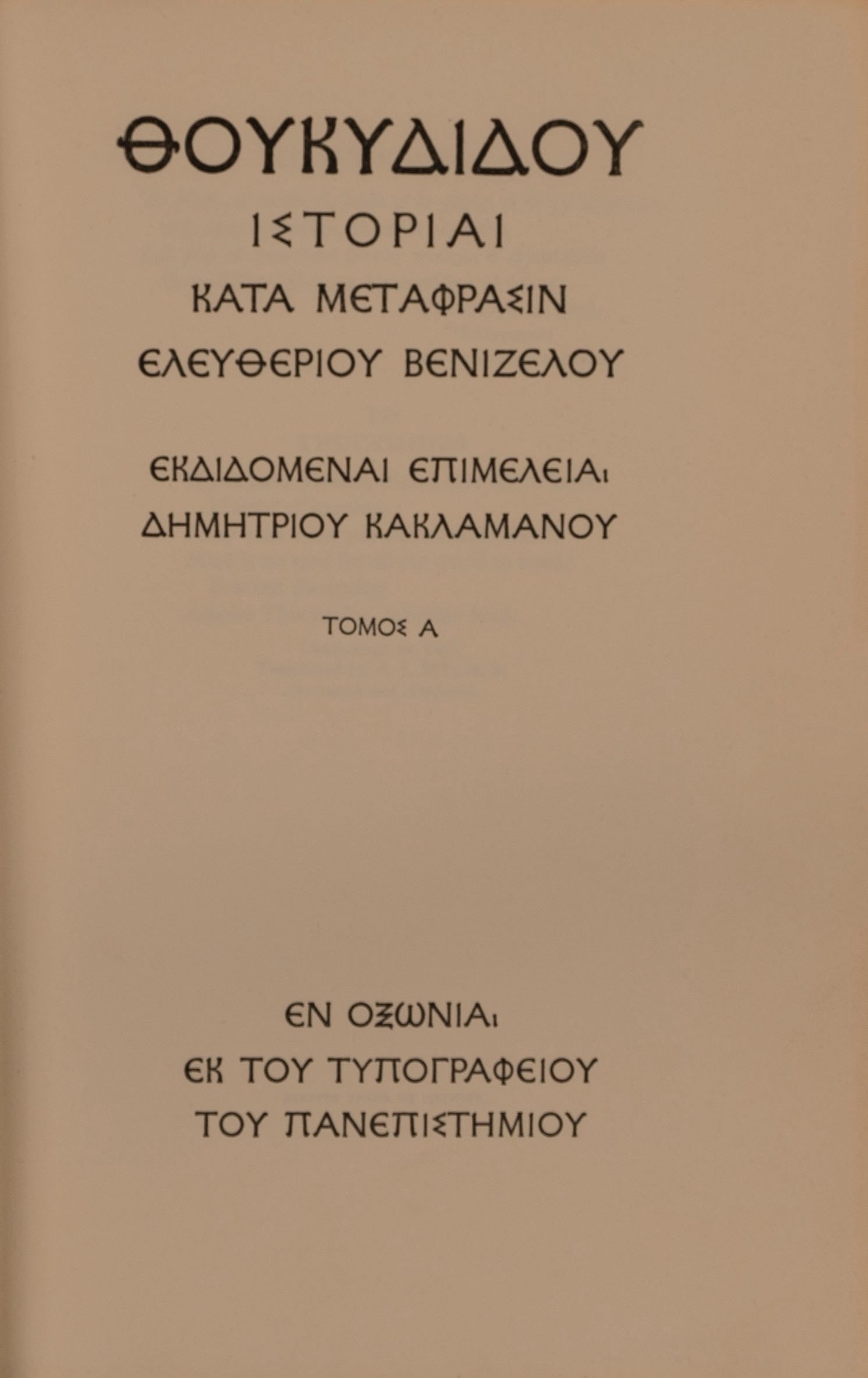
Image: Thucydides Venizelos Modern Greek translation Oxford c1937.jpg — Thucydides, transl. to Modern Greek by Eleftherios Venizelos, Public domain