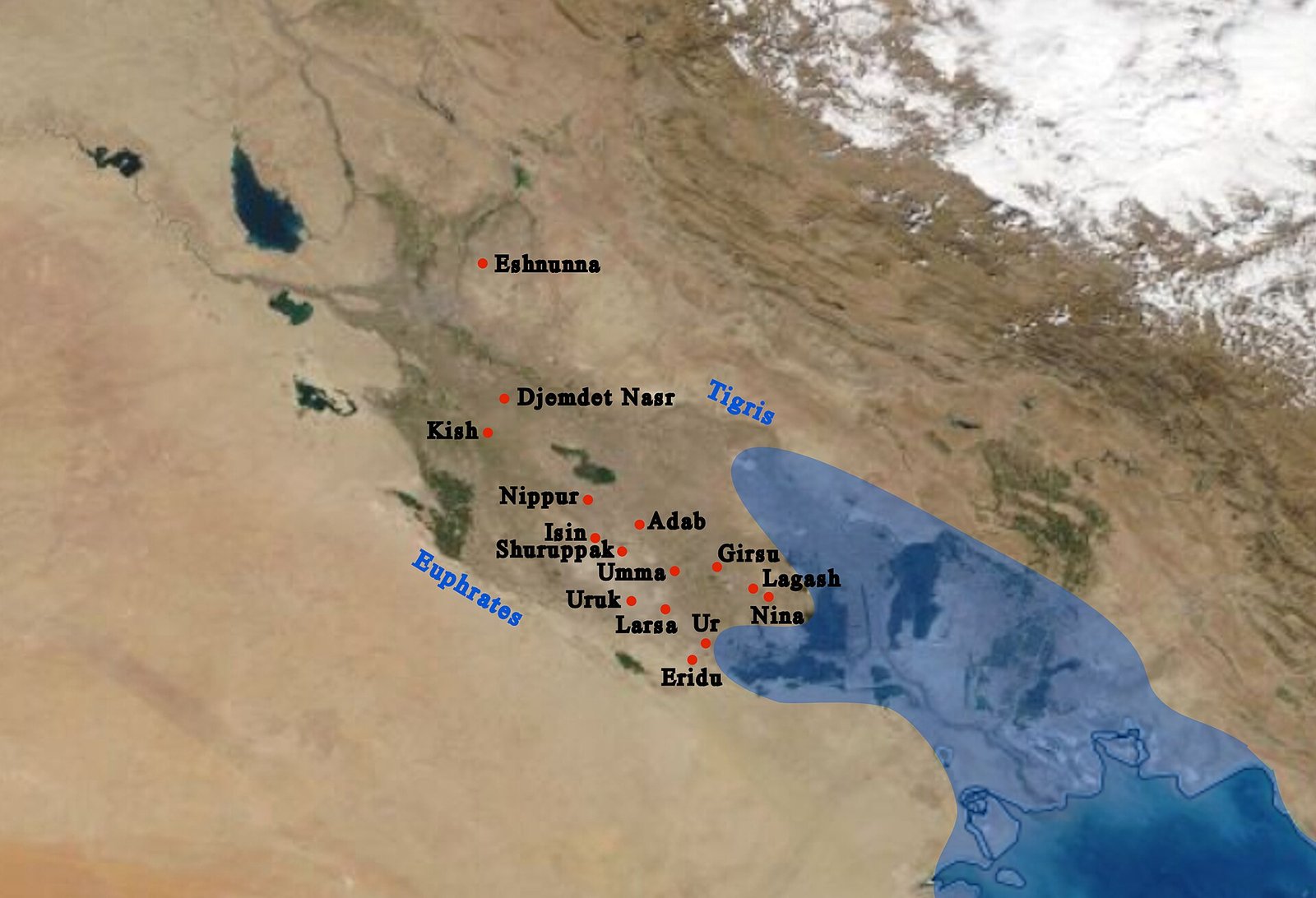
The Sumerians lived in the lower basin of the Tigris and Euphrates rivers, in what is now southern Iraq. Their heartland was the area around Uruk, Ur and Eridu. By about 3200 BC, Uruk was the largest settlement in southern Mesopotamia. Clay tablets from this region carry the earliest known writing, which the Getty Museum dates to around 3400 BC.
Sumer civilization: who were the Sumerians?
The Sumerians were one of the main peoples of the city-state system that dominated Mesopotamia in the Early Dynastic period, between about 2900 and 2350 BC. Before that, the Uruk culture had already taken shape in the region between about 4000 and 3500 BC. Potters in that culture made vessels in series, on a fast wheel or in moulds.
The Sumerians also traded over long distances. Uruk-period settlements dated to about 3500 to 3100 BC show that they exchanged goods with communities in Anatolia, Syria and Iran. If you travel in Turkey today, you are moving through one of Sumer’s old trading partners.
Who the Sumerians were, in ethnic terms, remains an open question. The Sumerian language cannot be tied to any recognised language family. For that reason the Metropolitan Museum of Art describes their origin as undetermined. The University of Oxford classifies Sumerian as an isolate, a language with no known relatives.
Ancient Sumer: where was it?
Sumer sat at the southern end of Mesopotamia, near the Persian Gulf. The landscape was wetter than today’s map suggests. According to UNESCO, between 5000 and 3000 BC the sea reached about 200 kilometres inland from the present coastline of southern Iraq.
The three core cities still exist as archaeological sites. Uruk, Ur and Eridu are part of the UNESCO World Heritage property called The Ahwar of Southern Iraq. That property has seven components in total: the three cities and four wetland areas.
Did the Sumerians really invent writing?
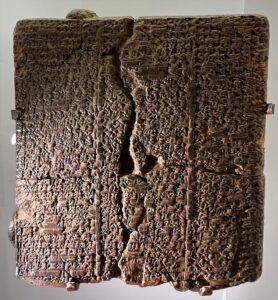
The Getty Museum places the earliest known writing at about 3400 BC in the Sumerian region near the Persian Gulf. Sumerian scribes wrote on clay tablets. They pressed reed styluses into the wet clay, leaving wedge-shaped marks. This system is called cuneiform.
There is a caveat. The University of Oxford points out that Ancient Egyptian is a rival candidate for the title of first written language, based on evidence from the late fourth millennium BC. So “the civilization that invented writing” is a fair headline, but the race was close.
The Sumerian language outlived the Sumerian state by a long way. According to the Oxford Classical Dictionary, Sumerian was used as a living language until about 1900 BC. After that it survived in temple rituals and written culture until the Common Era.
Did the Sumerians invent the wheel?
You will often read that the wheel was a Sumerian invention. The evidence does not settle the matter. A 1999 study by Bakker and colleagues, published in Antiquity, found that the earliest finds of wheeled vehicles in Europe and the Near East are contemporary with each other. Neither region can claim a clear head start.
Were the Sumerians Turkish or Kurdish?
This question comes up often in Turkish-language searches. Cevat Şakir Kabaağaçlı explained the Sumerians as a people who came from Central Asia. Turkish Wikipedia presents this as one origin thesis. It does not amount to an established migration route.
Language is the key test, and it gives no support to either claim. The University of Oxford classifies Sumerian as an isolate with no known relatives, so no proven kinship with Turkish exists. The University of Cambridge’s Department of Archaeology likewise states that Sumerian has no known linguistic relatives, which rules out a demonstrated link with Kurdish.
From Sargon to Ur-Nammu: how Sumer ended
The city-state era gave way to empire. Sargon of Akkad’s empire, dated by the middle chronology to about 2334 to 2154 BC, included the Sumerian region.
A new Sumerian state followed. In 2112 BC, again by the middle chronology, Ur-Nammu founded the Third Dynasty of Ur. Around 2100 BC he built ziggurats at Ur, Eridu, Uruk and Nippur. The Third Dynasty of Ur was the last major Sumerian state. It ended around 2004 BC.
Timeline
- About 4000–3500 BC The Uruk culture developed. Pottery was mass-produced on a fast wheel or in moulds.
- About 3400 BC The earliest known writing appeared in the Sumerian region, according to the Getty Museum.
- About 3200 BC Uruk was the largest settlement in southern Mesopotamia.
- About 2900–2350 BC City-states dominated Mesopotamian politics in the Early Dynastic period.
- About 2334 BC Sargon of Akkad’s imperial period began, by the middle chronology.
- 2112 BC Ur-Nammu founded the Third Dynasty of Ur, by the middle chronology.
- About 2100 BC Ur-Nammu built ziggurats at Ur and other southern Mesopotamian cities.
- About 2004 BC The Third Dynasty of Ur ended.
- About 1900 BC Sumerian ceased to be a living language, according to the Oxford Classical Dictionary. Written and religious use continued.
Details you won’t find in guidebooks
A tablet from Umma, dated to about 2028 BC, measures 3 by 2.8 by 1.2 centimetres. It records rations of beer, bread, oil and onions issued to messengers. If you have ever filed a receipt for lunch on a work trip, you have done the job of a Sumerian scribe.
A gold plaque with an inscription, dated to 2600–2340 BC, is thought to be part of a beard. It was fixed with gold nails to a statue of Shara, the god of Umma.
The Great Death Pit in the Royal Cemetery of Ur held 74 people. Of those, 68 were women.
Around 3200 BC, the monumental mud-brick buildings of Uruk had decorated walls. Builders pressed painted clay cones into the wall surface to form mosaics.
FAQ
Where was ancient Sumer?
In southern Iraq, in the lower basin of the Tigris and Euphrates rivers, around the cities of Uruk, Ur and Eridu.
When did the Sumerians exist?
Sumerian urban civilization became distinct in the fourth millennium BC. The last major Sumerian state, the Third Dynasty of Ur, ended around 2004 BC.
Did the Sumerians invent writing?
The Getty Museum dates the earliest known writing to about 3400 BC in the Sumerian region. The University of Oxford notes that Ancient Egyptian is a rival candidate from the late fourth millennium BC.
Were the Sumerians Turks?
No proven link exists. Oxford classifies Sumerian as an isolate with no known relatives, so no kinship with Turkish has been demonstrated.
Can you visit Sumerian cities?
Uruk, Ur and Eridu are components of the UNESCO World Heritage property The Ahwar of Southern Iraq, together with four wetland areas.
Sources
- UNESCO — The Ahwar of Southern Iraq whc.unesco.org
- Wikipedia — Sumer en.wikipedia.org
- The Metropolitan Museum of Art — Uruk: The First City metmuseum.org
- Getty — Where Did Writing Come From? getty.edu
- University of Oxford — ETCSL: Sumerian language etcsl.orinst.ox.ac.uk
- The Metropolitan Museum of Art — Mesopotamia, 8000–2000 B.C. metmuseum.org
- Antiquity — The earliest evidence of wheeled vehicles in Europe and the Near East doi.org
- Vikipedi — Sümerler, Türk edebiyatında Sümerler tr.wikipedia.org
- University of Cambridge, Department of Archaeology — Mesopotamian Languages arch.cam.ac.uk
- The Metropolitan Museum of Art — Ancient Near Eastern Art, Bulletin 41/4 resources.metmuseum.org
- The Metropolitan Museum of Art — Ur: The Ziggurat metmuseum.org
- Oxford Classical Dictionary — Sumerian doi.org
- The Metropolitan Museum of Art — Record of rations for messengers metmuseum.org
- University of Pennsylvania — Iraq’s Ancient Past: Rediscovering Ur’s Royal Cemetery penntoday.upenn.edu
Image: Sumer satellite map.jpg — NASA
Overlay: पाटलिपुत्र (talk), Public domain