Stede Bonnet was a wealthy Barbados planter and militia major who bought a ship and became a pirate in 1717; his personal reasons remain uncertain. After an association with Blackbeard and a return to piracy following a pardon, he surrendered to William Rhett at Cape Fear in September 1718, when rising water freed Rhett’s grounded ship to approach again.
Bonnet’s story connects a substantial inherited estate with a purchased pirate vessel, an unsuccessful escape, and a surviving death sentence. If you follow that trail, the central puzzle becomes clearer: his actions are documented more firmly than his motives. The evidence also requires care over the date of his capture and the record of his execution.
What is known about Bonnet’s life in Barbados?
Bonnet was baptized on 29 July 1688 in the parish of Christ Church, Barbados. His parents were the planter Edward Bonnet and Sarah Whetstone. That date records his baptism; it should not automatically be treated as his birthday.
His father died in 1694. Bonnet inherited the family property southeast of Bridgetown, an estate larger than 400 acres, or about 162 hectares. This inheritance provides a concrete starting point for understanding his position before piracy. He already possessed substantial landed wealth.
Bonnet settled in the parish of St. Michael and married Mary Allamby on 21 November 1709. By 1715, he held the rank of major in the Barbados militia. He belonged to the island’s wealthy planter class before leaving his family in Barbados and turning to piracy in 1717.
These details establish his property, marriage, and military rank. They also explain why the purchase of his first pirate ship matters: Bonnet entered piracy with resources accumulated before his departure.
Can his reasons for becoming a pirate be documented?
Bonnet’s decision to become a pirate is established. His private reasoning is much harder to pin down. NCpedia reports that people around him attributed his departure to mental disturbance or marital problems. It does not present either explanation as a proven personal motive.
Historian Robert C. Ritchie suggested that Bonnet may have wanted to escape an unhappy marriage or recover the adventures of his youth. These remain possible explanations. They should not become statements that Bonnet certainly abandoned Barbados because of his wife or a settled desire for adventure.
If you encounter a confident explanation based on marital misery, keep that distinction in mind. Bonnet married Mary Allamby in 1709 and left his family in 1717. Those events are documented, but they do not by themselves prove why he left.
His wealth also cannot supply a complete explanation. The inherited estate and his status as a prosperous planter establish his circumstances. They do not reveal the thought process behind buying a ship and using it for piracy.
How did he acquire the Revenge and become associated with Blackbeard?
In 1717, Bonnet bought and armed the Revenge rather than capturing it. The vessel began as a sloop carrying ten guns. He assembled a crew of more than seventy men and paid his first sailors wages from his own funds.
There is an everyday budgeting link here. Paying wages means meeting a payroll from money already available. Bonnet used his own resources in this way, instead of initially compensating his crew through the division of captured plunder customary among pirates.
His early command brought a serious setback. During a voyage toward the Caribbean in 1717, the Revenge fought a Spanish warship. Bonnet was wounded, and his vessel suffered heavy damage. He subsequently met Blackbeard on New Providence Island in the Bahamas.
While his wounds healed, Bonnet handed command of the Revenge to Blackbeard. The two later separated for a time. They met again off Central America in March 1718, when Bonnet relinquished command and moved aboard Queen Anne’s Revenge.
Bonnet was on Queen Anne’s Revenge during Blackbeard’s blockade of Charleston harbor in 1718. The blockade lasted about a week. His presence places him with Blackbeard during that operation, after his own initial attempt to command a purchased pirate ship.
Later in 1718, Bonnet went to Bath. North Carolina governor Charles Eden granted him a pardon and permission to travel to seek authorization for privateering against Spanish ships in the Virgin Islands. Yet Bonnet returned to piracy that summer. Along America’s eastern coast, he captured more than a dozen vessels.
How was he captured at Cape Fear in 1718?
In August 1718, Bonnet established a base in the Cape Fear estuary near present-day Southport. He used the location to maintain and repair his ship. Governor Robert Johnson commissioned William Rhett to pursue him.
Rhett’s force consisted of the sloops Henry and Sea Nymph. Each carried eight guns, and the expedition had 130 men in total. Rhett entered the Cape Fear River on the evening of 26 September 1718.
The fighting began the next morning as Bonnet tried to put to sea. Sloops on both sides ran aground. Rising water then freed the Henry first, allowing it to approach again. That change brought Bonnet’s surrender.
The National Park Service places the capture near Bald Head on 27 September 1718. Charleston County Public Library gives the same date. NCpedia offers a different sequence, placing Rhett’s arrival on 28 September and the battle on the following day.
The 27 September date therefore follows the National Park Service and the library’s chronology. If you are comparing accounts, the discrepancy concerns the calendar date; the grounded vessels and the Henry’s release explain how the surrender occurred.
Rhett left Cape Fear with his prisoners on 30 September. He reached Charleston on 3 October 1718. Bonnet’s capture had ended his freedom at sea, but his custody in Charleston would be interrupted by an escape.
What records underpin accounts of his trial and execution in Charleston?
On the evening of 24 October 1718, Bonnet escaped custody with his sailing master, David Heriot. Charleston County Public Library’s examination of the records places Bonnet’s recapture on Sullivan’s Island on 5 November. He was brought back to Charleston the next day.
His separate trial took place from 10 to 12 November 1718 in South Carolina’s Vice-Admiralty Court, where Nicholas Trott served. A court minute dated 12 November records convictions for two acts of piracy involving the capture of the sloops Francis and Fortune. It also records his death sentence.
The U.S. National Archives identifies this sentencing record within its Atlanta holdings. It belongs to Record Group 21, in the Court Minutes series covering 1716–1763. Its archival identifier is 334339257. That reference ties the sentence to a specific surviving court record.
Another important source is The Tryals of Major Stede Bonnet, and Other Pirates. It was printed in London for Benjamin Cowse in 1719. The Library of Congress preserves a copy of this early printed account of the proceedings.
The distinction between these records matters. Bonnet’s handwritten court journal from 1718 does not specify the day or place of his execution. Page 43 of the printed account supplies those details: he was executed at White Point near Charleston on Wednesday, 10 December 1718.
You can therefore distinguish two documented claims. The court minute establishes the conviction and death sentence on 12 November. The printed trial account records the execution at White Point on 10 December.
Details you won’t find in guidebooks
Bonnet tried to preserve the appearance of compliance with his pardon while returning to piracy. He adopted the name Captain Thomas and renamed the Revenge as the Royal James. These changes belong to his renewed operations after the pardon.
Ignatius Pell, the Revenge’s boatswain, became a prosecution witness. Unlike his companions, he was not indicted and tried. His position shows that members of the same crew did not all enter the proceedings as defendants.
The battle’s decisive detail was the movement of the water. Both sides had grounded vessels, but the Henry floated free first. That gave Rhett’s force the ability to approach again and brought the encounter to its conclusion.
Timeline
- 29 July 1688: Bonnet was baptized in Christ Church, Barbados.
- 1694: He inherited the family estate after his father’s death.
- 21 November 1709: He married Mary Allamby.
- 1717: He bought and armed the Revenge and began piracy.
- 1717: He was wounded fighting a Spanish warship and later met Blackbeard.
- March 1718: He rejoined Blackbeard off Central America.
- Summer 1718: After receiving a pardon, he returned to piracy as Captain Thomas aboard the Royal James.
- August 1718: He established his repair base at Cape Fear.
- 27 September 1718: He surrendered, according to the National Park Service and Charleston County Public Library; NCpedia dates the battle to 29 September.
- 3 October 1718: He arrived in Charleston as Rhett’s prisoner.
- 24 October 1718: He escaped with David Heriot.
- 5–6 November 1718: He was recaptured and returned to Charleston.
- 10–12 November 1718: He was tried and sentenced to death.
- 10 December 1718: He was executed at White Point.
- 1719: The printed trial account appeared in London.
FAQ
Who was Stede Bonnet?
Stede Bonnet was a wealthy Barbados planter and militia major who bought and armed the Revenge in 1717 and became a pirate.
Why did Stede Bonnet become a pirate?
His personal reasons are not established. Marital unhappiness, mental disturbance, and a desire for adventure appear as reported explanations or theories.
How was Stede Bonnet captured?
He surrendered to William Rhett at Cape Fear after the grounded Henry floated free on the rising water and approached again. The National Park Service and Charleston County Public Library date his capture to 27 September 1718.
When and where was Stede Bonnet executed?
The printed trial account published in 1719 records his execution at White Point near Charleston on 10 December 1718.
Sources
- NCpedia — Hugh F. Rankin, “Bonnet, Stede” ncpedia.org
- Charleston County Public Library — “The Pirate Hunting Expeditions of 1718” ccpl.org
- National Park Service — Cape Fear Report, history section, page 13 nps.gov
- Charleston County Public Library — “The Charleston Pirate Trials of 1718” ccpl.org
- U.S. National Archives — “Piracy Trial from the U.S. Colonial Era” archives.gov
- Library of Congress — The Tryals of Major Stede Bonnet, and Other Pirates loc.gov
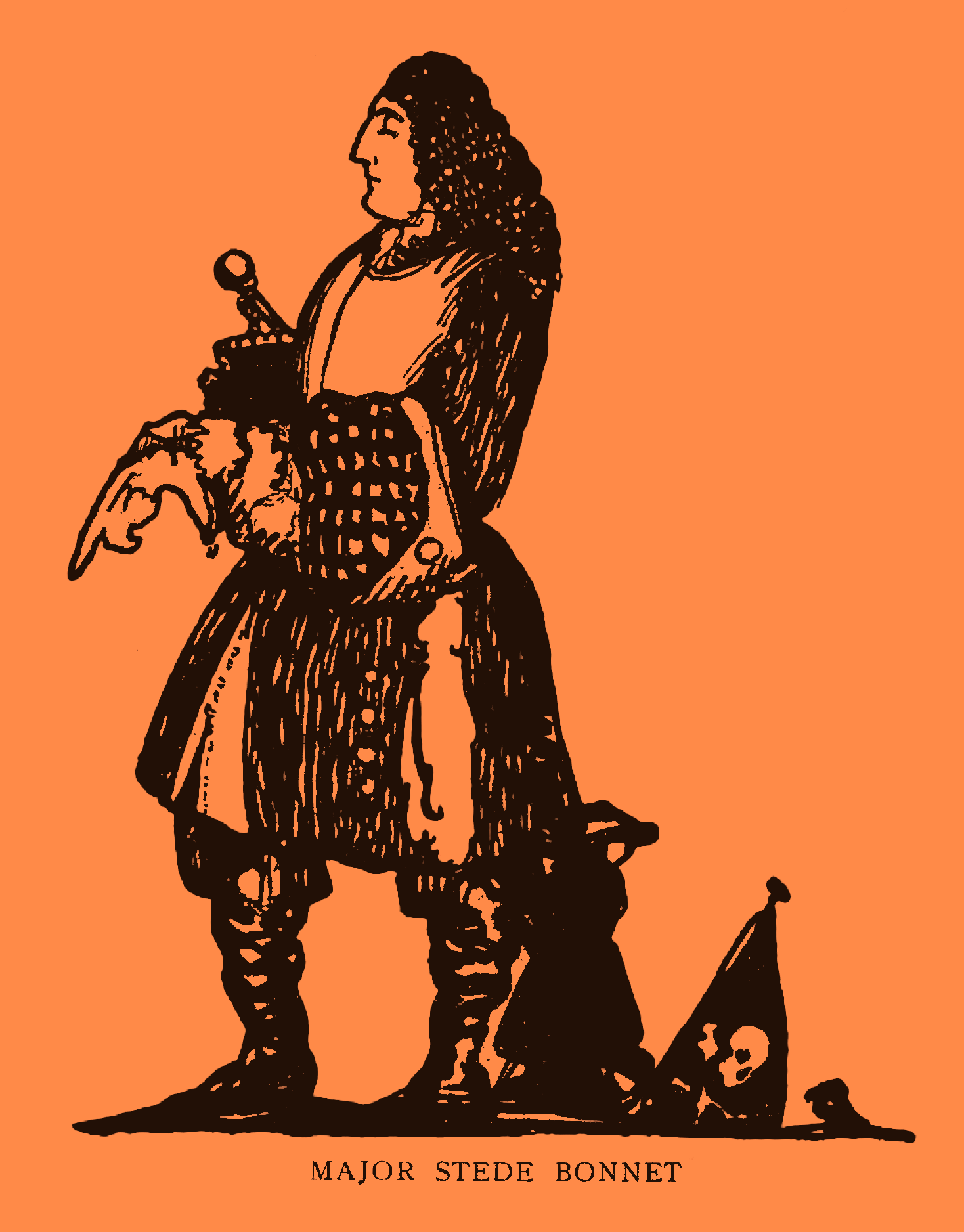
Image: Major Stede Bonnet – Pirates (1922).png — Claud Lovat Fraser; corrected by Parker Higgins, Public domain