Who built Ankara Castle?
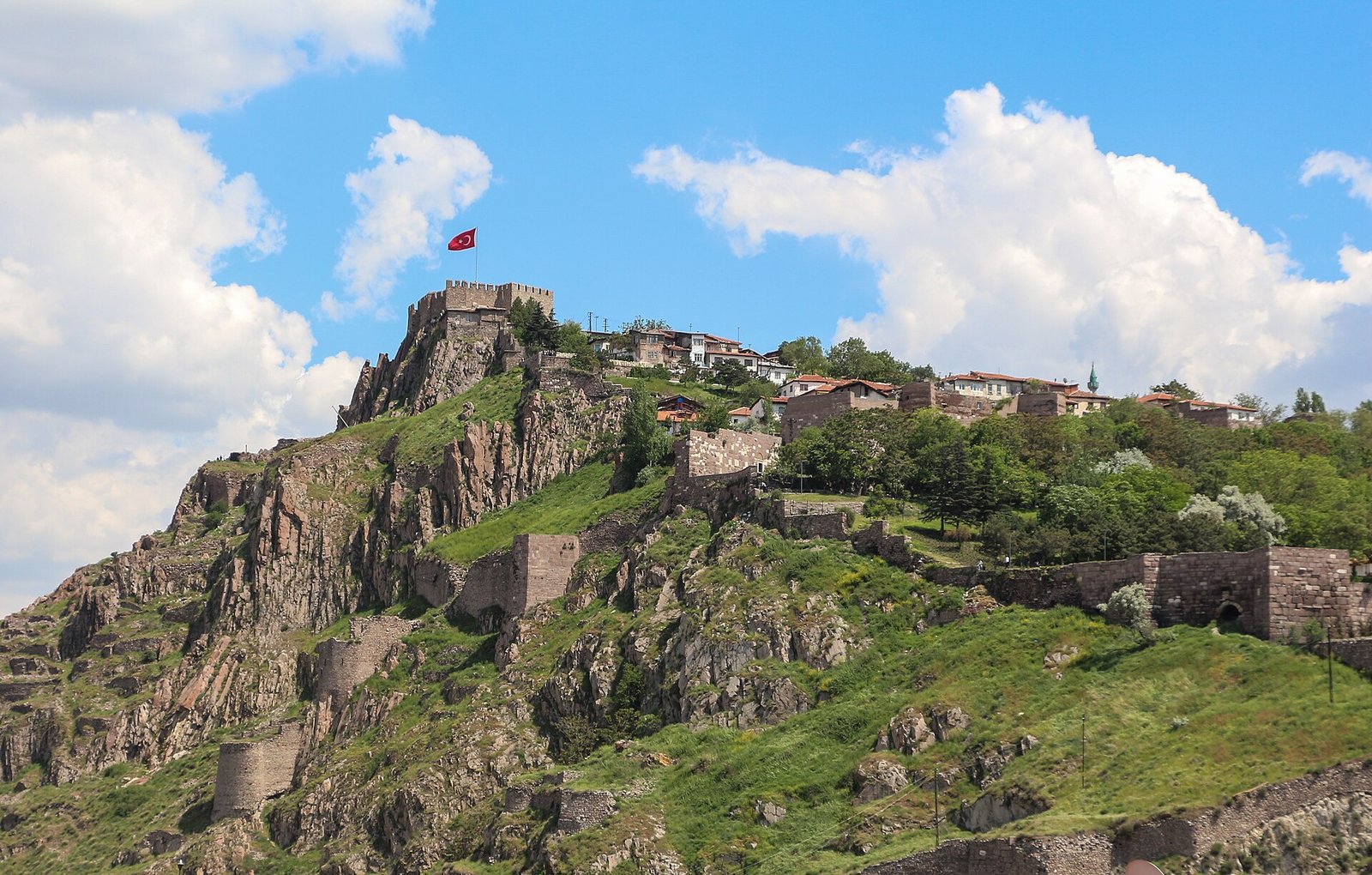
The Ankara Castle you see today is mainly Byzantine in its surviving architectural structure. Yet its walls belong to a longer sequence of use, repair, and expansion. Galatians used the castle, Romans repaired it, and Seljuks added to it. The clock tower arrived much later, in 1885. Asking who built Ankara Castle therefore leads you through several periods of construction, rather than to a single building campaign.
The castle stands in Kale Mahallesi, in Ankara’s Altındağ district. Its hill rises approximately 110 metres above Bent Deresi, where Hatip Çayı flows. That elevation is part of the setting you need to understand: the walls occupy a hill whose shape also influenced the layout of the inner citadel.
Ankara Castle history: Galatian use and Roman repairs
A 2023 study by Sansar and Akyol identifies the Tectosages, a Galatian group, as the castle’s earliest users mentioned through Strabo’s account. The Culture Portal likewise describes a castle already present when the Galatians settled in Ankara. These references establish early use, without making the surviving walls the work of the Galatians.
The Culture Portal records repairs during the Roman period. This matters when reading the castle’s history, because repair and initial construction are different events. Roman activity belongs to the building’s development, but the main architectural structure visible today is assigned to the Byzantine period by Sansar and Akyol.
A claim that the Hittites built the castle also appears in discussions of its origins. Altındağ District Governorate states that archaeological evidence has not confirmed that attribution. The better-supported account follows Galatian use, Roman repairs, and the Byzantine construction associated with the surviving fortifications.
Were Ankara Castle’s walls built in the seventh century or in 859?
The castle has two defensive circuits, called İç Kale and Dış Kale: the Inner Castle and Outer Castle. The distinction is essential. A date proposed for the inner walls does not automatically date the whole defensive complex. The two circuits need to be considered separately when tracing the citadel’s construction.
The Culture Portal follows the interpretation that Byzantines built the inner walls in the seventh century. Another interpretation appears in the second volume of The Greek and Latin Inscriptions of Ankara (Ancyra). It treats inscriptions dated 859 as evidence for the upper citadel’s first construction, rather than repairs to an existing upper fortress.
An inscription bearing the name of Michael III securely places building activity at the walls in 859. The disagreement concerns what that work represented. One reading sees substantial rebuilding. The other places the upper citadel’s initial construction in that year. The inscription anchors the discussion, even though scholars interpret the building sequence differently.
A 2016 thesis at Middle East Technical University connects the rebuilding of Ankara’s inner walls in 859 with Michael III’s fortification programme, which also included Nicaea. This interpretation places Ankara within a wider programme of defensive construction. It also explains why 859 is central to accounts of the castle’s Byzantine history.
Ankara Castle facts: how the walls were built
The Culture Portal counts 42 pentagonal towers in the inner castle. Their heights range from 14 to 16 metres. Along the eastern, western, and southern walls, pentagonal towers stand at intervals of approximately 15 to 20 metres, according to the architectural description reproduced in Turkish Wikipedia.
The inner enclosure does not follow the same geometry on every side. Its southern and western walls meet at a right angle. The eastern wall follows the hill’s projections and recesses. If you compare the sides, the contrast shows how the defensive layout responds to the ground beneath it.
The 2016 thesis describes large reused stone blocks extending to heights of eight to ten metres in the inner walls. Above them, builders completed the masonry with courses of brick and rubble stone. The walls therefore preserve both a change in materials and the extensive reuse of earlier stonework.
How did the Seljuks and later builders change the citadel?
Ankara Castle came under Seljuk control in 1073. It was repaired and enlarged during the Seljuk period. Sansar and Akyol assign Akkale tower to that period, while identifying the castle’s main architectural structure as Byzantine. The distinction helps separate an important addition from the older defensive framework.
Later repairs affected several named parts of the fortress. The repair chronology assembled by Sansar and Akyol records work commissioned by İbrahim Paşa in 1832–1833. It covered the Bent Deresi walls, Akkale tower, and the Ottoman wall. The castle’s later history thus includes repairs to several components, rather than one isolated intervention.
Timeline
- Galatian period: Sources describe the castle’s existence and its use by the Galatians.
- Roman period: The castle undergoes repairs.
- Seventh century: The Culture Portal dates the Byzantine inner walls to this century.
- 859: Inscriptions document construction under Michael III. Scholars differ over whether this represents rebuilding or the upper citadel’s first construction.
- 1073: The castle passes into Seljuk control.
- Seljuk period: Akkale tower is added.
- 1330: The Persian Ilkhanid inscription above Hisar Gate dates to this year.
- 1832–1833: İbrahim Paşa commissions repairs to walls and Akkale.
- 1885: The clock tower is added.
- 1921: Ankara’s first museum is established in Akkale.
- 2024: Ankara Metropolitan Municipality introduces an illustrated map showing 21 monuments around the castle.
Ankara Castle gate and clock tower
Hisar Gate carries a Persian inscription dated 1330, from the Ilkhanid period. The Ministry of Culture and Tourism’s Ankara guide identifies both its language and date. The inscription gives the entrance a specific historical reference within a fortress whose walls contain work from several periods.
The clock tower belongs to the Ottoman period and was added in 1885. It should therefore be read separately from the Byzantine defensive architecture. When you study a photograph of the castle’s silhouette, the tower represents a later addition to a much older fortified setting.
Details you won’t find in guidebooks
Beside the inner castle’s main entrance, the wall incorporates fragments of a wellhead above four herms laid on their sides. It provides a precise example of earlier carved objects being absorbed into the fortress masonry.
Another reused stone carries a first-century AD inscription honouring Axius. Builders placed it upside down in the wall. A Christian Chi-Rho symbol was then carved onto it in the upright direction. The inscription’s orientation and the symbol’s orientation preserve two different uses on the same stone surface.
Akkale also has a place in Ankara’s museum history. Mübarek Galip Bey, the director of culture, established the city’s first museum there in 1921. The Seljuk tower consequently became a museum setting, adding another documented use to a structure originally associated with the castle’s defences.
Ankara Castle photos: details to look for
The Ankara Regional Directorate for the Conservation of Cultural Property publishes an official castle gallery containing four images. For a more focused look at castle photographs, use the documented features as reference points: pentagonal towers, the later clock tower, and the differing materials used in the inner walls.
Close views of the masonry can be especially useful for understanding the castle’s construction. Large reused blocks belong to the lower portions described in the 2016 thesis, while brick and rubble complete the upper sections. Images of those changes help connect the architectural description with the surviving fabric.
How does Ankara Castle connect with everyday life?
Some Ottoman-period Ankara houses inside the castle have been restored and are used as restaurants and shops. This gives the site an everyday connection beyond its defensive history. If you stop for a meal or browse a shop in one of these buildings, the setting also belongs to the castle’s later residential history.
The surrounding area can also be read through the municipality’s illustrated map, introduced in 2024. It shows 21 monuments, including historic inns, the Roman Theatre, Arkeopark, and Arslanhane Mosque. The map places the castle within a broader historic area while keeping individual buildings identifiable.
For reaching the site, the Culture Portal describes a walk of approximately 15 minutes from Ulus metro station. That approach connects the practical visit with a specific destination: the castle in Kale Mahallesi, where Byzantine walls, Seljuk Akkale, and Ottoman-period buildings remain parts of the same historic setting.
FAQ
Who built the Ankara Castle you see today?
The surviving castle’s main architectural structure belongs to the Byzantine period. The Seljuks added Akkale, while later work included repairs in 1832–1833 and the addition of a clock tower in 1885.
Did the Hittites build Ankara Castle?
Altındağ District Governorate states that archaeological evidence has not confirmed the claim that the Hittites built the castle.
How old are Ankara Castle’s inner walls?
The Culture Portal dates the Byzantine inner walls to the seventh century. A competing scholarly interpretation treats the inscriptions dated 859 as evidence of the upper citadel’s first construction.
Is Ankara Castle’s clock tower Byzantine?
The clock tower was added in 1885, during the Ottoman period.
Sources
- Ministry of Culture and Tourism — Culture Portal: Ankara Castle kulturportali.gov.tr
- Altındağ District Governorate — Ankara Castle altindag.gov.tr
- Sansar and Akyol, 2023 — Additions and Repairs to Ankara Castle, TR Dizin search.trdizin.gov.tr
- Princeton University — Spolia at Ankara Castle medievalblackseaproject.princeton.edu
- The Greek and Latin Inscriptions of Ankara (Ancyra), Volume II — Book preview api.pageplace.de
- 2016 — Thesis, Middle East Technical University open.metu.edu.tr
- Sansar and Akyol, 2023 — Full article and repair chronology makale.isam.org.tr
- Turkish Wikipedia — Ankara Castle tr.wikipedia.org
- Ministry of Culture and Tourism — Ankara Guide ktb.gov.tr
- General Directorate of Cultural Heritage and Museums — Ankara Museum of Anatolian Civilizations Directorate kvmgm.ktb.gov.tr
- Ankara Metropolitan Municipality — Ankara Castle Brochure and Illustrated Map ankara.bel.tr
- Ankara Regional Directorate for the Conservation of Cultural Property — Ankara Castle Photo Gallery korumakurullari.ktb.gov.tr
Image: Ankara Castle.jpg — Bernard Gagnon, CC BY-SA 3.0