Where is Klimt’s The Kiss located?
Gustav Klimt’s The Kiss is in the Upper Belvedere in Vienna, the capital of Austria. The original belongs to the Österreichische Galerie Belvedere collection. The visitor address is Prinz-Eugen-Straße 27, 1030 Vienna. If you want to see the actual painting, this is the location to keep in your plans.
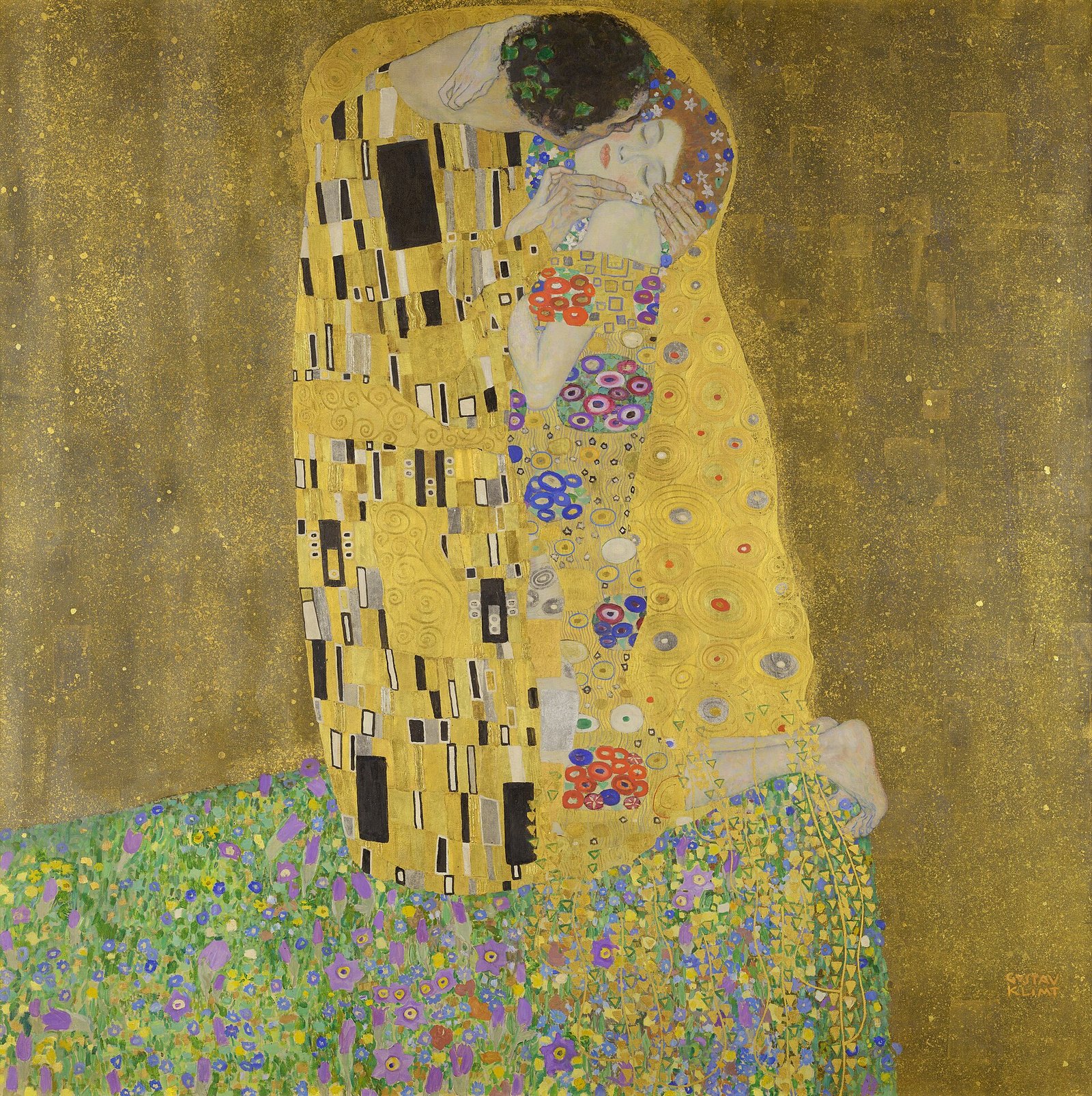
The work is a square measuring 180 × 180 centimetres. Its size matters when you look at the embracing figures. The couple occupies a broad golden surface, with a flower-covered patch beneath them. This is a painting in oil on canvas, enriched with gold leaf, silver and platinum. The golden appearance comes partly from metal applied to its surface.
What is The Kiss painting, and who painted it?
The Kiss is the work of Austrian Symbolist painter Gustav Klimt. Its original German title is Der Kuss. Yet that was not the title under which its first exhibition audience encountered it. At Vienna’s Kunstschau in 1908, the painting appeared as Liebespaar, meaning Lovers.
The difference between those titles gives you two ways to approach the image. Lovers directs attention toward the pair as a subject. The Kiss directs attention toward their action. In the painting, a man holds a woman’s face in his hands and kisses her cheek. Both titles connect directly to what Klimt placed on the canvas.
The work is counted among the masterpieces of the Vienna Secession, the Viennese expression of Art Nouveau. It is also regarded as the culmination and endpoint of Klimt’s Golden Period. Its gold therefore belongs both to the physical construction of this particular painting and to a named phase of his work.
What does The Kiss actually show?
The man holds the woman’s face as he kisses her cheek. Her eyes are closed. One arm reaches around his neck, while her other hand rests over his hand. These gestures make the embrace legible even within the dense patterns of their clothing.
Beneath the couple lies a flower-covered surface. It ends below the woman’s bare feet. Behind them, a flat golden background replaces a detailed setting. The contrast is clear: flowers establish a small area beneath the figures, while gold fills the space beyond them.
If you follow the woman’s hands before examining the patterns, the painting becomes easier to read. Her arm around the man’s neck and her hand over his connect the figures through touch. You can link this to everyday life through a familiar gesture: resting your hand on someone else’s. Klimt makes that small physical contact visible within the larger embrace.
What is the meaning behind Klimt’s golden painting?
Belvedere interprets the couple’s shared outer contour as an expression of love’s power to unite people. Their golden clothing brings them together within a single outline. The figures remain distinguishable through their faces, hands and patterns, but the enclosing shape joins them visually.
The clothing also carries contrasting forms. According to Belvedere’s interpretation, the rounded and floral patterns on the woman’s garment suggest softness. The black-and-white rectangles on the man’s garment suggest strength. These meanings belong to the museum’s reading of the image. They should be understood as interpretation, rather than a recorded explanation from Klimt.
Belvedere also allows a broader reading: the couple may represent love in human life instead of specific individuals. Under that interpretation, the embrace works as an allegory. The joined outline, the hands and the kiss support a subject that extends beyond the identities of the two figures.
Why did Gustav Klimt use gold?
One important source for Klimt’s use of gold was the Byzantine mosaics he saw in Ravenna in 1903. That encounter influenced his Golden Period. In The Kiss, gold appears both in the clothing around the couple and across the flat background behind them.
For readers interested in Byzantine art, Ravenna provides a concrete connection to Klimt’s painting. The link rests on his encounter with those mosaics. It also helps explain why the metallic surface deserves attention alongside the embrace. The materials and the subject work together in the finished image.
Gold leaf is only part of the material story. Klimt also used silver and platinum with oil paint on canvas. Calling the work a golden painting describes its dominant appearance, but its surface contains several materials. Its square format holds that metallic field around the two closely joined figures.
When was The Kiss painted?
The painting’s dates reflect different stages of its production. Wikipedia dates it to 1907–1908. The Klimt Foundation’s research database records it as 1908/09, taking its completion in 1909 into account.
The first exhibition did not mark the end of the process. The Austrian state bought the painting in 1908 for the Moderne Galerie while it was still unfinished. Klimt completed it in 1909. Exhibition, purchase and completion therefore belong to separate moments in its history.
Timeline
- 1901–1902: Klimt created the Beethoven Frieze. Its embracing couple was a precursor to the motif developed in The Kiss.
- 1903: He saw Byzantine mosaics in Ravenna, an important influence on his Golden Period.
- 1908: The painting appeared at the Kunstschau in Vienna as Liebespaar. The Austrian state purchased it before completion.
- 1909: Klimt finished the painting.
- 1911: The work appeared at the International Art Exhibition in Rome.
Details you won’t find in guidebooks
The agreed purchase price was 25,000 crowns. The state committed to the work in 1908, before Klimt had finished it. Together, the price and the timing give the purchase a more precise place in the painting’s history than a simple statement that it entered a public collection.
An early photograph by Moriz Nähr preserves evidence of changes to the figures. Comparison with the finished painting shows that Klimt lengthened their lower legs. He also increased the trailing plants over the legs. The photograph therefore records an earlier state of details that now belong to the familiar composition.
The embrace also had a place in Klimt’s work before this canvas. The couple in his Beethoven Frieze of 1901–1902 anticipated the motif. By 1911, The Kiss itself was being exhibited in Rome. Those two facts place the painting between an earlier treatment of the embrace and a later appearance outside Vienna.
Are the lovers Klimt and Emilie Flöge?
One theory identifies the figures as Klimt and Emilie Flöge. Belvedere treats that identification cautiously. Klimt left no explanation of the figures’ identities, and biographical evidence does not confirm that he intended a self-portrait. The theory should therefore remain separate from a firm identification.
The Klimt Foundation points to indirect evidence in a brooch dated 30 August 1908. It carries a similar embracing motif and the names Gustav and Emilie. The foundation considers this a reason to regard the identification as plausible. The connection is suggestive, but it does not establish who appears in the painting.
The alternative reading offered by Belvedere returns attention to the embrace itself. If the figures express love as a general human theme, their names are less central to the image’s meaning. You can examine the joined golden outline and the contrasting patterns without treating the painting as a confirmed portrait.
FAQ
Where is Klimt’s The Kiss located?
The original is in the Österreichische Galerie Belvedere collection at the Upper Belvedere in Vienna, Austria. The visitor address is Prinz-Eugen-Straße 27, 1030 Vienna.
What does The Kiss mean?
Belvedere interprets the couple’s shared outline and golden clothing as an expression of love’s power to unite people. It also presents the painting as a possible general allegory of love.
Does The Kiss contain real gold?
Yes. Klimt used gold leaf, silver and platinum alongside oil paint on canvas.
Are the figures Klimt and Emilie Flöge?
That identification is a theory supported by indirect evidence. Belvedere states that Klimt did not explain the figures’ identities and that no biographical evidence confirms an intended self-portrait.
Sources
- Wikipedia — The Kiss (Klimt)) en.wikipedia.org
- Vikipedi — Öpücük (tablo)) tr.wikipedia.org
- Belvedere — Permanent Collection belvedere.at
- Klimt Foundation — Gustav Klimt at His Zenith klimt-database.com
- Belvedere / Franz Smola — The Kiss artsandculture.google.com
Image: The Kiss – Gustav Klimt – Google Cultural Institute.jpg — Gustav Klimt, Public domain