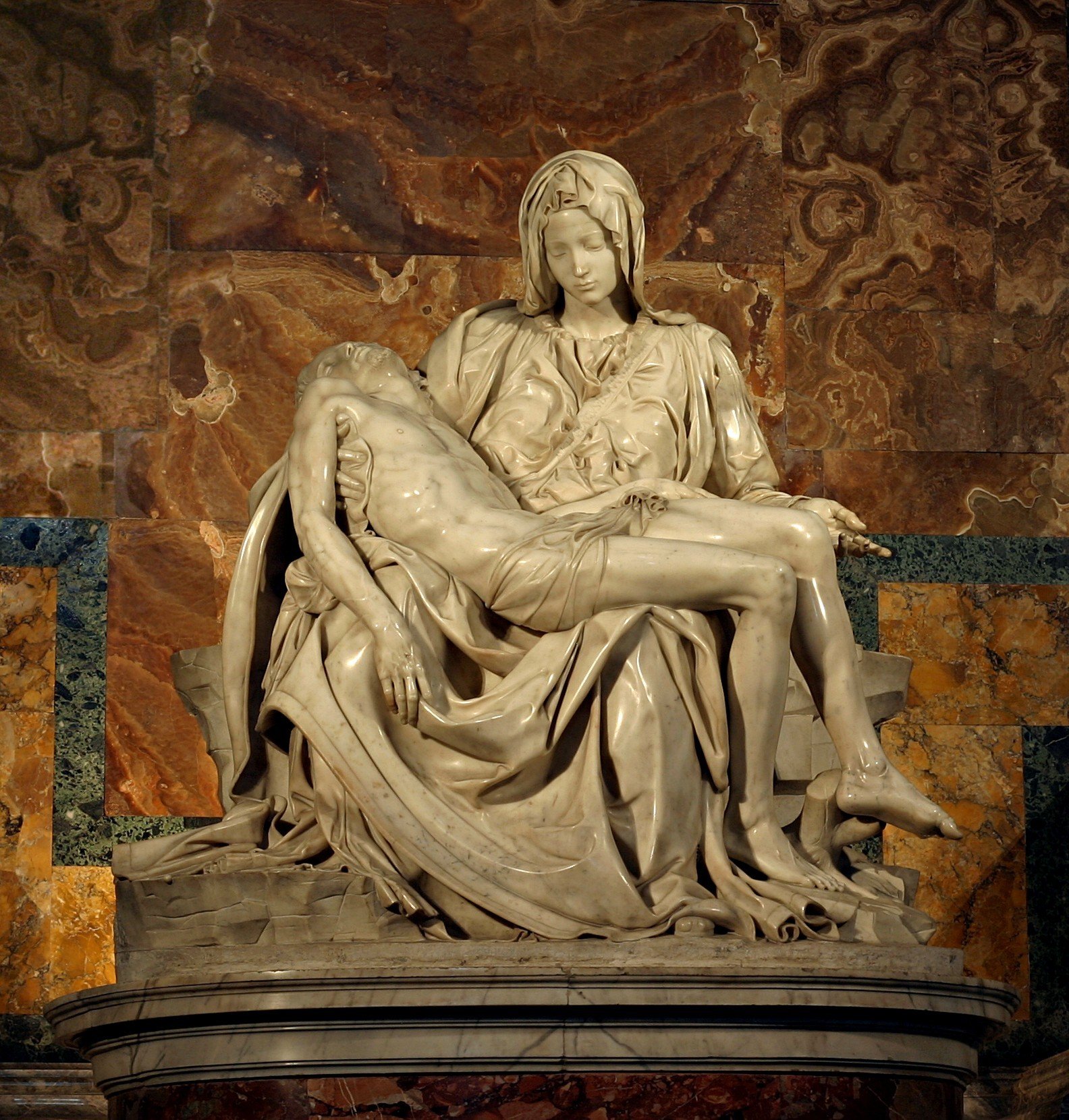
Michelangelo’s Pietà is a marble sculpture from 1498–1499. It shows Christ, taken down from the cross, lying across the lap of his mother Mary. It is also the only work Michelangelo ever signed. He was 23 when he started it, and the Opera del Duomo Museum in Florence dates its completion to his 24th year.
This article covers what the sculpture shows, where it is and what its name means. It also covers the other Michelangelo Pietàs you may be confused with.
What is the Pietà by Michelangelo?
The Vatican Pietà is a Renaissance sculpture dated 1498–1499. It shows the dead Christ in the lap of Mary.
It was carved from a single block of Carrara marble. The Fondazione Federico Zeri catalogue at the University of Bologna records its size as 174 cm high and 195 cm wide.
The composition is a pyramid. The peak is Mary’s head. The wide base is formed by the folds of her garments.
The patron was the French Cardinal Jean de Bilhères-Lagraulas. He ordered the sculpture for his own tomb, according to the Basilica of St. Peter.
Pietà meaning and pronunciation
The Italian word pietà means pity and compassion. In Christian art it also names a subject: Mary holding the dead Jesus on her lap.
The pronunciation is /pjeˈta/. Say “pyeh-TAH.” The stress falls on the last syllable.
The subject is older than Michelangelo. The Pietà image developed in Germany around 1300. It reached Italy around 1400. So Michelangelo carved a theme that Italian artists had known for about a century.
Pietà statue location: where is it?
The Pietà is in St. Peter’s Basilica in Vatican City. You find it in the first chapel on the right as you enter.
It did not begin there. The first home was the Santa Petronilla Chapel. That chapel stood beside the old St. Peter’s Basilica.
The sculpture was placed on the altar of its present chapel on 3 December 1749. It stands in front of a marble cross.
You will look at it through glass, so plan for reflections. Stand a little to one side if the light from the chapel hits the panels head-on.
Why is it the only work Michelangelo signed?
The signature is cut into the sash that runs across Mary’s chest. It is in Latin. It gives Michelangelo’s name and says he was a Florentine.
Why he signed is debated. Giorgio Vasari tells a story that Michelangelo heard the work was being credited to Cristoforo Solari. In that story, he then carved his name. The basilica’s official account instead stresses the artist’s satisfaction with the work. No contemporary document settles the question, so treat both explanations as accounts, not proven facts.
Why does Mary look so young?
Mary looks younger than her son. Writers have offered explanations. One is that her youth stands for virginity and purity preserved. Another links the figure to the mother-and-daughter relationship in Canto XXXIII of Dante’s Paradiso.
Neither explanation is a proven statement of Michelangelo’s intent. They are readings that scholars have proposed.
Timeline
- About 1300: The Pietà image develops in Germany.
- 1498–1499: Michelangelo makes the Vatican Pietà for Cardinal Jean de Bilhères-Lagraulas.
- About 1547–1555: Michelangelo works on the Pietà Bandini for his own tomb.
- 1550s–1564: Michelangelo works on the Pietà Rondanini. It stays unfinished.
- 3 December 1749: The Vatican Pietà is set on the altar of its present chapel.
- 1964–1965: The Vatican Pietà is shown at the New York World’s Fair.
- 21 May 1972: A hammer attack damages Mary’s face and left arm.
- 1973: After restoration, the sculpture is placed behind protective glass.
- November 2024: The chapel’s glass protection is renewed with nine new panels.
Details you won’t find in guidebooks
A cloth between Mary’s hand and her son. Mary’s right hand supports Christ. It does not touch his skin. A fold of fabric covers it.
Some wounds are missing. The nail marks in Christ’s hands and feet are there. So is the wound in his side. The wounds from the scourging and the crown of thorns are not shown.
It crossed the Atlantic. The Pietà traveled to the 1964–1965 New York World’s Fair. For the voyage, the shipping crate was fitted with an emergency transmitter and a marker buoy. If the crate fell into the sea, it could be found.
The glass has a number. The renewal finished in November 2024 put nine panels in front of the sculpture. Each is 24.5 mm thick. The glass resists breaking and bullets.
The 1972 attack and the glass
On 21 May 1972, a hammer attack damaged the sculpture. The figure of Mary was damaged on the left arm and in the face. The sculpture was restored.
In 1973 a large protective glass was installed. Think of a phone screen protector: it takes the hit so the surface underneath does not. The 2024 panels do the same job with a modern system.
Other Michelangelo Pietàs
People searching for “Pietà Michelangelo” often meet two more sculptures. They are separate works.
Pietà Bandini. Michelangelo worked on it from about 1547 to 1555. It has been in the Museo dell’Opera del Duomo in Florence since 1981. He designed it for his own tomb. The figure of Nicodemus, who supports Christ, carries Michelangelo’s own face.
Pietà Rondanini. Michelangelo started it in the 1550s and reworked it until his death in 1564. It is an unfinished marble from his last period. The City of Milan bought it in 1952. Since 2 May 2015 it has been shown in the Museo Pietà Rondanini. The museum is in the former Spanish hospital of the Castello Sforzesco in Milan.
If you want the signed, finished work, go to Rome. If you want the Rondanini, go to Milan. For the Bandini, go to Florence.
FAQ
Where is Michelangelo’s Pietà located?
It is in St. Peter’s Basilica in Vatican City, in the first chapel on the right as you enter.
How do you pronounce Pietà?
The Italian pronunciation is /pjeˈta/, with the stress on the last syllable.
Is the Pietà the only work Michelangelo signed?
Yes. The Vatican Pietà is the only work that carries his signature. It is carved on the sash across Mary’s chest.
How old was Michelangelo when he made the Pietà?
He was 23 when he began it in 1498. The Opera del Duomo Museum in Florence dates its completion in 1499 to his 24th year.
Is the Pietà Rondanini the same sculpture?
No. The Pietà Rondanini is a separate, unfinished marble from Michelangelo’s last years. It is in the Castello Sforzesco in Milan.
Sources
- Wikipedia — Pietà (Michelangelo) en.wikipedia.org
- Vikipedi — Pietà (Michelangelo) tr.wikipedia.org
- Wikipedia — Pietà en.wikipedia.org
- Basilica of St. Peter — The Pietà of Saint Peter’s basilicasanpietro.va
- Vatican News — Michelangelo’s Pietà shines again vaticannews.va
- Vatican Press Office — Fabbrica di San Pietro statement, 29 November 2024 press.vatican.va
- Fondazione Federico Zeri, University of Bologna — Pietà catalogo.fondazionezeri.unibo.it
- Opera di Santa Maria del Fiore — 12 cose che forse non sai della Pietà duomo.firenze.it
- Opera di Santa Maria del Fiore — Michelangelo Buonarroti, Pietà Bandini duomo.firenze.it
- Italian Ministry of Culture — Pietà, Castello Sforzesco catalogo.cultura.gov.it
- City of Milan, Castello Sforzesco — Una scultura di Michelangelo a Milano milanocastello.it
Image: Michelangelo’s Pieta 5450 cropncleaned edit.jpg — Stanislav Traykov, CC BY 2.5