What was the Hudson’s Bay Company (HBC)?
The Hudson’s Bay Company was a trading company founded in London on 2 May 1670. Its early business centred on exporting North American furs to Europe. A royal charter from Charles II gave it a trading monopoly across the drainage basin of Hudson Bay. That commercial privilege connected European demand with an enormous North American territory.
HBC’s history also explains part of Canada’s development. The company and rivals it later absorbed established about 500 trading posts across Canada. Some became towns and cities. When you follow these posts along river routes, you can see how the fur trade helped shape patterns of settlement.
Where was the Hudson’s Bay Company founded and located?
HBC began in London, but its original trading monopoly lay across the watersheds draining into Hudson Bay. This territory became known as Rupert’s Land. It took its name from Prince Rupert, the company’s first governor. At approximately 3,861,400 square kilometres, it exceeded one-third of the area of present-day Canada.
A successful voyage helped turn the commercial idea into a company. In 1668, Nonsuch sailed from England to Hudson Bay to trade for furs. The voyage encouraged investors to establish HBC in 1670. Its founding therefore followed the successful fur-trading voyage.
Hudson Bay gave English merchants water access to the continental interior. It also removed the need to use the French-controlled Saint Lawrence River. Geography shaped the business from the beginning: the bay provided an alternative entrance to North America’s fur trade.
Hudson’s Bay Company history: why did fur matter?
Demand for beaver-felt hats in seventeenth-century Europe helped drive HBC’s business. European beaver populations were declining. North American furs offered a supply for that market. The company’s early history linked changes in European wildlife and clothing demand with commerce across North America.
If you have ever chosen a wool blanket for its size and quality, you have an everyday connection to this trade. HBC’s point blankets entered the fur trade in 1780. Their exchange value depended on those same qualities, as well as the trading post. Clothing and household goods belonged within the commercial system that moved furs toward Europe.
Fashion could also weaken that system. During the 1830s, cheaper silk hats became more widespread in Europe. Beaver-fur prices fell. Métis hunters who depended on the fur trade faced pressure to find other livelihoods. A change in European headwear thus affected the income available from North American hunting.
How did trading posts help shape Canada?
York Factory, established in 1684, became HBC’s principal trading centre after 1774. Its importance rested on access to inland waterways connected with the Saskatchewan and Red rivers. The post linked the company’s coastal operations with routes reaching farther into the interior.
Competition pushed HBC to extend its network. The North West Company traded directly with hunters inland. This challenged HBC’s reliance on coastal centres. HBC responded by establishing inland posts, including Fort Douglas near The Forks. Rivalry changed where the company conducted business.
The roughly 500 posts established by HBC and its absorbed competitors formed a network across Canada. Some later developed into towns and cities. You can therefore approach the company’s history through settlement geography as well as commerce: places used for exchanging goods became foundations for later communities.
Who supplied the fur-trade communities?
Cree, Assiniboine and Métis communities were major suppliers of dried bison meat and pemmican. HBC used these foods to feed its northern employees. The fur trade depended on this provisioning alongside the exchange of pelts. Food supply was part of the company’s operating system.
Métis women supplied trading centres with fish, game, berries and garden produce. They also made and sold goods such as sashes and quilts. Their work connected food production, household manufacture and commercial exchange. Trading posts depended on products supplied by surrounding communities.
What changed when HBC and the North West Company merged?
HBC and the North West Company merged in 1821 under economic pressure from their fierce competition. The combined business continued under the Hudson’s Bay Company name. At The Forks, Fort Gibraltar II became Fort Garry. The new name honoured Nicholas Garry, who had come from London to oversee the merger.
The merger reduced the number of competing buyers. Métis hunters had fewer opportunities to sell their furs to whoever offered the highest price. Fur prices fell. The same consolidation that brought the companies together narrowed the choices available to hunters supplying them.
By the middle of the nineteenth century, the Red River settlement had about 5,000 inhabitants. HBC provided its formal government and was its largest landowner. Its influence therefore extended beyond buying furs. Landownership and administration gave the company a central role in the settlement’s economy.
Métis demands for free trade challenged that authority. HBC also struggled to enforce its administration. By 1850, it acknowledged that it could no longer maintain an effective trading monopoly around Red River. The charter’s commercial privileges had encountered limits in practice.
How did Rupert’s Land shape Canada’s expansion?
In 1870, HBC received £300,000 in connection with the transfer of Rupert’s Land to Canada. The transfer was a major step in Canada’s westward expansion. Territory associated with a company’s trading charter became central to the expansion of the Canadian state.
Métis and First Nations communities had not been consulted about the transfer. Their objections were among the causes of resistance to settlement and agricultural policies in western Canada. The transaction raised questions about whose agreement mattered when land changed hands.
Louis Riel challenged the company’s claimed right to sell the territory. In an 1885 petition, he argued that HBC could not sell land it did not own. His objection confronted the ownership and transfer powers recognised under British law. The company’s legal claims remained contested by Indigenous leaders.
After 1870, growing trade with settlers changed HBC’s business. Retail, wholesale and real-estate activities overtook the shrinking fur trade. The company that had begun by exporting North American furs increasingly drew its business from other forms of commerce.
What was the Hudson’s Bay Company flag?
HBC’s historical flag was a British red maritime ensign bearing the letters HBC. The company received permission to use this modified design on 21 July 1682. The flag belonged to the early period of its chartered trade, before the establishment of York Factory in 1684.
What was the Hudson’s Bay Company blanket?
Hudson’s Bay point blankets were wool blankets introduced into the fur trade in 1780. They became closely associated with the company. Their place in HBC history comes from their use as exchange goods within the trading network.
The point lines along a blanket’s edge indicated its size. Exchange value varied by trading post, blanket quality and dimensions. When you look at these marks, read them as a size indicator. The trading value depended on additional factors.
Details you won’t find in guidebooks
HBC traders used an accounting unit called the made beaver. It represented a prime winter beaver pelt. This unit gave the trade a reference value rooted in the condition and season of a particular kind of fur.
Large York boats took their name from York Factory. Eight rowers propelled each boat. A boat could carry more than 75 freight bundles averaging 40 kilograms apiece. Those figures show the scale of goods moving through the company’s water-based transport network.
The Nonsuch replica at the Manitoba Museum was built in England in 1968 using seventeenth-century hand tools. It travelled 14,000 kilometres before reaching the museum in 1974. The vessel connects a museum visit with the voyage that encouraged HBC’s founding.
Where are the Hudson’s Bay Company archives?
HBC lent its historical records to the Archives of Manitoba in 1974. On 27 January 1994, it formally donated them to the province. The surviving collection includes a management minute book from 1671, the earliest company record in the archives.
Management minutes survive for 1671–1970 with only a four-year gap. In 2007, HBC records covering 1670–1920 entered UNESCO’s Memory of the World Register. These records preserve a long documentary history of the company behind the posts, trade and territorial claims.
Timeline
- 1668: Nonsuch sailed from England to Hudson Bay to trade for furs.
- 2 May 1670: HBC was founded under Charles II’s royal charter.
- 21 July 1682: HBC received permission to use its modified red maritime ensign.
- 1684: York Factory was established.
- 1780: Point blankets entered the fur trade.
- 1821: HBC and the North West Company merged.
- 1830s: The spread of silk hats helped lower beaver-fur prices.
- 1850: HBC acknowledged the limits of its effective monopoly around Red River.
- 1870: HBC received £300,000 in connection with Rupert’s Land’s transfer to Canada.
- 1974: HBC lent its historical records to the Archives of Manitoba.
- 27 January 1994: The records were formally donated to Manitoba.
- 2007: Records covering 1670–1920 entered UNESCO’s Memory of the World Register.
FAQ
What was the Hudson’s Bay Company?
The Hudson’s Bay Company was a trading company founded in London on 2 May 1670. It initially focused on exporting North American furs to Europe under a royal trading monopoly.
Where was the Hudson’s Bay Company founded and located?
HBC was founded in London. Its original monopoly covered the drainage basin of Hudson Bay, while its trading operations spread through posts in North America.
What did the marks on Hudson’s Bay blankets mean?
The point lines indicated blanket size. A blanket’s exchange value varied with its size, quality and the trading post.
Where are the Hudson’s Bay Company archives?
The historical records are held by the Archives of Manitoba. HBC lent them to the archives in 1974 and formally donated them to Manitoba on 27 January 1994.
Sources
- Wikipedia — Hudson’s Bay Company en.wikipedia.org
- Vikipedi — Hudson’s Bay Company tr.wikipedia.org
- Manitoba Museum — Nonsuch Gallery manitobamuseum.ca
- Bank of Canada Museum — Fur Trade Economics bankofcanadamuseum.ca
- Parks Canada — The Competitive Fur Trade Period: 1760–1821 parks.canada.ca
- University of Nebraska–Lincoln — Hudson’s Bay Company plainshumanities.unl.edu
- Indigenous Peoples Atlas of Canada — Fur Trade indigenouspeoplesatlasofcanada.ca
- Parks Canada — Indigenous Settlement and the Hudson’s Bay Company: 1812–1850 parcs.canada.ca
- University of Saskatchewan — Rupert’s Land Transfer gladue.drc.usask.ca
- Canadian Geographic — The Untold Story of the Hudson’s Bay Company canadiangeographic.ca
- Wikipedia — Flag of the Hudson’s Bay Company en.wikipedia.org
- University of British Columbia — DCHP-3: Hudson’s Bay Blanket dchp.arts.ubc.ca
- Archives of Manitoba — HBCA Glossaries gov.mb.ca
- Archives of Manitoba — About HBCA gov.mb.ca
- Archives of Manitoba — UNESCO Designation gov.mb.ca
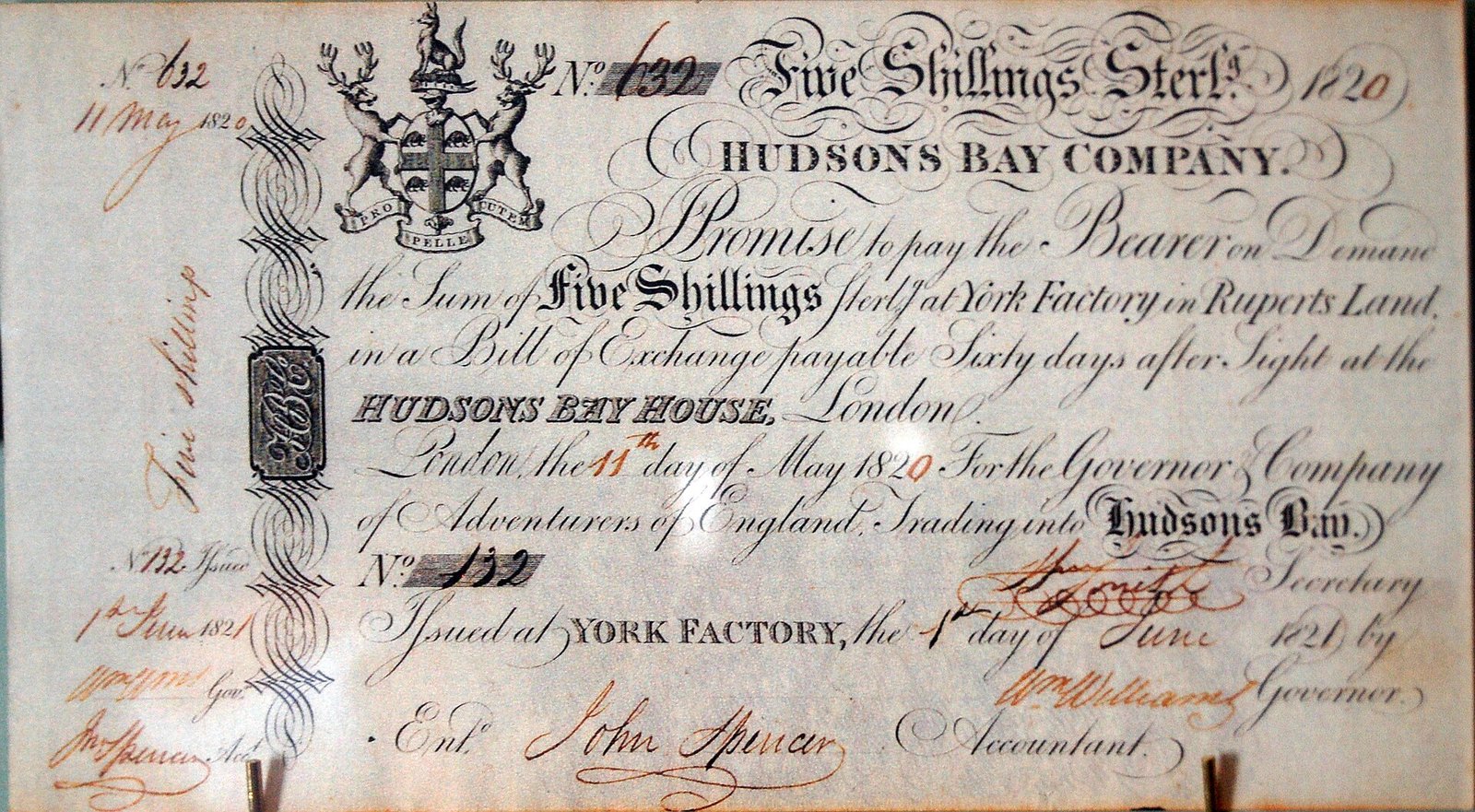
Image: Hudsons Bay Company currency to fur traders 1820 Fort York (crop).jpg — Hudsons_Bay_Company_currency_to_fur_traders_1820_Fort_York.j, CC BY-SA 2.0