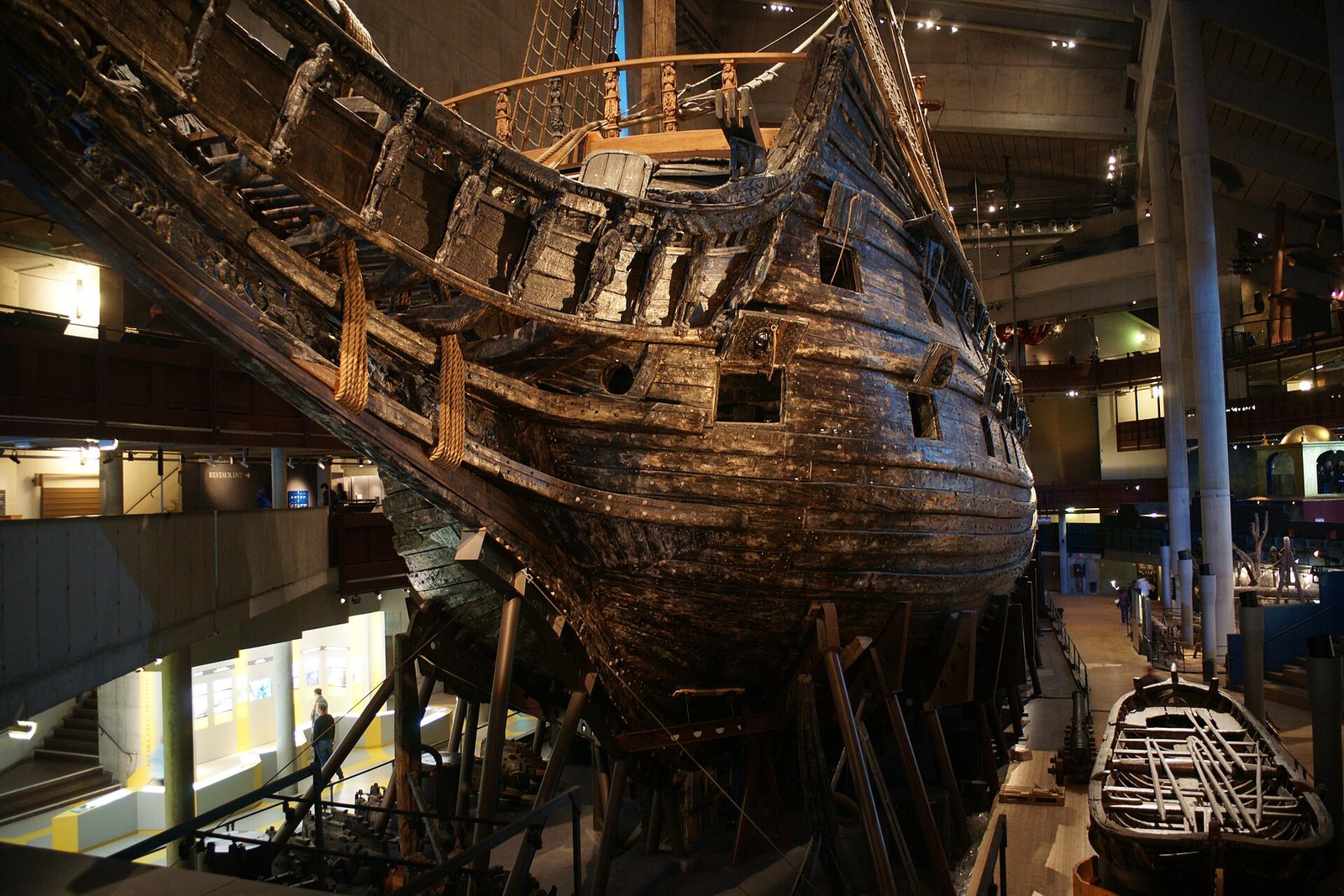
On Sunday, 10 August 1628, the pride of the Swedish fleet slid away from the quay in Stockholm. Crowds watched. Guns fired a salute. Then a gust of wind caught the ship, water rushed in, and the Vasa went to the bottom of the harbour. This article explains what the Vasa was, why it sank, who was to blame and why you can walk around it today.
What was the Vasa?
The Vasa was a warship ordered by King Gustav II Adolf of Sweden in 1625. It was built between 1626 and 1628.
The numbers were impressive. The ship was about 69 metres long and 11.7 metres wide. From the keel to the top of the mast it measured 52.5 metres. It carried 64 guns and ten sails.
The name comes from the Old Swedish word vase. It describes the sheaf of grain, or bundle of twigs, on the coat of arms of the Swedish royal house.
How was the Vasa built?
Construction began in the winter of 1626 at the Skeppsgården naval shipyard in Stockholm. The master shipbuilder was Henrik Hybertsson. He fell ill, and in the summer of 1626 he handed responsibility to his assistant, Hein Jakobsson. Hybertsson died in 1627.
The hull was launched in the spring of 1627. The work did not end there. Decoration, rigging and armament took roughly another year.
What happened on 10 August 1628?
The Vasa left its mooring in front of the Tre Kronor Palace in Stockholm. It was the ship’s first voyage.
Only four of the ten sails were set. The crew fired a salute from the ship’s guns.
Then came the wind. The first gust made the Vasa heel to port, but the ship came upright again. Off Tegelviken a second, stronger gust hit. This time the lower gunports were open. Water entered through them, and the ship began to sink.
The Vasa Museum says the ship sailed for about 20 minutes before it began taking in water and sinking. It had covered roughly 1,300 metres. It went down near Beckholmen, in 32 metres of water.
Think of a trip you could walk in about fifteen minutes.
Why did the Vasa sink?
The answer is stability. The part of the hull above the water was too tall and too heavy compared with the part below the water. A ship built like this cannot stand up to wind. It leans, and it does not come back.
Here is an everyday comparison. Picture a car with a heavy box strapped high on the roof. In a strong crosswind, the car feels unsteady. The Vasa had the same problem on a much bigger scale.
The guns get blamed often, but they were not the main cause. They made up only about 5 per cent of the ship’s total displacement. By themselves they do not explain the sinking. The real cause was a high centre of gravity, and that came from the structure of the hull itself.
Was the danger known before the voyage?
Yes. In the summer of 1628 a stability test was held. Thirty men ran from one side of the deck to the other. The ship leaned over so dangerously that Vice Admiral Klas Fleming stopped the test.
The king was pressing to get the ship to sea. Fleming did not report the alarming result to Gustav II Adolf.
The ship sailed anyway.
Who was aboard?
About 150 to 250 people were on board when the ship sank. About 30 of them died.
Many were not sailors on duty. The wives and children of crew members had joined the first leg as guests. The plan was to put them ashore at Vaxholm before the ship continued.
Another group was missing. The Vasa was meant to pick up 300 soldiers at the summer naval base at Älvsnabben. They had not yet boarded when the ship went down.
Who was blamed?
Investigators looked at two ideas. One was that the crew was drunk. The other was that the guns had broken loose from their lashings. Captain Söfring Hansson rejected both on 11 August 1628. The testimony that the museum cites points to a design flaw.
On 5 September 1628, a 17-member commission held hearings at the Tre Kronor Palace. Despite this effort, nobody was punished for the sinking.
Timeline
- 1625: King Gustav II Adolf orders the Vasa.
- 1626: Construction begins in Stockholm.
- 1627: The Vasa is launched. Henrik Hybertsson dies.
- Summer 1628: A stability test with thirty men is stopped because the ship leans dangerously.
- 10 August 1628: The Vasa sinks in Stockholm Harbour on its first voyage.
- 11 August 1628: Captain Söfring Hansson is questioned.
- 5 September 1628: The inquiry commission holds hearings at the Tre Kronor Palace.
- 1663–1665: Divers using a diving bell recover almost all of the guns.
- 1920: A request to blast wrecks for furniture oak is refused.
- 25 August 1956: Anders Franzén locates the Vasa.
- 24 April 1961: The ship is raised to the surface.
- 1962–1979: The hull is sprayed with a polyethylene glycol solution.
- 15 June 1990: The permanent Vasa Museum opens.
How was the Vasa found and raised?
The guns came first. From 1663 to 1665, divers led by Albrecht von Treileben and Andreas Peckell used a diving bell. They brought up almost all of the Vasa’s guns.
Then the wreck lay quiet for centuries. Anders Franzén found it on 25 August 1956. He took blackened oak samples from the seabed off Beckholmen, and that identified the ship.
The Vasa came up on 24 April 1961. It had spent 333 years on the bottom.
Why was the wreck so well preserved?
Three things helped, according to a research paper by Lars Ivar Elding. The brackish water of Stockholm contains no shipworm. The mud on the bottom has no oxygen. The water is cold.
These conditions kept the wood in good shape. The Vasa Museum says that about 98 per cent of the ship on display is original.
Where is the Vasa now?
The ship stands in the Vasa Museum on Djurgården island in Stockholm, the capital of Sweden. The permanent museum building opened on 15 June 1990.
If you plan a trip to Stockholm, this is the answer to “Vasa museum” and “where is the Vasa” in one stop. You will see the real hull, not a copy.
Details you won’t find in guidebooks
- The name is not written on the ship. The word Vasa does not appear in letters on the hull. A sheaf of grain on the stern, from the Vasa dynasty’s coat of arms, stands for the name.
- A refused blast. In 1920 the brothers Simon and Leonard Olschanski asked to blow up wrecks between Beckholmen and Tegelviken to get dark oak for furniture. The authorities said no.
- Wood treatment took 17 years. Waterlogged wood shrinks and cracks as it dries. To prevent this, a polyethylene glycol solution was sprayed on the hull from 1962 to 1979.
- The ship was colourful. Peter Tångeberg studied about 1,200 tiny paint samples between 1990 and 2002. They showed that the Vasa was painted in bright colours at first, and some parts were gilded.
FAQ
Where did the Vasa sink?
The Vasa sank in Stockholm Harbour, near Beckholmen, at a depth of 32 metres. It had sailed about 1,300 metres from its mooring in front of the Tre Kronor Palace.
Why did the Vasa sink?
Its hull above the waterline was too high and heavy compared with the hull below it. A strong gust heeled the ship over, and water poured in through the open lower gunports.
Where can you see the Vasa today?
The ship is on display at the Vasa Museum on Djurgården island in Stockholm, Sweden’s capital. The permanent museum building opened on 15 June 1990.
How many people died when the Vasa sank?
About 30 people died. Roughly 150 to 250 people were aboard, including crew members’ wives and children who were guests on the first leg of the voyage.
Did anyone get punished for the sinking?
No. A 17-member inquiry commission questioned witnesses at the Tre Kronor Palace on 5 September 1628, but nobody was punished.
Sources
- Vasa Museum — Facts about Vasa vasamuseet.se
- Vasa Museum — Timeline vasamuseet.se
- Vasa Museum — The Disaster vasamuseet.se
- Vasa Museum — Utredningen (the inquiry) vasamuseet.se
- Vasa Museum — Vasa genom åren vasamuseet.se
- Vasa Museum — Why was Vasa so well preserved when the ship was salvaged? faq.vasamuseet.se
- Lars Ivar Elding — VASA: Recent Preservation Research lucris.lub.lu.se
- English Wikipedia — Vasa (ship) en.wikipedia.org
- English Wikipedia — Vasa Museum en.wikipedia.org
- Turkish Wikipedia — Vasa (gemi) tr.wikipedia.org
Image: The Vasa from the Bow.jpg — JavierKohen, CC BY-SA 3.0