Most ruins in Turkey sit on a plain or a coast. Termessos does not. It sits high in the mountains above Antalya, in a valley between peaks. An army marching below had to look up at it.
This guide covers the history, the map, the ruins, the hike and the national park around them. It is written for you if you are planning a trip, studying the ancient world, or just curious about the city Alexander the Great did not take.
Termessos history: who lived here?
Termessos is an ancient Pisidian city. It stands on Güllük Mountain in the Taurus range, in Antalya Province. The mountain’s ancient name was Solymos. The city was founded in the valley between its peaks.
The people of Termessos had their own name for themselves. In the poetic inscriptions found in the city, they called themselves Solymians. The name is old. In Homer’s Iliad, the Solymians appear among the peoples Bellerophon fought.
So the city carried a Homeric name on its own stones. Think of a town today that prints a famous old story on its street signs. The people here did the same, only in verse.
Termessos map: where is it and how high?
The Ministry of Culture and Tourism places the national park about 34 kilometres northwest of Antalya. Directions follow the Antalya–Korkuteli road.
UNESCO’s tentative-list entry gives the height of Termessos as about 1,050 metres above sea level. That is the number to remember when you plan your day. You are not visiting a seaside site. You are climbing into the mountains.
If you open a map, look for the Güllük Mountain–Termessos National Park. The ruins lie inside it.
Termessos how to get there
Use the Antalya–Korkuteli road northwest from Antalya. The park lies about 34 kilometres from the city.
Once you park, the rest is on foot. A path leads uphill from the car park to the ancient city. Wear shoes you trust on stone.
Termessos hike: what you meet on the path
The walk is the first part of the visit. The path climbs from the car park to the ruins.
On the right side of the path, you will see the steps and monumental entrance of an Ionic temple. It was built in the time of Emperor Hadrian. You pass it before you reach the main city.
The path rises steadily, so you feel the altitude in your legs.
Alexander the Great and Termessos in 333 BC
This is the story that brings most readers here. During his Anatolian campaign in 333 BC, Alexander the Great did not capture Termessos.
What exactly happened is disputed. The Antalya Provincial Directorate of Culture and Tourism describes a siege in 333 BC that met strong defence. The Princeton Encyclopedia of Classical Sites tells it differently. It says Alexander considered an attack, then chose to march on Sagalassos.
Both versions agree on the result. He did not take the city.
The ground explains why. Princeton, passing on the account of Arrian, says the hills below Termessos squeezed the road from both sides. That formed a pass that was easy to defend. An attacker had to enter a narrow gap with defenders above.
Timeline
- 333 BC: Alexander the Great moves on toward Sagalassos without taking Termessos. The sources differ on whether this was a siege or a decision not to attack.
- 319 BC: Alketas, who fled Antigonos, takes refuge in Termessos and kills himself.
- 189 BC: Manlius Vulso lifts the siege of Isinda and imposes a 50-talent penalty on Termessos.
- 159–138 BC: The stoa west of the agora is built in the reign of Attalos II.
- About 70 BC: A treaty with Rome secures the city’s autonomy.
- 2nd century AD: The period indicated by the architecture of the surviving theater stage building.
- 1970: Güllük Mountain–Termessos National Park is established.
- 25 February 2000: The park is submitted to the UNESCO World Heritage Tentative List.
- 2025: Findings from the systematic excavations led by Mustafa Koçak are announced, including the necropolis.
What happened after Alexander
The city kept appearing in the wars that followed. In 319 BC, Alketas lost a fight to Antigonos. He fled to Termessos. According to Princeton, he killed himself so that he would not be handed over to his enemy.
In 189 BC, the Roman commander Manlius Vulso lifted the siege of Isinda, which Termessos had been conducting. He then imposed a 50-talent penalty on Termessos. So the city could be pressed. It could not simply be erased.
Around 70 BC, Termessos made an alliance treaty with Rome. The Termessos Epigraphy Project at Akdeniz University says the treaty gave the city wide autonomy. Coins from the Roman Imperial period carry the title Autonomous, which expresses that status.
Termessos ruins: what to see
The ruins lie in the mountain valley. Here are the main sights, in the order they matter.
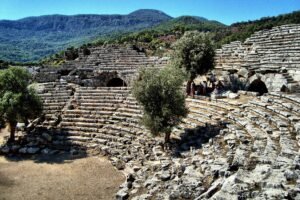
The theater. The Culture Portal gives the capacity as about 4,000 to 5,000 spectators. The seating has 24 rows in total. Eight lie above the horizontal walkway and sixteen below it. Picture a small stadium cut into the slope. The stage building shows the architecture of the 2nd century AD.
The stoa. West of the agora stands a Doric stoa. It dates to the reign of King Attalos II of Pergamon, between 159 and 138 BC.
The Hadrian-era temple. You pass its steps and monumental entrance on the path up. The temple has an Ionic order.
The cisterns. On the flat ground east of the agora, five cisterns are joined by passages.
Details you won’t find in guidebooks
- A house with a founder’s name. A Roman-type villa in the southwest of the city is called the House of the Founder, after an inscription on its door. Its facade wall reaches six metres.
- A dog with a poem. The Dog Sarcophagus came from Termessos and is shown in the Antalya Museum. Its poetic inscription was written by Rhodope for her dog, Stephanos. Today people post tributes to their pets online. Rhodope had hers carved in stone.
- Five linked cisterns. The five connected cisterns east of the agora are joined by passages.
- A word on Roman coins. The word Autonomous on Roman Imperial coins announced the city’s political status.
- A city that named itself. The Solymian name appears in the city’s own poetic inscriptions, not only in Homer.
Termessos National Park and UNESCO status
The Güllük Mountain–Termessos National Park was established in 1970, according to the Ministry of Environment and Urbanisation’s 2013 Antalya report. On 25 February 2000, it was submitted to the UNESCO World Heritage Tentative List in the mixed heritage category.
Tentative list means the site is proposed. It is not yet inscribed. That wording matters if you read travel pages that claim more.
New excavations at Termessos
Work continues. A news report dated 28 November 2025 says systematic excavations at Termessos are led by Assoc. Prof. Mustafa Koçak of Antalya Science University. They run under the Legacy for the Future Project.
The 2025 report says the necropolis has more than 3,000 tombs and over 900 inscriptions recorded. Those numbers show how much of the city’s story still lies in its graves.
FAQ
Where is Termessos?
Termessos is in Antalya Province, Türkiye, on Güllük Mountain in the Taurus range. The Ministry of Culture and Tourism places the national park about 34 kilometres northwest of Antalya, reached by the Antalya–Korkuteli road.
Did Alexander the Great conquer Termessos?
No. He did not capture the city during his Anatolian campaign in 333 BC. Sources differ on why. One account describes a siege met by strong defence. Another says he considered an attack and marched on Sagalassos instead.
How high is Termessos?
UNESCO’s tentative-list entry puts Termessos at about 1,050 metres above sea level.
How do you reach the ruins from the car park?
A path runs uphill from the car park to the ancient city. On the right side of the path you pass the steps and monumental entrance of an Ionic temple built in the time of Emperor Hadrian.
What is the Dog Sarcophagus?
It is a sarcophagus from Termessos, now shown in the Antalya Museum. Its poetic inscription was dedicated by Rhodope to her dog Stephanos.
Sources
- Getty Research Institute — Termessus getty.edu
- UNESCO — Güllük Dagi-Termessos National Park whc.unesco.org
- Antalya Provincial Directorate of Culture and Tourism — Termessos antalya.ktb.gov.tr
- Ministry of Culture and Tourism — Antalya-Güllük Mountain National Park ktb.gov.tr
- Princeton Encyclopedia of Classical Sites — Termessos perseus.tufts.edu
- Akdeniz University — Termessos Epigraphy Project edkb.akdeniz.edu.tr
- Wikipedia — Termessos en.wikipedia.org
- Turkish Museums — Antalya Termessos Örenyeri turkishmuseums.kprod.kultur.gov.tr
- Culture Portal — Tarihin Tanıkları Antik Tiyatrolar kulturportali.gov.tr
- Hürriyet Daily News — Termessos excavations reveal ancient tombs and sarcophagi hurriyetdailynews.com
Image: Termessos – Theater.jpg — Ingo Mehling, CC BY-SA 3.0