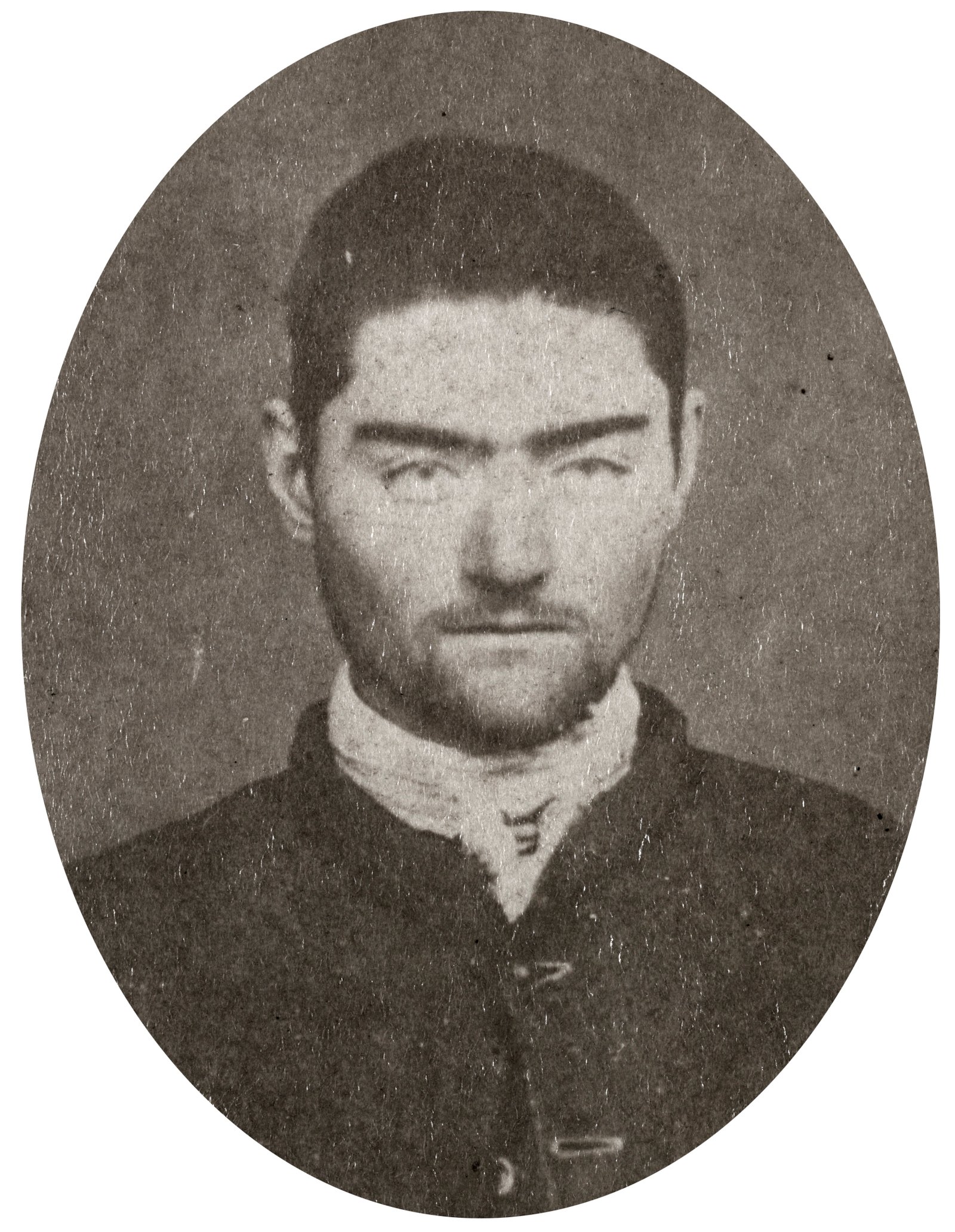
Ned Kelly is the man in the iron bucket helmet. Australians know his image the way you know a national flag. Yet people still disagree about what he stood for. Was he a cold-blooded gang leader, or a voice for poor families who felt crushed by the police? The facts are well documented, and they point in both directions.
Who was Ned Kelly?
Edward “Ned” Kelly was an outlaw and gang leader who operated in the colony of Victoria. He is best known for the metal armour he wore in his last fight with the police.
He was born in Beveridge, Victoria. The exact date is unknown. State Library Victoria says it falls between December 1854 and June 1855.
His mother, Ellen, was a free Irish immigrant. His father, John “Red” Kelly, came from Tipperary in Ireland. He was sent to Australia as a convict in 1841.
That background matters. It shapes how many Australians read his story.
Where did Ned Kelly live?
The records tie him to Beveridge, Victoria, by birth and to Glenrowan by his final stand.
In 1878 Ned and his brother Dan Kelly went into hiding. They were joined by Joe Byrne and Steve Hart. Together they formed the four-man Kelly Gang.
The gang’s story ends at Glenrowan, a town in Victoria about 236 kilometres north-east of Melbourne.
Timeline
- December 1854–June 1855: Ned Kelly is born in Beveridge, Victoria. The exact date is unknown.
- 1871: He receives prison sentences for assault and for receiving a stolen horse.
- 1878: Ned and Dan Kelly, Joe Byrne and Steve Hart form the Kelly Gang.
- October 1878: Three police officers are killed at Stringybark Creek.
- 1878: The gang robs a bank at Euroa.
- 1879: The gang robs a bank at Jerilderie, and the Jerilderie Letter sets out Kelly’s account.
- 27–28 June 1880: The siege at Glenrowan ends with Ned Kelly wounded and captured. The other three gang members die.
- 28–29 October 1880: Kelly is tried for the murder of Thomas Lonigan and sentenced to death.
- 11 November 1880: He is hanged at Old Melbourne Gaol.
- 2001: Allison Holland shows that the armour in the library is Ned Kelly’s.
- 5 July 2005: The Glenrowan Heritage Precinct is added to Australia’s National Heritage List.
From petty crime to the Kelly Gang
Kelly’s record began early. In 1871 he got three months for assault. Later that year he got three years for receiving a stolen horse.
The gang’s worst day came in October 1878. At Stringybark Creek in Victoria, the Kelly Gang killed three police officers.
The gang then turned to banks. They robbed one at Euroa in 1878. In 1879 they robbed another at Jerilderie, in New South Wales.
The Jerilderie Letter: Kelly’s own defence
Kelly wanted his side printed in the newspapers. He had Joe Byrne write it down in 1879. The result is the Jerilderie Letter, a 56-page manuscript explaining the gang’s actions.
In it, Kelly argued that he shot the police in self-defence. He also argued that his family suffered discrimination.
The court saw it differently. It treated the killing of Thomas Lonigan as murder.
This gap between the letter and the verdict is the core of the whole debate.
Ned Kelly’s armour: how it was made
The armour is the reason the story travels. It is also less mysterious than the legend suggests.
Kelly’s helmet, with its narrow eye slit, and his body armour were shaped from the thick metal mouldboards of ploughs. That is a farm tool, not a weapon. The pieces were joined with bolts and leather fastenings.
All four gang members wore armour at Glenrowan. State Library Victoria records Kelly’s suit at 44 kilograms. Think of the heaviest suitcase you have ever dragged through an airport. Now imagine wearing something heavier, in a gunfight, in winter.
What happened at Glenrowan?
In June 1880, Kelly planned to derail a train carrying police. The gang tore up part of the railway line for this purpose.
The plan failed. Thomas Curnow was a teacher whom the gang had let go. In the early hours of 28 June 1880 he stopped the oncoming engine and warned of the danger on the line.
The final siege took place on the night of 27–28 June 1880 around the Glenrowan Inn.
The armour did its job against bullets. But it left the legs exposed. Police sergeant Arthur Steele fired at Kelly’s unprotected legs, and Kelly went down.
Ned Kelly was the only gang member to survive the siege. Dan Kelly, Joe Byrne and Steve Hart all died.
Ned Kelly’s trial and death
Kelly was tried at the Central Criminal Court in Melbourne on 28–29 October 1880. He was found guilty of the murder of police officer Thomas Lonigan. Judge Redmond Barry sentenced him to death.
He was hanged at Old Melbourne Gaol on 11 November 1880.
Ned Kelly’s last words
Most people know the line “Such is life”. It appears on souvenirs and in books.
State Library Victoria is more careful. It says that most observers reported “Ah well I suppose”, or a longer form of those words. It adds that the reliability of the famous phrase is questioned.
So the best-known quote may be a later polish on a plainer sentence.
Outlaw or folk hero?
The Australian Government’s heritage listing for Glenrowan sums up the split. Some people see Kelly as a defender of poor and oppressed Irish people. Others see him as a murderer and an ordinary criminal.
Both views rest on real facts:
- The hero case: His family’s treatment, his Irish convict roots and the claims in the Jerilderie Letter.
- The criminal case: Three police officers killed at Stringybark Creek, bank robberies, and a plan to derail a train of police.
A court found him guilty of murder. Some Australians still see him as a defender of the poor. You can hold both facts at once.
Ned Kelly’s armour and museum: where to see it
The original armour is on display in the Redmond Barry Reading Room at State Library Victoria in Melbourne. If you are visiting the city, it is an easy stop.
For the siege site, travel to Glenrowan. The eight-hectare Glenrowan Heritage Precinct covers the railway platform, the inn site and the place where Kelly was captured. It joined the National Heritage List on 5 July 2005.
One film note for the curious: Mick Jagger played Kelly in a 1970 film, and Heath Ledger played him in 2003.
Details you won’t find in guidebooks
- A green sash under the iron. As a child, Kelly saved a boy from drowning and was given a green silk sash. He wore it under his armour during the last fight at Glenrowan.
- The armour was misidentified. For years the library’s suit was thought to be Steve Hart’s. Allison Holland’s 2001 research showed it was Ned Kelly’s.
- Police wanted the armour destroyed. Police chief Frederick Standish feared the suits would feed admiration for Kelly. He asked for all four to be broken up. Superintendent Sadler in Benalla delayed their return until Standish retired.
- The judge died soon after. Redmond Barry, an Irish-born judge, died on 23 November 1880. That was just 12 days after Kelly’s hanging.
- Science studied a second suit. The National Museum of Australia, the University of Canberra and ANSTO used neutron diffraction and X-ray tests on Joe Byrne’s armour. The results fit with it having been made in an open-air fire.
FAQ
What were Ned Kelly’s last words?
The famous line is “Such is life”. State Library Victoria notes that most observers reported “Ah well I suppose”, or a longer version of it, and that the famous line’s reliability is questioned.
Where can you see Ned Kelly’s armour?
The original armour is on display in the Redmond Barry Reading Room of the State Library Victoria in Melbourne.
How did Ned Kelly die?
He was hanged at Old Melbourne Gaol on 11 November 1880, after a court found him guilty of the murder of police officer Thomas Lonigan.
Where did Ned Kelly live?
He was born in Beveridge, Victoria, between December 1854 and June 1855. His last stand took place at Glenrowan, about 236 kilometres north-east of Melbourne.
Sources
- State Library Victoria — Ned Kelly information sheet slv.vic.gov.au
- State Library Victoria — Key information guides.slv.vic.gov.au
- State Library Victoria — Jerilderie letter guides.slv.vic.gov.au
- State Library Victoria — Kelly’s armour guides.slv.vic.gov.au
- State Library Victoria — Trial, execution and aftermath guides.slv.vic.gov.au
- State Library Victoria — Ned Kelly slv.vic.gov.au
- National Museum of Australia — Bushrangers nma.gov.au
- DCCEEW — Glenrowan Heritage Precinct dcceew.gov.au
- Wikipedia — Ned Kelly en.wikipedia.org
- Wikipedia — Glenrowan, Victoria en.wikipedia.org
- Türkçe Vikipedi — Ned Kelly tr.wikipedia.org
Image: Ned kelly 1874.jpg — Charles Nettleton (attributed), Public domain