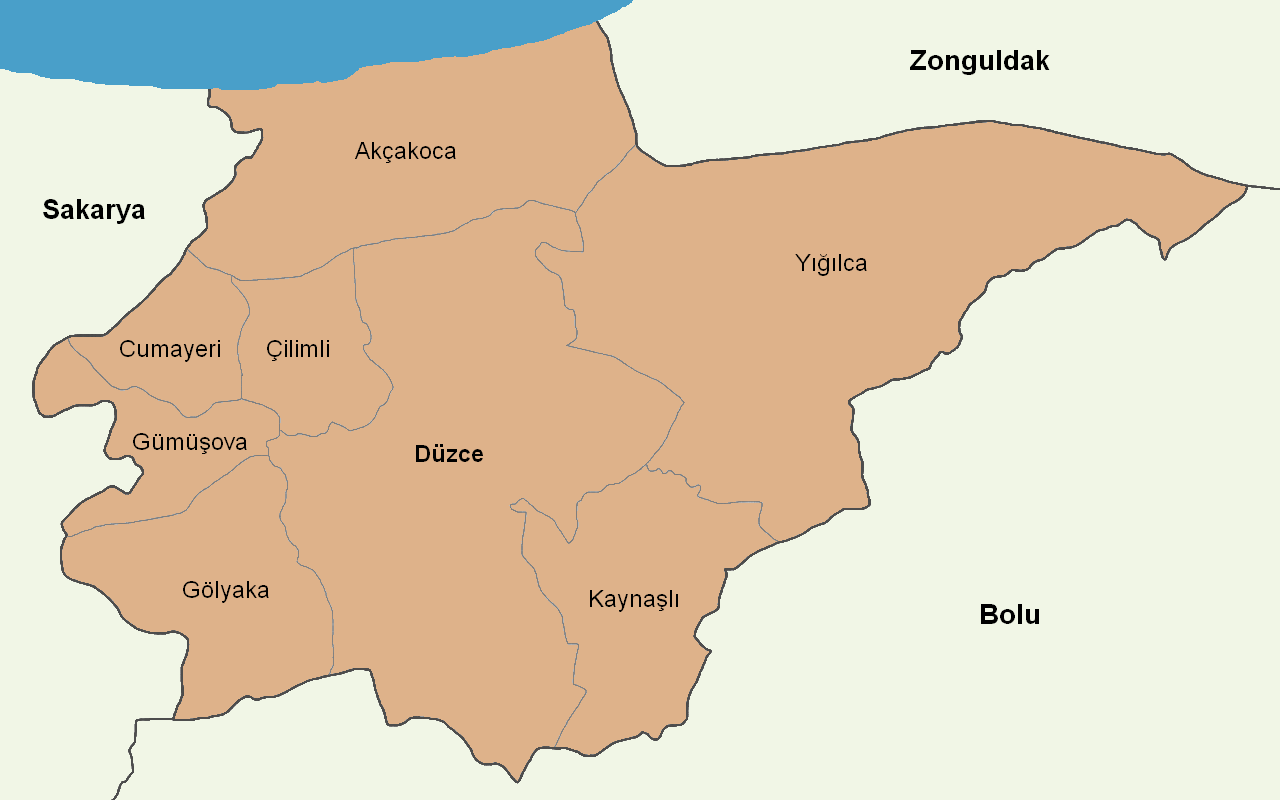
Understanding the history of Düzce
The history of Düzce begins with a distinction between two neighbouring places. Modern Düzce developed in the nineteenth century. About nine kilometres north stands Konuralp, formerly Üskübü, with its ancient settlement of Prusias ad Hypium. The modern city gradually took over the older centre’s role. If you want to understand Düzce, you need to follow both histories.
The contrast is clear in the records. In 1519, Düzce appeared as a rural market without a resident settlement. Konuralp’s history reaches back to Kieros and the kingdom of Bithynia. A market on the plain and an ancient town nearby therefore provide different starting points for the same regional story.
What is the origin of the name Düzce?
The origin of the name Düzce remains debated. One explanation connects it with flat terrain. Another links it to a salt market. A third proposes a connection with the ancient settlement of Dusae. These explanations should be treated as alternatives, rather than combined into a single settled account.
The salt-market explanation rests on the spelling in the 1519 register. It can be read as Tuzca or Duzca. In his entry for the TDV İslâm Ansiklopedisi, Metin Tuncel considers this connection more likely than the explanation based on flat land. The written form matters because it connects the name debate with an actual market record.
The Dusae theory points elsewhere. A Kiepert map places that ancient settlement about fifteen kilometres south of Düzce. The proposed connection therefore depends on a name associated with another location. It also needs to be distinguished from Prusias ad Hypium, whose remains are at Konuralp to the north.
For an everyday-life connection, think of the place where you do your shopping. Düzce’s 1519 entry identifies a place through its market activity without recording a resident settlement there. The register even gives its tax revenue: 1,200 akçe. That small financial detail makes the market more tangible than a name alone.
From Kieros to Prusias ad Hypium
The ancient settlement at Üskübü was called Kieros. According to the Düzce Governorate’s history, Prusias I took it from the Herakleians and renamed it Prusias Pros Hypios.
The TDV İslâm Ansiklopedisi uses the form Prusias ad Hypium. This name honoured Prusias and referred to the Hypius watercourse. For you as a reader, the key distinction is geographical: these ancient names belong to the settlement at present-day Konuralp. They are separate from the competing explanations for the name Düzce.
Bithynia passed under Roman rule in 74 BC following the bequest of its last king, Nicomedes IV. When the Roman Empire divided in 395, the Düzce region remained within the Eastern Roman territories. These dates place the area’s history within successive political settings without making the modern city itself an ancient foundation.
What survives from the ancient town?
Konuralp’s ancient theatre was built in the Hellenistic period. Roman additions later enlarged it. The building therefore preserves more than one phase of construction. Its history connects the settlement’s earlier development with its period under Roman rule.
The Düzce Governorate also lists Atlı Kapı, walls, aqueducts and the Roman Bridge among the principal surviving structures from the Hellenistic and Roman periods. Together with the theatre, they give you several points through which to approach Prusias ad Hypium. The ancient town’s surviving fabric extends beyond its best-known performance building.
Konuralp Museum was built to display finds from Prusias ad Hypium. Construction began in 1977 and ended in 1992. Archaeological work continued into a later phase when the theatre excavations joined the programme for twelve months of excavation each year in 2020.
Ottoman Konuralp and the rise of modern Düzce
The Provincial Directorate of Culture and Tourism dates Konur Alp’s incorporation of Konuralp into Ottoman territory to 1323. His name remains attached to the settlement and its tomb. Konuralp Tomb contains three graves, one of which is attributed to Ali Hamza, a person close to Konur Alp.
Düzce’s later development followed a different course. Its nineteenth-century growth accelerated with the settlement of immigrants from the Caucasus. This development explains why the region’s ancient remains and its later administrative centre occupy different places.
According to the municipality’s history, the district centre moved from Üskübü to Düzce in 1871. That transfer gives a precise administrative marker for the shift between the settlements. Düzce’s nineteenth-century growth was therefore accompanied by a formal change in where the district was administered.
The First Düzce Uprising began on 13 April 1920 and was suppressed on 26 May 1920. These dates mark another distinct episode in the city’s history. They belong to the story of the growing modern centre, long after the ancient settlement had acquired the name Prusias.
Earthquakes and provincehood in 1999
Düzce was affected by the earthquakes of 17 August and 12 November 1999. On 9 December that year, it became Türkiye’s 81st province. The new province was established through separation from Bolu after the November earthquake.
Konuralp’s administrative position changed again on 31 March 2014. Its municipal legal status ended, and the settlement became neighbourhoods within Düzce’s central district. Ancient Konuralp and modern Düzce thus became linked through another administrative change, following the district-centre transfer of 1871.
Historical buildings beyond Konuralp
The region’s surviving buildings also include mosques from different periods. The Provincial Directorate of Culture and Tourism dates Orhangazi Mosque in Sarıçökek village, in Kaynaşlı district, to the fourteenth century. It provides another point of reference for the area’s early Ottoman history alongside Konuralp.
Akçakoca preserves a different part of the architectural record. According to the Türkiye Culture Portal, 160 historic houses are protected within a conservation area. Most stand in Yukarı Mahalle. These houses broaden the regional story beyond ancient public buildings and religious monuments to include domestic architecture.
Details you won’t find in guidebooks
Konuralp’s theatre has a revealing difference between its popular name and its recorded dimensions. Local people call it Kırk Basamaklar, or Forty Steps. The official description calculates approximately thirty-six seating rows. The familiar name and the architectural count therefore preserve different ways of describing the same building.
A mosaic reported in November 2023 adds another close-up detail. Found in the upper part of the theatre, it depicts two lions facing a pine tree. A drum and a pan flute appear among the branches. These specific images offer a different perspective from the theatre’s seating and construction phases.
Hemşin Village Mosque, fifteen kilometres from Akçakoca, combines different building materials. Its lower storey is stone. Its upper storey uses the çantı timber construction technique, and wood also appears in its minaret. At the Republican-period Çuhallı Çarşı Mosque in Akçakoca’s Osmaniye neighbourhood, the pulpit carries the date 1371 AH, corresponding to 1951.
The regional heritage record also includes a tree and recovered objects. The oriental plane tree at Gölormanı village was reported as 550 years old; its monumental-tree registration received ministry approval on 17 June 2023. Separately, an Anadolu Agency report dated 21 October 2021 recorded twenty-six coins and sixteen objects recovered in Akçakoca and delivered to Konuralp Museum Directorate for examination.
Timeline
- 74 BC: Bithynia passed under Roman rule.
- 395: The region remained within the Eastern Roman territories.
- 1323: The provincial tourism authority dates Konuralp’s incorporation into Ottoman territory to this year.
- 1519: Düzce was recorded as an uninhabited rural market.
- 1871: The district centre moved from Üskübü to Düzce.
- 13 April–26 May 1920: The First Düzce Uprising took place.
- 1977–1992: Konuralp Museum’s building was constructed.
- 17 August and 12 November 1999: Earthquakes affected Düzce.
- 9 December 1999: Düzce separated from Bolu and became Türkiye’s 81st province.
- 31 March 2014: Konuralp’s municipal legal status ended.
- 2020: Theatre excavations entered the twelve-month programme.
- 17 June 2023: Gölormanı’s plane tree received approval for monumental-tree registration.
- November 2023: The theatre’s lion mosaic was found.
FAQ
What is the origin of the name Düzce?
The origin remains debated. Proposed explanations connect it with flat terrain, a salt market suggested by the Tuzca/Duzca reading in the 1519 register, or the ancient settlement of Dusae.
Is modern Düzce the same settlement as ancient Prusias ad Hypium?
Modern Düzce developed in the nineteenth century, replacing Üskübü, now Konuralp, as the principal centre. Konuralp, about nine kilometres north, occupies the ancient settlement.
When did Düzce become a province?
Düzce became Türkiye’s 81st province on 9 December 1999. It separated from Bolu after the earthquakes of 17 August and 12 November 1999.
What historical remains can you find at Konuralp?
The principal remains include the ancient theatre, Atlı Kapı, walls, aqueducts and the Roman Bridge. Konuralp Museum was built to display finds from Prusias ad Hypium.
Sources
- TDV İslâm Ansiklopedisi — Düzce, Metin Tuncel islamansiklopedisi.org.tr
- Düzce Governorate — History duzce.gov.tr
- Düzce Provincial Directorate of Culture and Tourism — Konuralp Tomb duzce.ktb.gov.tr
- Düzce Municipality — Düzce History duzce.bel.tr
- English Wikipedia — Düzce Province en.wikipedia.org
- Turkish Wikipedia — Düzce tr.wikipedia.org
- Düzce Provincial Directorate of Culture and Tourism — Konuralp Ancient Theatre duzce.ktb.gov.tr
- Düzce Provincial Directorate of Culture and Tourism — Ancient Theatre Excavations duzce.ktb.gov.tr
- TRT Haber / Anadolu Agency — Lion Mosaic Discovery trthaber.com
- Ministry of Culture and Tourism — Konuralp Museum muze.gov.tr
- Düzce Provincial Directorate of Culture and Tourism — Mosques duzce.ktb.gov.tr
- Düzce Provincial Directorate of Culture and Tourism — Hemşin Village Mosque duzce.ktb.gov.tr
- Türkiye Culture Portal — Çuhallı Çarşı Mosque kulturportali.gov.tr
- Türkiye Culture Portal — Akçakoca Historic Houses kulturportali.gov.tr
- Arkeolojik Haber / Anadolu Agency — Historical Objects Recovered in Düzce arkeolojikhaber.com
Image: Düzce location districts.png — Batuhan duz, CC BY-SA 4.0