Where is the Hippodrome of Constantinople today?
The Hippodrome of Constantinople occupies the site now called Sultanahmet Square, in Istanbul’s Fatih district. Its surviving central monuments are the Obelisk of Theodosius, the Serpent Column and the Walled Obelisk. Together, they connect the square to Egypt, Delphi and the imperial life of Constantinople.
You can place the former arena between two familiar landmarks. The Sultanahmet Mosque stands to the east. To the west is the Ibrahim Pasha Palace, which houses the Museum of Turkish and Islamic Arts. These buildings frame the modern square around the former racing ground.
Today, the site is a public square. This ground also served public gatherings under the Ottomans, when it was called Atmeydanı. Princes’ circumcision festivities and other entertainments took place here. The setting changed, but the former Hippodrome continued to accommodate collective public life.
Hippodrome of Constantinople history: who built it?
The traditional account credits Septimius Severus with the first Hippodrome. That attribution is disputed. Cyril Mango instead attributed the structure to Constantine I. One reason was the absence of archaeological evidence that could securely date it to Severus’s reign.
Constantine made Constantinople his capital in 330. Within that imperial arrangement, the Hippodrome stood beside the palace. Its position joined the racing arena to the seat of power. Chariot racing and the emperor’s public appearances therefore belonged to the same architectural setting.
The emperor’s box, called the kathisma, stood on the eastern side. A private passage connected it to the Great Palace. This connection gave the ruler direct access to his place before the crowd. You can understand the arena’s political role more clearly by keeping that palace connection in mind.
In 532, the Hippodrome became a setting for mass killing during the suppression of the Nika uprising. The figure of approximately 30,000 deaths comes from the contemporary historian Procopius. It should be understood as a figure transmitted through his account.
Hippodrome of Constantinople capacity: how large was it?
English Wikipedia estimates the Hippodrome’s dimensions at approximately 450 by 130 metres. It also gives an estimated capacity of 100,000 spectators. Both figures are estimates, rather than precise measurements of a complete surviving arena.
The capacity is especially contested. Jonathan Bardill’s calculation, based on the seating areas, suggests approximately 30,000 spectators. The two estimates produce very different pictures of the crowd, so neither should pass without qualification.
The Obelisk of Theodosius: an Egyptian monument in Sultanahmet
The Obelisk of Theodosius began its history at the Temple of Karnak in Egypt. It was erected for Pharaoh Thutmose III in the fifteenth century BCE. Its Egyptian origin long predates its installation in Constantinople.
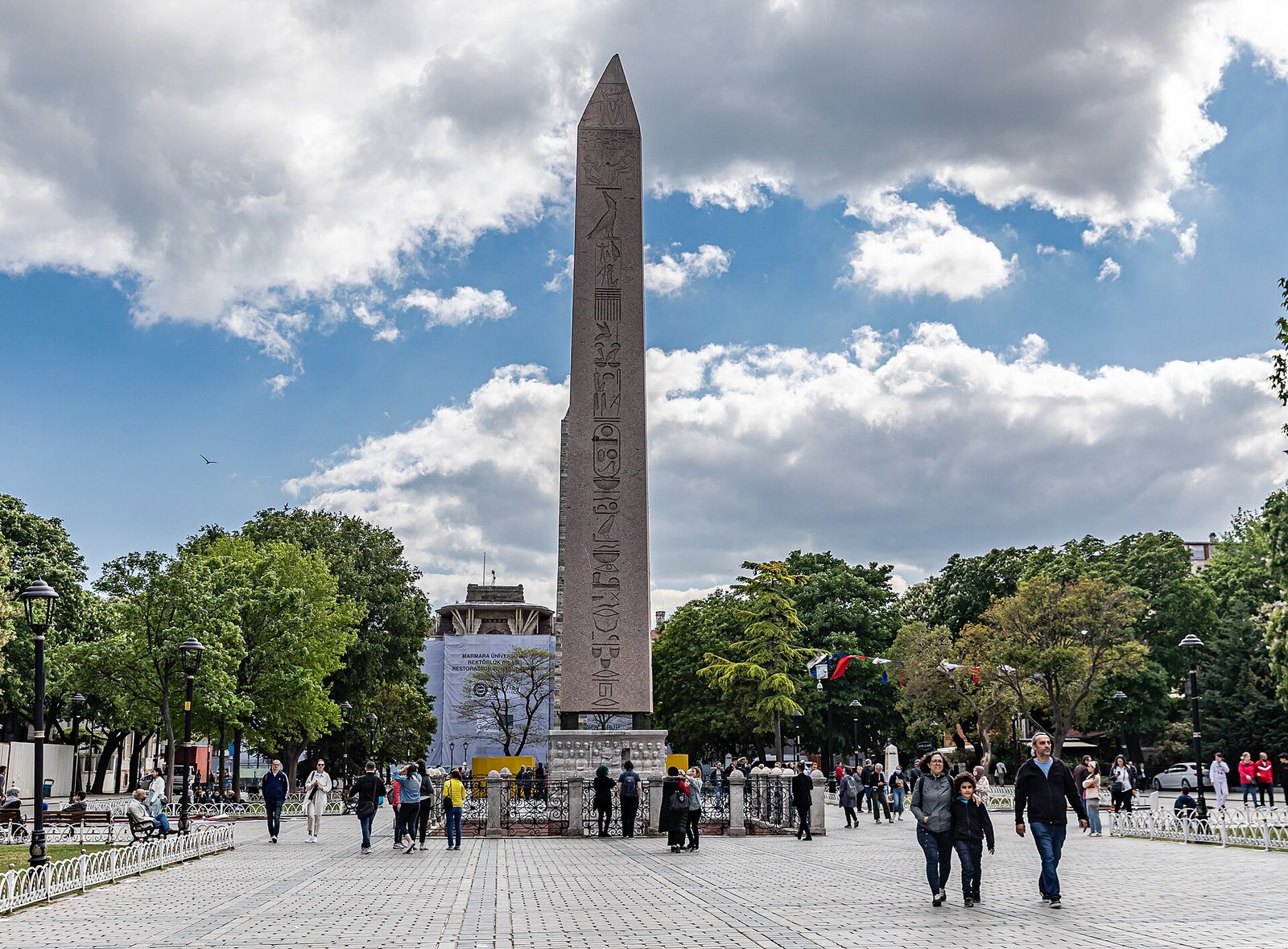
Theodosius I had the transported monument erected in the Hippodrome in 390. Its surviving shaft is approximately 18.54 metres high. The stone is red granite from Aswan. These facts distinguish the Egyptian shaft from the marble pedestal beneath it.
Four bronze supports carry the granite shaft above that pedestal. If you study the monument from its base upward, you can separate its materials: marble below, bronze at the supporting points and red granite above. The familiar name commemorates Theodosius, but the shaft itself was made for Thutmose III.
The pedestal also records the work of erection. Its Latin inscription gives a duration of 30 days. Its Greek inscription gives 32 days. Both figures belong to the monument’s own written presentation of the undertaking.
The Serpent Column: why is it among the obelisks?
The Serpent Column is a bronze support from a tripod cauldron monument dedicated to Apollo at Delphi. The Greeks made that offering after the victory at Plataea in 479 BCE. Its original purpose was therefore a victory dedication, rather than an Egyptian royal monument.
Constantine I brought it from the Temple of Apollo at Delphi to the Hippodrome. The surviving work represents three intertwined snakes. It is hollow and was cast in a single piece. Its material and construction differ sharply from the granite obelisk nearby.
The column’s coils bear the names of 31 Greek city-states that participated in the Persian Wars. Those names connect the bronze to the communities commemorated by the dedication. The column carried that written record with it from Delphi to Constantinople.
An account dated 21 October 1700 complicates claims that someone deliberately broke off the snakes’ heads. Silâhtar Fındıklılı Mehmed Ağa recorded that the heads fell. He also reported that an investigation found no evidence of human intervention.
The Walled Obelisk: the monument stripped of bronze
The Walled Obelisk stands in the southern part of the Hippodrome’s central axis. It is approximately 32 metres high. Constantine VII’s intervention in the tenth century repaired and clad an existing monument. His work should therefore be described as restoration and embellishment.
Its gilded bronze plates were removed and melted during the Fourth Crusade in 1204. The monument standing in the square has consequently lost a major part of that earlier appearance. Its recorded bronze covering matters when you imagine the Hippodrome’s central line of monuments.
The Greek restoration inscription compares the monument to the Colossus of Rhodes. It also names Romanos, the son of Constantine VII. The inscription connects the repair to both an imperial family and an admired monumental precedent.
What happened to the Hippodrome of Constantinople?
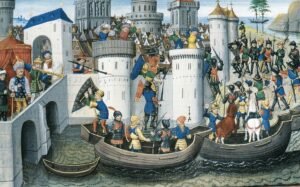
The Hippodrome suffered looting during the Fourth Crusade in 1204. Its four bronze horses were taken to Venice and installed at the Basilica of San Marco. The same episode saw the removal of the Walled Obelisk’s bronze cladding.
Part of the substructure supporting the curved southern end survives. This section is called the sphendone. It preserves evidence of the arena’s built form beyond the freestanding monuments in the square.
The former arena later served as the Ottoman Atmeydanı. Excavations at Sultanahmet began on 27 March 1927. The site also belongs to the wider heritage setting recognized by UNESCO: the Historic Areas of Istanbul entered the World Heritage List in 1985, and UNESCO identifies the Hippodrome among their important monuments.
Hippodrome of Constantinople vs Circus Maximus
The Hippodrome of Constantinople and Rome’s Circus Maximus shared an imperial function. Both combined chariot racing with the emperor’s appearance before the public. Their significance extended beyond the contests taking place on the track.
At Constantinople, the kathisma and its private connection to the Great Palace made that relationship architectural. The ruler’s place in the arena was linked directly to his palace. This provides a concrete comparison with the Circus Maximus as an imperial spectacle ground.
Timeline
- Fifteenth century BCE: Thutmose III’s obelisk was erected at Karnak.
- 479 BCE: The victory at Plataea prompted the dedication at Delphi associated with the Serpent Column.
- Disputed origins: The traditional account places the Hippodrome’s beginnings under Septimius Severus.
- 330: Constantine I’s capital incorporated the Hippodrome as a palace-connected imperial space.
- 390: Theodosius I erected the Egyptian obelisk in the Hippodrome.
- 532: The suppression of the Nika uprising brought mass killing to the arena.
- Tenth century: Constantine VII repaired the Walled Obelisk and covered it with gilded bronze plates.
- 1204: Crusader looting removed the bronze horses and the Walled Obelisk’s cladding.
- 21 October 1700: Silâhtar’s account recorded the fall of the Serpent Column’s heads.
- 27 March 1927: Excavations began at the Sultanahmet Hippodrome.
- 1985: The Historic Areas of Istanbul entered the World Heritage List.
- 2021: Cambridge University Press published Engin Akyürek’s The Hippodrome of Constantinople.
Details you won’t find in guidebooks
The Hippodrome’s seating changed after the Nika uprising. Wooden spectator benches burned during the unrest. Under Justinian, stone benches replaced them. This repair ties a change in the arena’s fabric to the events of 532.
The Walled Obelisk also acquired a practical use. During the 1927 excavations, investigators found positions for taps on all four sides of its pedestal. Those traces showed that the pedestal had served as a fountain. A monument associated with imperial restoration had also supplied an everyday need.
Hippodrome of Constantinople photos: what should you look for?
For photographs of the Egyptian obelisk, look at the relationship between the granite shaft, bronze supports and marble pedestal. These are distinct parts of the surviving monument. A view that includes the base helps explain how the shaft is supported.
For the Serpent Column, concentrate on the intertwined bronze coils. For the Walled Obelisk, remember its lost gilded bronze covering. You are looking at monuments with different materials and histories, although all three stand along the former Hippodrome’s central axis.
FAQ
Where is the Hippodrome of Constantinople today?
Its site is Sultanahmet Square in Istanbul’s Fatih district. The Sultanahmet Mosque stands to the east, and the Ibrahim Pasha Palace stands to the west.
Do you need tickets for the Hippodrome of Constantinople?
You can see the outdoor Hippodrome monuments without buying an entrance ticket because they stand in a public square.
How many spectators could the Hippodrome hold?
Estimates differ. English Wikipedia gives approximately 100,000 spectators, while Jonathan Bardill’s calculation based on seating areas suggests approximately 30,000.
Are all the surviving monuments Egyptian obelisks?
No. The Obelisk of Theodosius came from Egypt. The Serpent Column came from Delphi, while the Walled Obelisk was repaired and clad under Constantine VII.
Sources
- Vikipedi — Sultanahmet Meydanı tr.wikipedia.org
- Engin Akyürek — The Hippodrome of Constantinople, Cambridge excerpt assets.cambridge.org
- Wikipedia — Hippodrome of Constantinople en.wikipedia.org
- Wikipedia — Obelisk of Theodosius en.wikipedia.org
- Arif Müfid Mansel — İstanbul’daki Burmalı Sütun, Belleten belleten.gov.tr
- Wikipedia — Walled Obelisk en.wikipedia.org
- Yasemin Tümer Erdem — Atatürk Dönemi Arkeoloji Çalışmalarından Biri: Sultanahmet Kazısı dergipark.org.tr
- Cambridge University Press — The Hippodrome of Constantinople cambridge.org
- UNESCO — Historic Areas of Istanbul whc.unesco.org
Image: Sultanahmet Square, Obelisk of Theodosius, Istanbul (52121868925).jpg — Ninara, CC BY 2.0