Where is Harran, Turkey?
Harran is a historic settlement in Şanlıurfa Province, Türkiye. It sits in Upper Mesopotamia, about 45 kilometres southeast of the city of Şanlıurfa. If you plan a trip, start in Şanlıurfa and head southeast.
The town stands in the middle of the plain that bears its name. This was not an accident. Harran grew where the historic trade routes between Anatolia and Mesopotamia crossed.
Think of a major motorway junction today. Fuel stations, cafés and warehouses gather there because everyone passes through. Harran played that role for travellers on foot and with animals.
The name fits the setting. Scholars explain Harran through the Akkadian word harranu, which meant road, journey and caravan. The town’s name is, in effect, “the road”.
How old is Harran city?
Harran is very old. Cuneiform tablets found at Kültepe and Mari, dated to the early second millennium BCE, record the name as Har-ra-na or Ha-ra-na. So the name was already written down about four thousand years ago.
In the ancient Mesopotamian religions, Harran was one of the major cult centres of Sin, the Moon God.
Harran also had a brief moment as a capital. After Nineveh fell in 612 BCE, the Assyrian administration gathered at Harran under Ashur-uballit II. This made the town the last capital of the Assyrian Empire.
In 53 BCE the Battle of Carrhae took place around Harran. A Parthian army under Surena defeated the army of the Roman commander Marcus Licinius Crassus. Carrhae is the Roman name of the town.
In 640, during the time of Caliph Umar, Harran came under Islamic rule. Later it became a capital again. Under Marwan II, the last Umayyad caliph, Harran was the capital of the caliphate from 744 to 750.
Timeline
- Early 2nd millennium BCE: Tablets from Kültepe and Mari record the name Harran.
- After 612 BCE: Harran becomes the last capital of the Assyrian state under Ashur-uballit II.
- 53 BCE: The Parthians defeat the Roman army at the Battle of Carrhae.
- 640: Harran enters Islamic rule.
- 744–750: Harran is the capital of the Umayyad caliphate.
- Early Abbasid period: Harran is known for science and the translation of Greek works.
- 12th century: The period of the Zengids, to which the medrese excavated in 2021 is dated.
- 1979: Harran is placed under protection as an archaeological and urban site.
- 25 February 2000: Harran and Şanlıurfa are submitted to the UNESCO Tentative List.
- 2021: Medrese remains are uncovered north of the Great Mosque.
Harran University and the “world’s first university” claim
Searches for “Harran University” bring up two different things. One is the modern university that carries the town’s name. The other is the old claim that Harran held the world’s first university. Here is what the sources say.
First, there is a real scientific tradition. In the early Abbasid period, Harran was one of the important centres where Greek texts on astronomy, mathematics and medicine were translated. One of its best-known names is Thabit ibn Qurra, a mathematician and translator who died in 901.
Second, there is a building. In 2021, archaeologists from Harran University excavated a medrese, a school building. The university’s own report of 22 November 2021 dates it to the 12th century, the Zengid period, based on archaeological data.
The building lies about 50 metres north of the Harran Great Mosque. It has an open courtyard and two storeys. The excavators identified 24 rooms from the surface. Five of them, together with the monumental entrance, have been fully uncovered.
Third, there is the label. In a statement of 17 January 2023, Harran University presented the find as confirmation that the world’s first university stood in Harran. Turkey’s UNESCO Tentative List text also calls Harran the place where the first Islamic university was founded. UNESCO’s page notes that the state that submitted the text is responsible for its content.
The sources do not agree on dates. The Turkish Maarif Encyclopedia describes the medrese built by Fakhr al-Din ibn Taymiyya, who died in 1225, as the building that could be counted as Harran’s first medrese. That points to a later period of institutions.
The careful summary is this. Harran had a lively centre of science and translation. A 12th-century medrese has been excavated there. Whether either one counts as “the world’s first university” depends on how you define a university. That is why we do not present it as proven fact.
Harran in the Bible: Abraham and Haran
Many readers arrive here because of Abraham. In the Book of Genesis, 11:31, Terah takes his son Abraham, his grandson Lot and Abraham’s wife Sarah. They set out for the land of Canaan, but they settle in Haran.
Genesis 12:4 says Abraham was 75 years old when he left Haran for Canaan.
The biblical Haran is usually identified with the Harran near Şanlıurfa. There is a caution, though. Excavations have not provided enough evidence to confirm the period attributed to Abraham and his family. So the link rests on the sacred text and tradition, not on a find you can point to.
If you visit, treat the Abraham story as the story told about the place. Do not expect a marker that proves it.
Beehive houses: how they are built
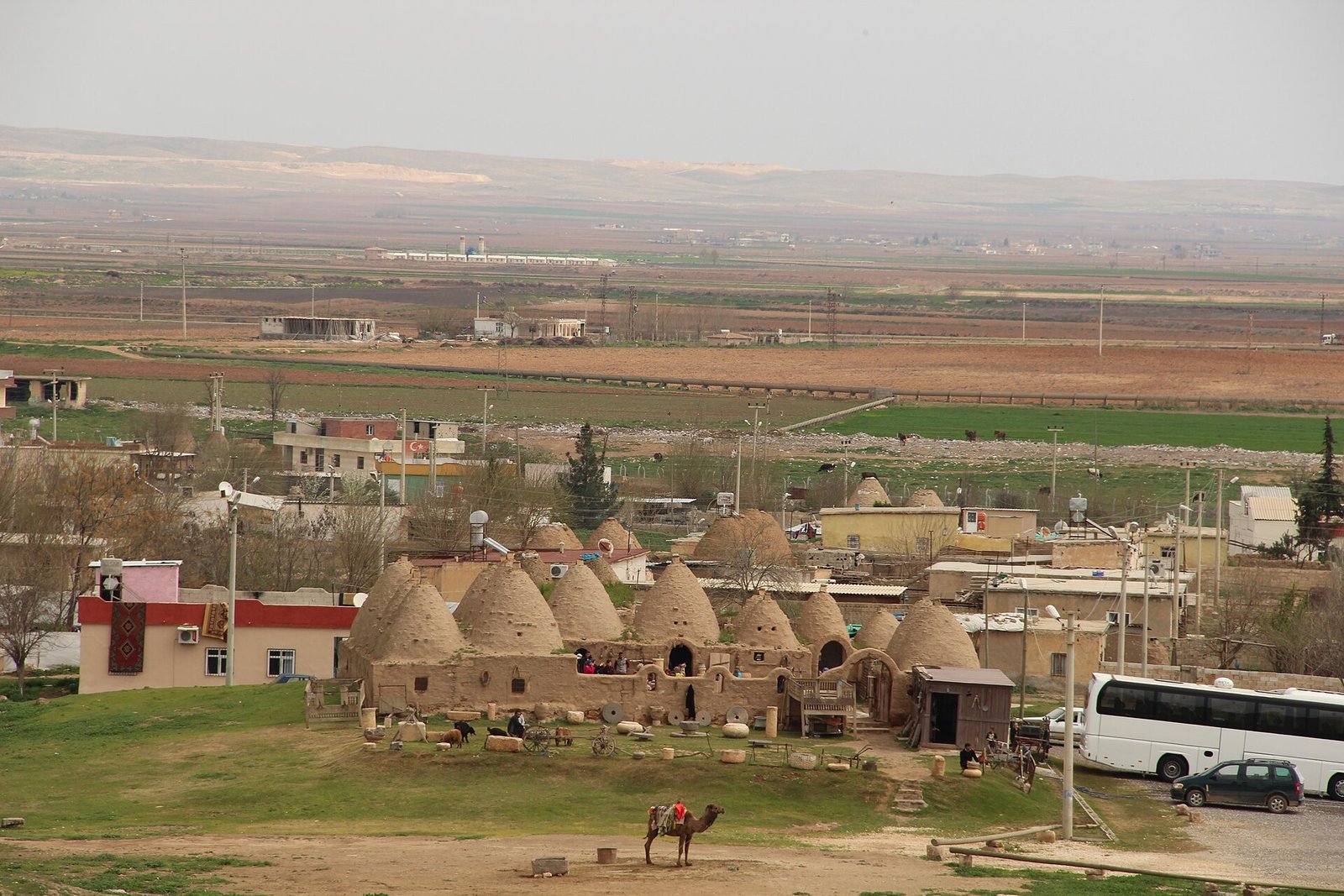
The beehive houses are what most visitors photograph. Locals call them kümbet houses. Each one is a brick dome on a nearly square base.
Builders use corbelling. They narrow the brick courses gradually as the walls rise, until the rows close at the top.
The numbers are impressive. Inside, a dome can reach 5 metres in height. It may be made of 30 to 40 courses of brick.
A 1998 study in Habitat International adds a practical point. These houses are built from flat bricks, either fired or sun-dried. They could be put up quickly, much like tents.
There is also a simple everyday comparison. A tent keeps heat off a family in summer and shelters it in winter, and it goes up fast. These domes follow the same logic in brick.
How old are they?
The houses you see today are younger than the town. The sources give different estimates. The Harran District Governorate says 150–200 years. The Culture Portal says about 250 years.
So when you read that the houses are “thousands of years old”, be careful. The tradition is old, but the buildings are not.
Details you won’t find in guidebooks
- Old bricks reused. According to the Culture Portal, the roughly 250-year-old domed houses reuse bricks collected from the ancient site.
- 960 domes counted. When Harran was protected as an archaeological and urban site in 1979, 960 domes were counted. Collecting building material from the ancient site was banned at that time.
- A hole with two jobs. The opening at the top of each dome works as both a skylight and a chimney.
- Built-in ladders. Brick projections on the outside of the dome let people climb up for maintenance.
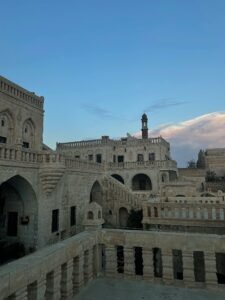
- A tall minaret. The square-bodied minaret of the Great Mosque is 33.30 metres high. Its base measures 5.20 × 5.20 metres, according to the measurements of Nurettin Yardımcı.
- A disputed mosque date. The first construction of the Great Mosque is debated. A 2021 study by Ahmet Aslan links the building to Maslama ibn Abd al-Malik. It treats the time of Marwan II as an expansion phase, which challenges earlier datings.
What to look for when you visit
Start with the domes. Step inside one, look up and count the brick courses. You will see how a flat brick becomes a curved roof.
Then look at the skyline. Find the square minaret of the Great Mosque, and remember that it stands 33.30 metres tall.
Finally, think about the road. Harran began as a stop on a route, and its name means “road”. Everything else in this article grew from that fact.
FAQ
Where is Harran located?
Harran is in Şanlıurfa Province, Türkiye, in Upper Mesopotamia. It lies about 45 kilometres southeast of the city of Şanlıurfa, at the centre of the plain that carries its name.
Was Harran home to the world’s first university?
This is a claim, not a settled fact. Harran University calls a medrese found in 2021 the world’s first university, but archaeological data date that building to the 12th century, the Zengid period. Other sources describe an earlier science and translation tradition rather than a university.
Is the biblical Haran the same as Harran in Turkey?
It is usually identified with it. Genesis 11:31 says Terah, Abraham, Lot and Sarah settled in Haran. Excavations have not yet produced enough finds to confirm the period linked to Abraham and his family.
How old are the beehive houses of Harran?
The houses standing today are not ancient. The district governorate gives 150–200 years, and the Culture Portal gives about 250 years. The building tradition itself is much older.
Is Harran a UNESCO World Heritage Site?
Not yet. Harran and Şanlıurfa were submitted to the UNESCO Tentative List on 25 February 2000 by the Ministry of Culture. That is a preliminary step.
Sources
- TDV İslâm Ansiklopedisi — Harran islamansiklopedisi.org.tr
- Republic of Türkiye Ministry of Culture and Tourism — Harran ve Harran’daki Mimari Eserler ekitap.ktb.gov.tr
- Encyclopaedia Iranica — Ḥarrān iranicaonline.org
- Wikipedia — Harran en.wikipedia.org
- Türk Maarif Ansiklopedisi — Harran turkmaarifansiklopedisi.org.tr
- UNESCO World Heritage Centre — Harran and Sanliurfa (Tentative List) whc.unesco.org
- Harran University — Dünya’nın İlk Üniversitesi’nin Harran Şehrinde Olduğu Tescillendi harran.edu.tr
- Harran University — Eski Harran Okulunda Önemli Bir Kalıntı w3.harran.edu.tr
- Wikipedia — Harran (biblical place) en.wikipedia.org
- Kültür Portalı — Harran Kümbet Evleri kulturportali.gov.tr
- Harran Kaymakamlığı — Harran Kümbet Evleri harran.gov.tr
- Ministry of Culture and Tourism — Harran Yönetim Planı 2016–2021 kvmgm.ktb.gov.tr
- Karadeniz Technical University AVESİS — Vernacular domed houses of Harran, Turkey avesis.ktu.edu.tr
- Harran İlahiyat Dergisi — Harran Ulu (Firdevs) Camii’nin İnşa, Genişleme ve Yıkılış Süreci dergipark.org.tr
Image: Harran 2015.jpg — Hamdigumus, CC0