Basilica Cistern history: what it is
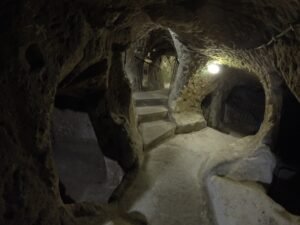
The Basilica Cistern, called Yerebatan Sarnıcı in Turkish, is an underground water reservoir in Istanbul. It was built in the 6th century under Emperor Justinian I. It sits in the historic peninsula, about 150 metres southwest of Hagia Sophia.
The name “Basilica” comes from the Stoa Basilica, the building above which the cistern lies. The Turkish name Yerebatan Sarayı, “the palace sunk into the ground”, is linked to the look of many marble columns rising out of the water.
Think of the water tank in any apartment building. It exists so the taps keep running when supply is short. Byzantine Constantinople needed the same kind of reserve on a city scale, and this hall is one of those reserves.
How big is it?
The Culture Portal of the Turkish Ministry of Culture and Tourism describes a rectangular plan measuring 140 × 70 metres. That gives an area of 9,800 square metres. The cistern can hold about 100,000 tons of water.
The first measurements were made during the First World War by the German archaeologist Eckhard Unger. He measured the hall at 138 × 64.6 metres. The small gap between his numbers and the modern ones is a detail most guidebooks skip.
The forest of 336 columns
Inside, 336 columns stand in 12 rows of 28. Each is about 9 metres high. Most are made of marble and granite, and most were taken from older buildings. Some are a single piece. Others are made of two pieces.
One decorated column repeats three motifs: a peacock’s eye, a drooping branch and a teardrop shape.
Before you reach the columns, you walk down a stone staircase of 52 steps.
The two Medusa heads
The two Medusa heads are Roman-period sculpture fragments. They sit in the northwest corner of the cistern, and each is used as a base under a column.
They do not face the same way. The western head is upside down. The eastern one lies on its side.
Researchers still debate several points:
- Why the angles? One theory says the positions neutralise the protective power of Medusa’s face. Another says the stones were set this way when they were reused from other buildings.
- Where did they come from? One claim says they came from the Column of Constantine (Çemberlitaş). It rests on similarities with examples around the Istanbul Archaeology Museums. The building they were taken from is not known for certain.
- Why are they here? Researchers think they were brought to the cistern only to serve as column bases.
The heads came to light during the Istanbul Metropolitan Municipality’s extensive repair and cleaning work in 1985–1987.
Timeline
- 6th century: The cistern is built under Justinian I.
- After 1453: It keeps serving the water needs of Topkapı Palace for a time.
- 16th century: Petrus Gyllius introduces it to Western readers. Local people are already drawing water from it.
- 1723: Architect Kayserili Mehmet Ağa repairs it under Ahmed III.
- 1955–1960: Nine columns at risk of breaking are wrapped in thick concrete.
- 1985–1987: Cleaning and restoration reveal the Medusa heads.
- 1987: The cistern opens as a museum.
- 2020–2022: İBB Miras carries out structural strengthening and restoration.
- 18 April 2026: A 1 TL entry fee starts for Turkish citizens.
- 6 June 2026: The cistern reopens under the Directorate General of Foundations.
- 12 October 2026: Travel agencies’ new bulk ticket purchases move to a digital portal.
From Ottoman water store to museum
After the Ottoman conquest of 1453, the cistern kept working for a while. It supplied the water needs of Topkapı Palace.
In the 16th century, Petrus Gyllius researched Istanbul and described the cistern to Western readers. By then, people living nearby were already using it to draw water.
In 1723, Architect Kayserili Mehmet Ağa repaired it during the reign of Ahmed III.
The modern era began with the 1985–1987 restoration. Workers removed more than 50,000 tons of mud from the hall. The cistern opened to visitors as a museum in 1987.
The most recent works ran from 2020 to 2022. Worn iron ties were replaced with stainless steel elements. The aim was to make the structure more resistant to earthquakes.
Basilica Cistern photos: what to look for
You will want a few specific shots:
- The long rows of columns rising from the water. This is the view behind the name “underground palace”.
- The two Medusa heads in the northwest corner. One is upside down and one lies sideways.
- The column with the peacock’s-eye, branch and teardrop motifs.
- The stone staircase of 52 steps as you go down.
Where is the Basilica Cistern?
The cistern is in Fatih, in Istanbul’s historic peninsula. The registered address is Alemdar Mahallesi, Yerebatan Caddesi 1/3, Fatih, Istanbul. Map coordinates are about 41.00806° N, 28.97778° E.
It lies about 150 metres southwest of Hagia Sophia, which makes that landmark a handy reference point.
Basilica Cistern tickets, entrance fee and official website
Ticket arrangements changed in 2026, so read dates carefully.
- 18 April 2026: Kültür İstanbul announced a 1 TL entry fee for Turkish citizens showing ID.
- 6 June 2026: The cistern reopened under the Directorate General of Foundations. Entry was free for Turkish citizens throughout June.
- Müzekart: The Directorate General’s statement, reported in the press in June 2026, said entry would work through the Müzekart system once it was set up.
- 12 October 2026: Travel agencies now make new bulk ticket purchases only through the Museum Business Partner Portal.
Price announcements from the earlier operating period should not be treated as the current tariff. Check the current price before you travel.
Two websites appear as the official site. Turkish Wikipedia lists yerebatansarnici.gov.tr, and English Wikipedia links yerebatan.com. Because management changed hands in 2026, confirm which one is current before you pay.
Basilica Cistern opening hours
Because the management changed in 2026, check the hours on the current official channel before you go.
An older notice from the previous operating period listed “Night Shift” visits from 19:30 to 22:00. That record comes from the earlier operator, so confirm it before planning an evening around it.
Details you won’t find in guidebooks
- Unger’s First World War measurement was 138 × 64.6 metres. The modern figure is 140 × 70.
- Nine columns were wrapped in concrete in 1955–1960 because they risked breaking.
- The latest restoration removed later-added flooring. That revealed the original Byzantine paving.
- The staircase down into the cistern has 52 steps.
- One decorated column repeats peacock-eye, drooping-branch and teardrop motifs.
- When Gyllius described the cistern to Western readers, local people were already drawing water from it.
Frequently asked questions
See the FAQ block below for short answers on location, builder, the Medusa heads, the columns and the official website.
FAQ
Where is the Basilica Cistern?
It is in Istanbul’s historic peninsula, about 150 metres southwest of Hagia Sophia. The registered address is Alemdar Mahallesi, Yerebatan Caddesi 1/3, Fatih, Istanbul.
Who built the Basilica Cistern?
It was built in the 6th century under Emperor Justinian I as an underground water reservoir.
Why is one Medusa head upside down?
Nobody knows for certain. One theory says the position neutralised the head’s protective power. Another says the stones were simply placed that way when they were reused from other buildings. The western head is upside down and the eastern one lies on its side.
How many columns does the Basilica Cistern have?
There are 336 columns, each about 9 metres high. They form 12 rows of 28.
Can you buy Basilica Cistern tickets from one official website?
Two websites appear in public references: yerebatansarnici.gov.tr in the Turkish Wikipedia entry and yerebatan.com in the English Wikipedia entry. Management changed in 2026, so check which channel is current before you buy. The Directorate General of Foundations (Vakıflar Genel Müdürlüğü) has announced that entry will work through the Müzekart system.
Sources
- Wikipedia — Basilica Cistern en.wikipedia.org
- Vikipedi — Yerebatan Sarnıcı tr.wikipedia.org
- Kültür Portalı — Yerebatan Sarnıcı kulturportali.gov.tr
- İBB Atatürk Kitaplığı — Yerebatan Sarnıcı Müzesi ataturkkitapligi.ibb.gov.tr
- Kültür İstanbul — 15 asırlık Yerebatan Sarnıcı kultur.istanbul
- Kültür İstanbul — Yerebatan Sarnıcı Türk vatandaşlarına 1 TL kultur.istanbul
- Anadolu Ajansı — Yerebatan Sarnıcı’nı hafta sonu yaklaşık 25 bin kişi ziyaret etti aa.com.tr
- Habertürk — Yerebatan Sarnıcı haziranda Türk vatandaşlarına ücretsiz haberturk.com
- TÜRSAB — Yerebatan Sarnıcı Güncel Ziyaret Bilet Fiyatları Hakkında Duyuru tursab.org.tr
- TÜRSAB — Yerebatan Sarnıcı’nda Yeni Biletleme Uygulaması tursab.org.tr
Image: Cisterna Basílica, Estambul, Turquía, 2024-09-28, DD 58-60 HDR.jpg — Diego Delso, CC BY-SA 4.0