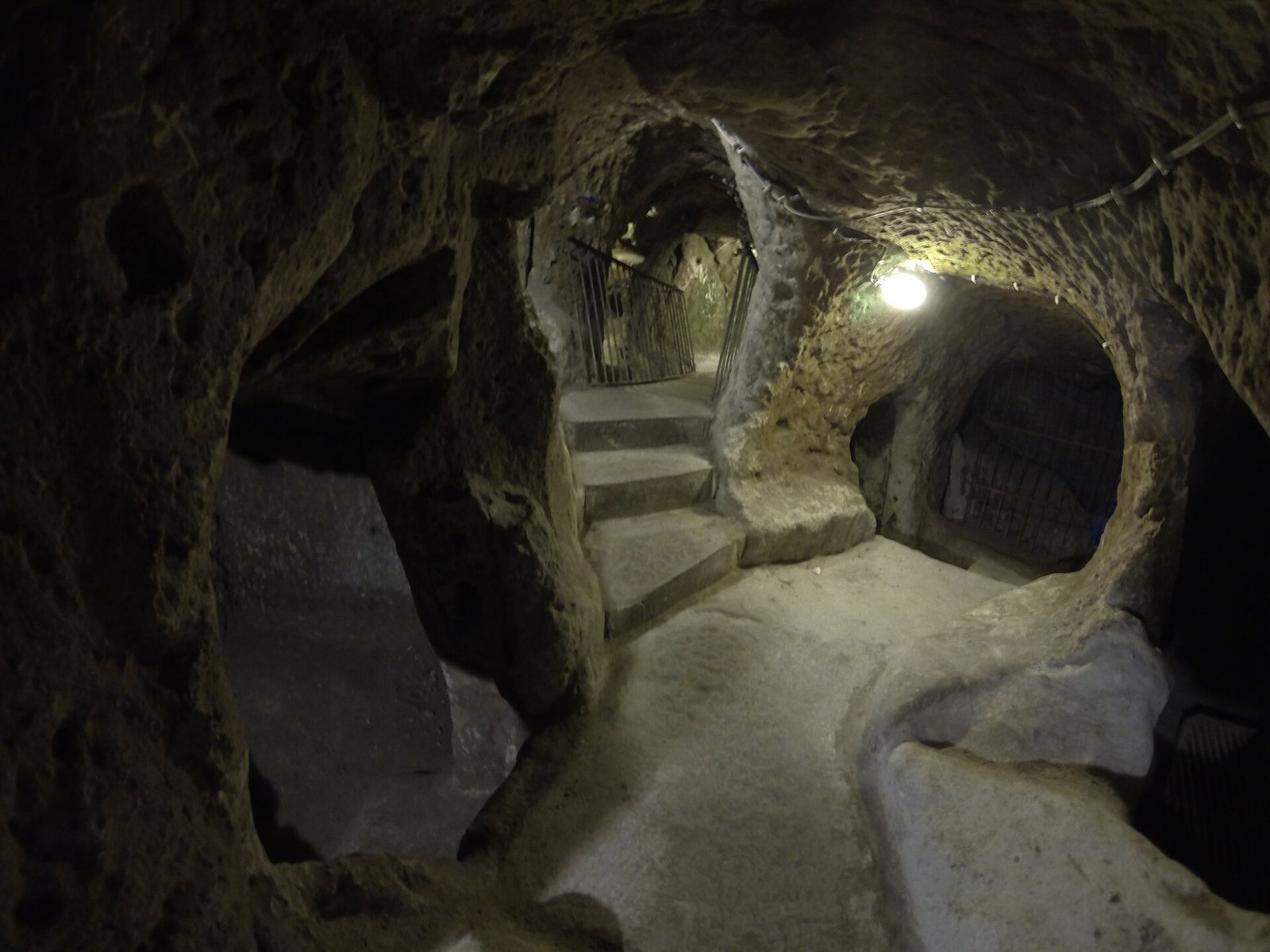
Derinkuyu is a whole settlement cut into the rock under a Cappadocian town. The ministry describes it as eight levels deep. It had stables, storerooms, a refectory, a church and a winery. This guide gives you the facts: where it is, how old it is, who used it, how it was found and how to visit.
Derinkuyu Underground City: where is it?
The city lies in the Derinkuyu district of Nevşehir Province, Türkiye. It sits on the Nevşehir–Niğde road. Central Nevşehir is about 30 kilometres away.
The official visiting address is Bayramlı Mahallesi, Şemşili Yolu Sokak, No:15, Derinkuyu/Nevşehir. Put that into your navigation app.
The site is also part of a larger World Heritage property. In 1985 UNESCO listed “Göreme National Park and the Rock Sites of Cappadocia”. Derinkuyu is one of its components. That is why you will see it on most Cappadocia itineraries.
Derinkuyu underground city map: how the levels are arranged
The ministry’s current museum text calls Derinkuyu eight-level. A plan in the ministry brochure, reworked from O. Aydan, shows each level in a different colour. The seventh and eighth levels share one legend entry.
So do not expect eight neat, separate floors on paper. The brochure plan groups the two deepest levels together.
The museum page also links to Google, Apple and Yandex maps. These cover the route to the site. Inside, you follow the marked path.
How deep does it go?
The Nevşehir Museum Directorate gives a depth of about 85 metres. The brochure adds a detail that guidebooks skip. The vent shaft near the entrance shows a depth of about 40 metres. Counting the well on the seventh level brings the figure to about 85 metres.
Another source describes a vent shaft that reaches the surface and is 55 metres deep. It also works as a water well. One shaft therefore supplied both air and water.
What was inside?
People lived here with their daily needs close at hand. The site has spaces set aside for different uses:
- stables
- storerooms
- a refectory
- a church
- a winery where grapes were pressed
Think of a village squeezed into a cellar. Animals, food and worship all sat within a short walk of one another.
The ministry also names a missionary school, a baptismal pool and a confession place. On the second level, the large hall called the missionary school has a barrel-vaulted ceiling. The sources note that this shape is rare in underground cities.
Stairs that descend after the third and fourth levels lead to a cross-plan church on the level below.
How was it defended?
The defence system used large round stone blocks. People rolled them across tunnels to close them off.
Water was a weak point in any siege. The ministry explains that the link between some wells and the surface was kept closed. The aim was to stop an invader from poisoning the water.
UNESCO says underground settlements such as Derinkuyu and Kaymaklı served as refuges against Arab invasions.
Derinkuyu underground city age: when was it built?
This is the part where the sources disagree. English Wikipedia relays a view that ties the first carving to the Phrygians in the 8th–7th centuries BCE. A 2025 academic review by Elif Kahya Yıldırım says such early dates are not settled. The review points to a lack of archaeological and archaeometric data.
A claim about a Hittite-period hand mill also appears. It was reportedly found on the lower levels. Since the mill may have been carried there later, it is not enough to date the whole city. A moved object cannot date the whole city. So the Hittite origin is not proven.
What the sources do support is a later story. English Wikipedia says the site was expanded in the Late Roman period, with chapels and Greek inscriptions added. It also says the multi-level form took shape in the Byzantine period.
If someone gives you an exact year for the first dig, treat it with caution.
Who built Derinkuyu underground city?
The honest answer is that the original builders are unknown. Phrygians are one proposal, and the evidence is thin. The Hittite idea rests on a movable object.
The better-supported answer concerns later users. Late Roman additions and the Byzantine multi-level layout point to Christian communities. The missionary school, the baptismal pool, the confession place and the churches fit that picture.
The rock helped them. The rooms and passages are carved into tuff, a common Cappadocian rock made of compacted volcanic ash.
Timeline
- 8th–7th centuries BCE: The period proposed by the theory linking the first carving to the Phrygians. Do not treat it as a confirmed construction date.
- Late Roman period: The underground spaces are said to be expanded with chapels and Greek inscriptions.
- Byzantine period: The multi-level settlement develops. It serves as a refuge during Arab invasions.
- 1923: According to English Wikipedia, the settlement is abandoned after the Turkish–Greek population exchange.
- 1963: A house renovation reveals the way into the tunnel network. This is the root of the rediscovery story.
- 1965 / 1967: The opening to visitors is dated 1965 on the ministry’s museum directorate page and 1967 on Turkish Wikipedia.
- 1985: Göreme National Park and the Rock Sites of Cappadocia, which includes Derinkuyu, joins the UNESCO World Heritage List.
- 24 October 2026: The official tariff lists 13 euros for foreign visitors. T.C. identity card holders appear under MüzeKart.
Derinkuyu underground city discovery: the 1963 story
English Wikipedia gives the rediscovery account. In 1963 a local resident was renovating a house. Behind a basement wall, the person found a room and the entrance to a tunnel network. The sources do not name the resident.
If you have ever opened a wall during a home renovation, you know the feeling of finding something unexpected. Here the hidden space turned out to be a city.
According to English Wikipedia, the settlement was abandoned after 1923, when the Christian population left under the population exchange. The visitor opening came later. The ministry’s directorate gives 1965. Turkish Wikipedia gives 1967.
Derinkuyu underground city tickets, hours and visiting tips
The official tariff was checked on 24 October 2026. It lists 13 euros for foreign visitors. It says holders of a T.C. identity card can enter with MüzeKart. Prices change, so confirm the figure on the official tariff before you go.
The official museum page, read the same day, gives the hours. The site is open daily from 08.00 to 18.00. The ticket office closes at 17.15. Do not arrive at closing time.
The Ministry of National Education’s visit notes warn about the passages. They are narrow and low. The floor is slippery in places and has steps. Wear shoes with grip and expect to duck.
If you want a guide, check with the site or a local operator.
Derinkuyu underground city photos
The ministry’s museum page carries interior photographs, so you can preview the rooms before you go. Inside, you can look for:
- the round stone blocks used to close the tunnels
- the barrel-vaulted hall on the second level
- the cross-plan church below the third and fourth levels
- the vent shaft that doubles as a water well
The passages are narrow, so keep your pace steady for other visitors.
Details you won’t find in guidebooks
- Two depths for one city. About 40 metres is the figure from the vent shaft near the entrance. About 85 metres includes the seventh-level well, according to the ministry brochure.
- A rare ceiling. The second-level hall called the missionary school has a barrel vault. The sources say this form is rare in underground cities.
- A shaft with two jobs. A 55-metre vent shaft reaches the surface and also works as a water well.
- Wells cut off on purpose. The surface link of some wells was kept closed to prevent poisoning of the water during an invasion.
- Levels seven and eight share a legend. In the brochure plan from O. Aydan, the two deepest levels sit under one colour entry.
FAQ
Where is Derinkuyu Underground City?
It is in the Derinkuyu district of Nevşehir Province, Türkiye. It lies on the Nevşehir–Niğde road, about 30 kilometres from central Nevşehir.
What are the opening hours?
The official museum page, read on 24 October 2026, says the site is open every day from 08.00 to 18.00. The ticket office closes at 17.15.
How deep is Derinkuyu?
The Nevşehir Museum Directorate gives a depth of about 85 metres. The ministry brochure explains that the roughly 40 metres measured by the vent shaft near the entrance grows to about 85 metres once the well on the seventh level is counted.
Sources
- Ministry of Culture and Tourism — Derinkuyu Yeraltı Şehri muze.gov.tr
- General Directorate of Cultural Heritage and Museums — Nevşehir Müze Müdürlüğü kvmgm.ktb.gov.tr
- General Directorate of Cultural Heritage and Museums — Derinkuyu brochure turkishmuseums.kprod.kultur.gov.tr
- UNESCO — Göreme National Park and the Rock Sites of Cappadocia whc.unesco.org
- English Wikipedia — Derinkuyu underground city en.wikipedia.org
- Turkish Wikipedia — Derinkuyu Yeraltı Şehri tr.wikipedia.org
- Elif Kahya Yıldırım — Nevşehir ve Çevresindeki Yeraltı Şehirlerinin Kültürel Coğrafya Açısından Değerlendirilmesi (Asia Minor Studies) dergipark.org.tr
- DÖSİMM — Müze ve Ören Yeri Ücretleri dosim.ktb.gov.tr
- Ministry of National Education — Okul Dışı Öğrenme Ortamları, Derinkuyu Yeraltı Şehri okuldisiogrenme.eba.gov.tr
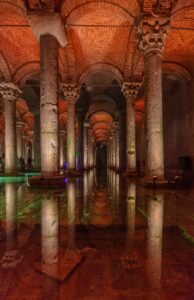
Image: Derinkuyu Underground City 9910 Nevit.jpg — Nevit Dilmen (talk), CC BY-SA 3.0