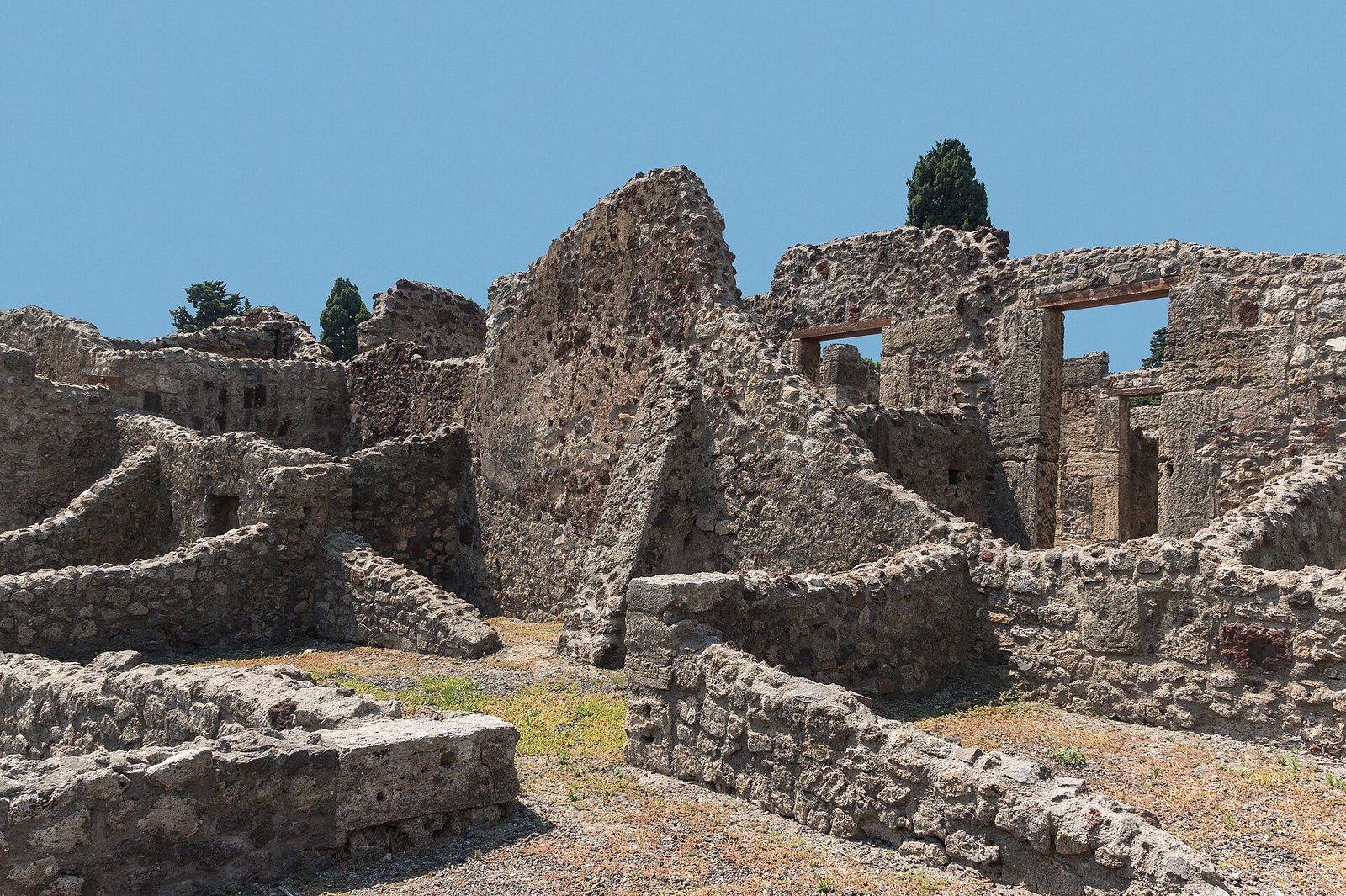
Pompeii: where is it?
Pompeii is an ancient Roman city in Italy’s Campania region. It lies near Naples, inside the borders of the modern commune of Pompei. If you want to find the ruins on a map, the coordinates are about 40.75 degrees north and 14.486 degrees east. Since 1997, Pompeii has shared a place on the UNESCO World Heritage List with Herculaneum and Torre Annunziata.
The city had a rough history long before the eruption. Sulla besieged Pompeii in 89 BC during the Social War. The amphitheatre went up in 70 BC. In AD 59 a bloody clash broke out there between fans from Pompeii and Nuceria. The Roman Senate answered with a ten-year ban on shows. On 5 February AD 62 a strong earthquake caused heavy damage across the city. Seventeen years later, the volcano finished the job.
The Pompeii eruption: what happened in AD 79
In AD 79 Vesuvius erupted and buried Pompeii under volcanic material. The first phase was a rain of pumice. It lasted about 18 hours. That long first phase gave most residents a chance to flee. The pumice and debris piled up to about three metres. Roofs and walls collapsed under the weight. Pyroclastic flows completed the destruction.
Excavators have found the remains of more than a thousand victims of the eruption. The archaeological evidence explains the disaster through pumice fall, building collapse and pyroclastic flows. The old claim that the city was punished for moral reasons is not part of that scientific explanation.
The Pompeii volcano: did it erupt in August or October?
The traditional date for the eruption is 24 August. That date comes from Pliny the Younger’s letter to Tacitus. In 2018, excavators found a charcoal inscription dated 17 October. It supports an autumn eruption. But the inscription carries no year. Dating it to AD 79 is an inference. It rests on the archaeological context and on the fact that charcoal does not survive long on a wall.
In 2022 Italy’s National Institute of Geophysics and Volcanology (INGV) announced an interdisciplinary assessment. It favoured 24 or 25 October AD 79. The question is still open. In 2025 archaeologist Allison Emmerson pointed out that Pliny’s manuscript tradition gives 24 August. Whether that was the real day of the eruption, she said, remains disputed. If a guide gives you one date with full confidence, you now know the other side of the argument.
Timeline
- 89 BC Sulla besieges Pompeii during the Social War.
- 70 BC The amphitheatre is built.
- AD 59 A bloody clash in the amphitheatre leads to a ten-year ban on shows.
- 5 February AD 62 A strong earthquake damages the city.
- AD 79 Vesuvius erupts and buries Pompeii. The debate between 24 August and an autumn date continues.
- 1748 Modern excavation begins.
- 1863 Giuseppe Fiorelli pours plaster into the voids left by victims.
- 20 November 1874 A dog found in the House of Orpheus is cast in plaster.
- 1997 Pompeii, Herculaneum and Torre Annunziata join the UNESCO World Heritage List.
- 2018 A charcoal inscription dated 17 October is announced as support for an autumn eruption.
- 2023 A pizza-like still life and a locked bakery-mill are announced in Regio IX.
- 2024 DNA research changes family and sex interpretations for some victims.
- January 2026 79 unpublished graffiti are announced in the theatre corridor.
The plaster casts
Modern excavation of Pompeii began in 1748. In 1863 Giuseppe Fiorelli introduced a method that changed how people see the victims. Bodies had decayed inside the volcanic layer and left hollow spaces. Fiorelli poured plaster into those voids. The hardened casts showed the shapes of the dead.
The casts are powerful, but they can also mislead. For a long time a pair found in the House of the Golden Bracelet was described as a mother and child. In 2024 a DNA study published in Current Biology showed something else. The two were a man and a child with no genetic relationship. The pose had told a story that the genes did not confirm.
Pompeii graffiti: the walls still talk
In January 2026 Sorbonne University and UQAM announced the results of a project in Pompeii’s theatre corridor. Using digital imaging methods, the team identified 79 graffiti that had never been published. The messages include declarations of love, insults, gladiator fights, portraits, animals and drawings of ships.
Think of it as the comment section of a Roman theatre. People scratched the same things you scroll past on a phone today. Who loves whom. Who is a fool. Who won the fight. The medium changed. The habit did not.
Details you won’t find in guidebooks
- A dog has a cast too. On 20 November 1874 excavators made a plaster cast of a dog found in the House of Orpheus.
- The “mother and child” were not related. The 2024 Current Biology DNA study showed the pair in the House of the Golden Bracelet was a man and a child with no genetic link.
- The “pizza” has no tomato and no mozzarella. The still life announced in Regio IX in 2023 shows a flatbread topped with what appear to be fruit and condiments.
- A bakery built like a prison. In December 2023, in Regio IX, Insula 10, archaeologists announced a bakery-mill with small, high windows barred with iron. Its only exit opened into the atrium of the house.
- The 17 October inscription has no year. Its link to AD 79 is an inference from context and from the short life of charcoal on a wall.
Pompeii tickets and opening hours
On the official tariff checked on 24 October 2026, the Pompeii Express ticket costs 20 euros. It covers the ancient city only. The Pompeii Plus ticket costs 25 euros and also includes the suburban villas. The official visiting page sends online buyers to Vivaticket. It also states a daily entry limit of 20,000 people.
The winter schedule runs from 15 October to 15 March. The site opens at 09:00. Last entry is at 15:30. The gates close at 17:00. If you plan a winter afternoon visit, arrive before last entry. You cannot enter after it.
Pompeii movie: the 2014 film
The 2014 film Pompeii is a fictional action-drama set in AD 79: the eruption is real, the love story is not.
FAQ
Where is Pompeii?
Pompeii is in Italy’s Campania region, near Naples, inside the modern commune of Pompei. The ruins sit at about 40.75 degrees north and 14.486 degrees east.
When did Vesuvius bury Pompeii?
In AD 79. The traditional date is 24 August, based on Pliny the Younger’s letter to Tacitus. A charcoal inscription dated 17 October and a 2022 INGV assessment point to late October, but the question is still debated.
How much do Pompeii tickets cost?
On the official tariff checked on 24 October 2026, the Pompeii Express ticket for the ancient city alone costs 20 euros. The Pompeii Plus ticket, which also covers the suburban villas, costs 25 euros. Online sales go through Vivaticket.
Sources
- Türkçe Vikipedi, Pompeii tr.wikipedia.org
- English Wikipedia, Pompeii en.wikipedia.org
- Pompeii Archaeological Park, The Casts pompeiisites.org
- Pompeii Archaeological Park, I Calchi pompeiisites.org
- Pompeii Archaeological Park, The Charcoal Inscription (Regio V excavations) pompeiisites.org
- INGV, Vesuvius: revealed ancient mysteries of the eruption of 79 AD ingv.it
- Live Science, Pompeii victims were wearing woolen cloaks livescience.com
- Tufts University Perseus, The Princeton Encyclopedia of Classical Sites, Pompeii perseus.tufts.edu
- Associated Press, New DNA evidence rewrites long-told stories apnews.com
- Pompeii Archaeological Park, A still life discovered by the new excavations of Regio IX pompeiisites.org
- Euronews, Pompeii archaeologists unearth disturbing bakery-prison euronews.com
- Sorbonne University, Unseen ancient graffiti sorbonne-universite.fr
- UNESCO World Heritage Centre, Archaeological Areas of Pompei, Herculaneum and Torre Annunziata whc.unesco.org
Image: Composition ruins Pompeii.jpg — Jebulon, CC0