Al-Andalus meaning and location: what the name covers
Al-Andalus is the historical name for the parts of the Iberian Peninsula that were under Muslim rule between 711 and 1492. In Turkish the name appears as Endülüs, the Turkish form of the Arabic al-Endelüs.
It was never a single fixed country. Its borders moved over the centuries. At its widest it covered large parts of today’s Spain and Portugal. In some periods it also reached into southern France, north of the Pyrenees.
So if you ask “al-Andalus, where?”, the answer is the Iberian Peninsula, with the centre of gravity shifting over time. First it was Córdoba, then Seville, then Granada.
The name itself is older than most of the monuments. The earliest known written evidence is a set of coins struck in 716. They carry inscriptions in both Latin and Arabic.
Where the name comes from is still debated. The traditional explanation links it to the Vandals. In 1989 Heinz Halm suggested the Gothic word landahlauts. In 2002 Georg Bossong proposed a pre-Roman language origin. Nobody has settled the question.
Why “800 years” is a round number
The title promises 800 years. The real span is shorter. It runs from the conquest in 711 to the surrender of Granada in 1492, which is 781 years.
The round figure is a convenience. Keep the exact number in mind when you read other sources. It helps you spot loose claims.
Al-Andalus history: the conquest and the Umayyad period
In 711 Tariq ibn Ziyad landed at Gibraltar with his army. He served as a commander under Musa ibn Nusayr, the governor of North Africa. The force contained both Arabs and Berbers.
From 711 to 756, al-Andalus was run as a province of the Umayyad caliphate in Damascus.
In 756 Abd al-Rahman I founded an independent Umayyad emirate based in Córdoba. Work on the Great Mosque of Córdoba began under him in 784.
In 929 Abd al-Rahman III took the title of caliph. The emirate of Córdoba became the Caliphate of Córdoba. During the caliphate, which lasted from 929 to 1031, Córdoba was an important centre of thought, with libraries and schools.
Construction of the palace-city of Madinat al-Zahra near Córdoba began in 936.
From the caliphate to the Almohads
The caliphate ended in 1031. Independent local dynasties followed. They are known as the taifa kingdoms, from the Arabic tawa’if al-muluk.
In 1085 Alfonso VI took Toledo. The Almoravids were called in to help. In 1086 they defeated the Christian army at Zallaqa.
In the 12th century the Almohads replaced the Almoravids. They kept Marrakesh as their centre in North Africa. In al-Andalus they made Seville their administrative centre.
This was also the world of Ibn Rushd, the philosopher from Córdoba. Latin translations of his works influenced the development of philosophy and science in Europe.
The long retreat: 1212 to 1248
In 1212 the allied armies of Castile, Aragon and Navarre defeated the Almohads at the Battle of Las Navas de Tolosa.
Two great cities fell soon after. Córdoba passed to King Ferdinand III of Castile in 1236. Seville followed in 1248.
After that, one state remained: the Nasrid emirate of Granada. It survived as the last Muslim state on the peninsula until it surrendered in 1492.
Timeline
- 711: Tariq ibn Ziyad lands at Gibraltar. The Muslim conquest of Iberia begins.
- 716: The first known coins bearing the name al-Andalus are struck.
- 756: Abd al-Rahman I founds the Umayyad emirate based in Córdoba.
- 784: Work on the Great Mosque of Córdoba begins.
- 929: Abd al-Rahman III proclaims himself caliph.
- 936: Construction of Madinat al-Zahra begins.
- 1031: The Caliphate of Córdoba ends. The taifa period begins.
- 1085–1086: Toledo is taken. The Almoravids then win at Zallaqa.
- 1212: The Almohads are defeated at Las Navas de Tolosa.
- 1236: Córdoba falls to Castile.
- 1238: Muhammad I settles in Granada and develops the Alhambra as his palace centre.
- 1248: Seville falls to Castile.
- 1362–1391: Muhammad V’s second reign. The Court of the Lions is built.
- 2 January 1492: Granada surrenders to the Catholic Monarchs. Nasrid rule ends.
- 1984: The Alhambra and the Generalife join the UNESCO World Heritage List.
- 1994: The UNESCO site is extended to include the Albaicín.
The Alhambra: palace, city and fortress
The Alhambra is a palace, a city and a fortress in one. It stands on the Sabika Hill in Granada, Spain.
Muhammad I, founder of the Nasrid dynasty, settled in Granada in 1238. He then rebuilt the Alhambra site and began setting up his palace there.
The main building phases came later. They are the reign of Yusuf I from 1333 to 1354 and the second reign of Muhammad V from 1362 to 1391.
The Generalife lies to the east of the Alhambra. It is a garden estate. In the 13th and 14th centuries the emirs of Granada used it as a country residence.
On a visit, think of it as two parts. The Alhambra is the working palace and fortress. The Generalife is the retreat outside it.
The Court of the Lions
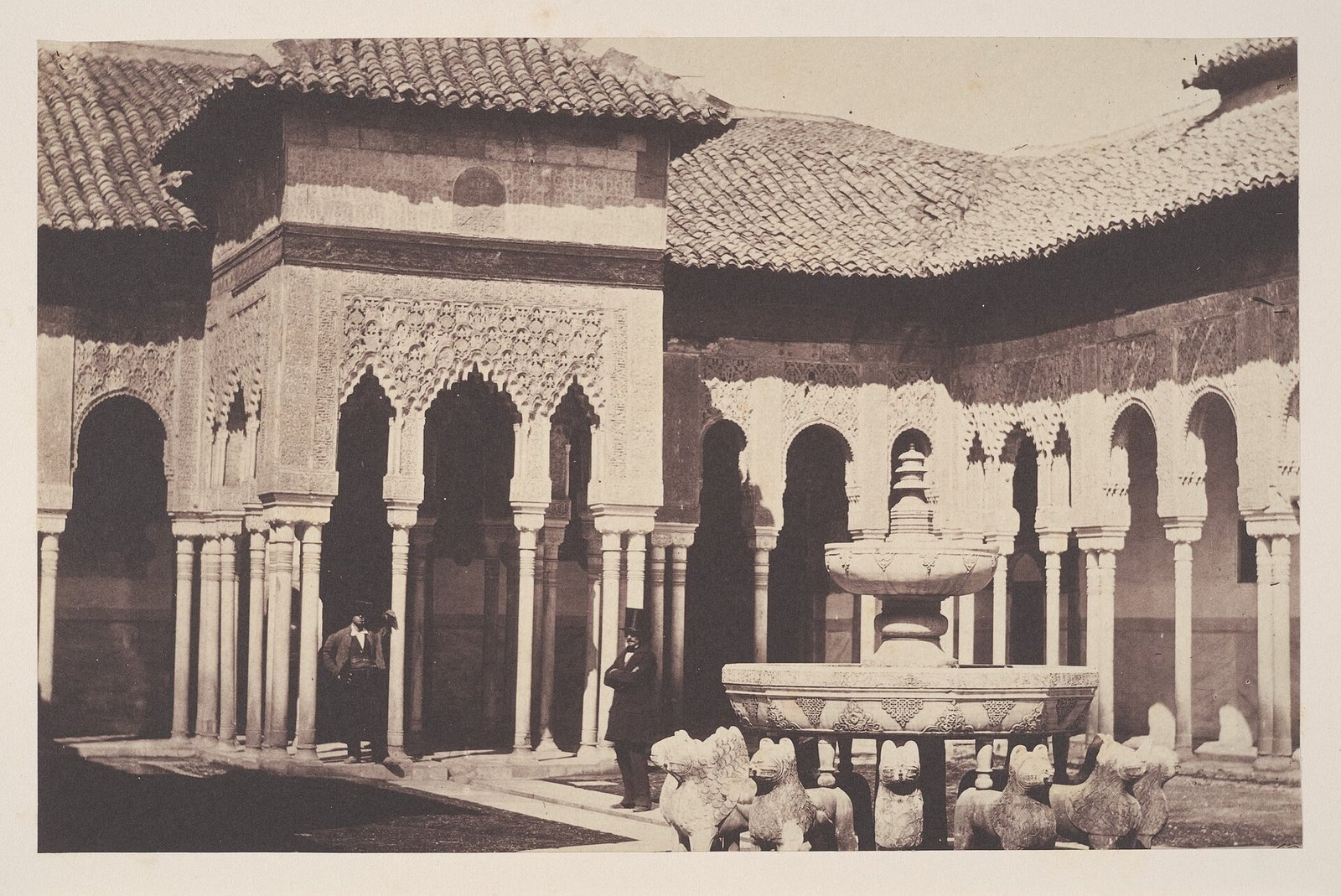
Muhammad V had the Palace of the Lions built during his second reign. The famous Fountain of the Lions stands in the courtyard at its centre.
The fountain has a twelve-sided basin. Twelve lion sculptures carry it.
Details you won’t find in guidebooks
- The lions are not identical. The carving on each of the twelve lions differs from the others.
- The fountain has a poem on it. Verses by the court poet Ibn Zamrak are carved around the basin. They describe the structure and the movement of the water.
- It has a built-in overflow control. The cylinder in the centre brought water into the basin. It also drained water away, so the surface would not overflow. Think of the overflow hole near the top of a bathtub. The idea is the same, and here it is hidden in the centrepiece.
- Madinat al-Zahra was forgotten. After it was looted in the civil war of 1009–1010, the palace-city lay forgotten for about a thousand years. It was rediscovered in the early 20th century.
- Morisco craftsmen worked after 1492. The Catholic Monarchs ordered extensive repairs at the Alhambra after the conquest. Much of that work was done by Morisco craftsmen.
- The courtyard floor is debated. One view says its four sections were originally paved with stone. Another says they were planted gardens, lying below the level of the walkways.
1492 and after
On 2 January 1492 the Catholic Monarchs, Isabella and Ferdinand, entered Granada. Nasrid rule ended.
The Alhambra did not disappear with it. In 1984 the Alhambra and the Generalife were listed by UNESCO. In 1994 the Albaicín quarter was added to the protected area.
When you walk the site today, you are looking at the product of two stages. The first is the Nasrid building campaigns of the 14th century. The second is the repairs ordered after 1492.
FAQ
Why do people say 800 years if the period lasted 781 years?
The phrase rounds the span between the conquest in 711 and the surrender of Granada in 1492. That span is 781 years.
Where is the Alhambra?
It is on the Sabika Hill in the city of Granada, in present-day Spain. It is a complex of palaces, a city and a fortress.
Who built the Court of the Lions?
It was built during the second reign of Muhammad V, which ran from 1362 to 1391. The Nasrid dynasty ruled Granada at the time.
When did the Alhambra become a UNESCO site?
The Alhambra and the Generalife were listed in 1984. The Albaicín quarter was added to the protected area in 1994.
What does the name al-Andalus first appear on?
The earliest known written evidence is a set of coins struck in 716. They carry inscriptions in both Latin and Arabic.
Sources
- Vikipedi — Endülüs tr.wikipedia.org
- Wikipedia — Al-Andalus en.wikipedia.org
- UCL Discovery — A brief history of al-Andalus discovery.ucl.ac.uk
- El legado andalusí — Chronology legadoandalusi.es
- The Metropolitan Museum of Art — The Spanish Umayyads metmuseum.org
- Museo Arqueológico Nacional — Al-Andalus man.es
- The Metropolitan Museum of Art — The Art of the Umayyad Period in Spain metmuseum.org
- UNESCO — Caliphate City of Medina Azahara whc.unesco.org
- The Metropolitan Museum of Art — Iberian Peninsula, 1000–1400 A.D metmuseum.org
- Patronato de la Alhambra y Generalife — Historia alhambra-patronato.es
- Patronato de la Alhambra y Generalife — The court of the lions alhambra-patronato.es
- Patronato de la Alhambra y Generalife — The spouts of the fountain of the Lions alhambra-patronato.es
- UNESCO — Alhambra, Generalife and Albayzín, Granada whc.unesco.org
Image: The Court of Lions in the Alhambra, Spain MET DP209232.jpg — John Gregory Crace, CC0