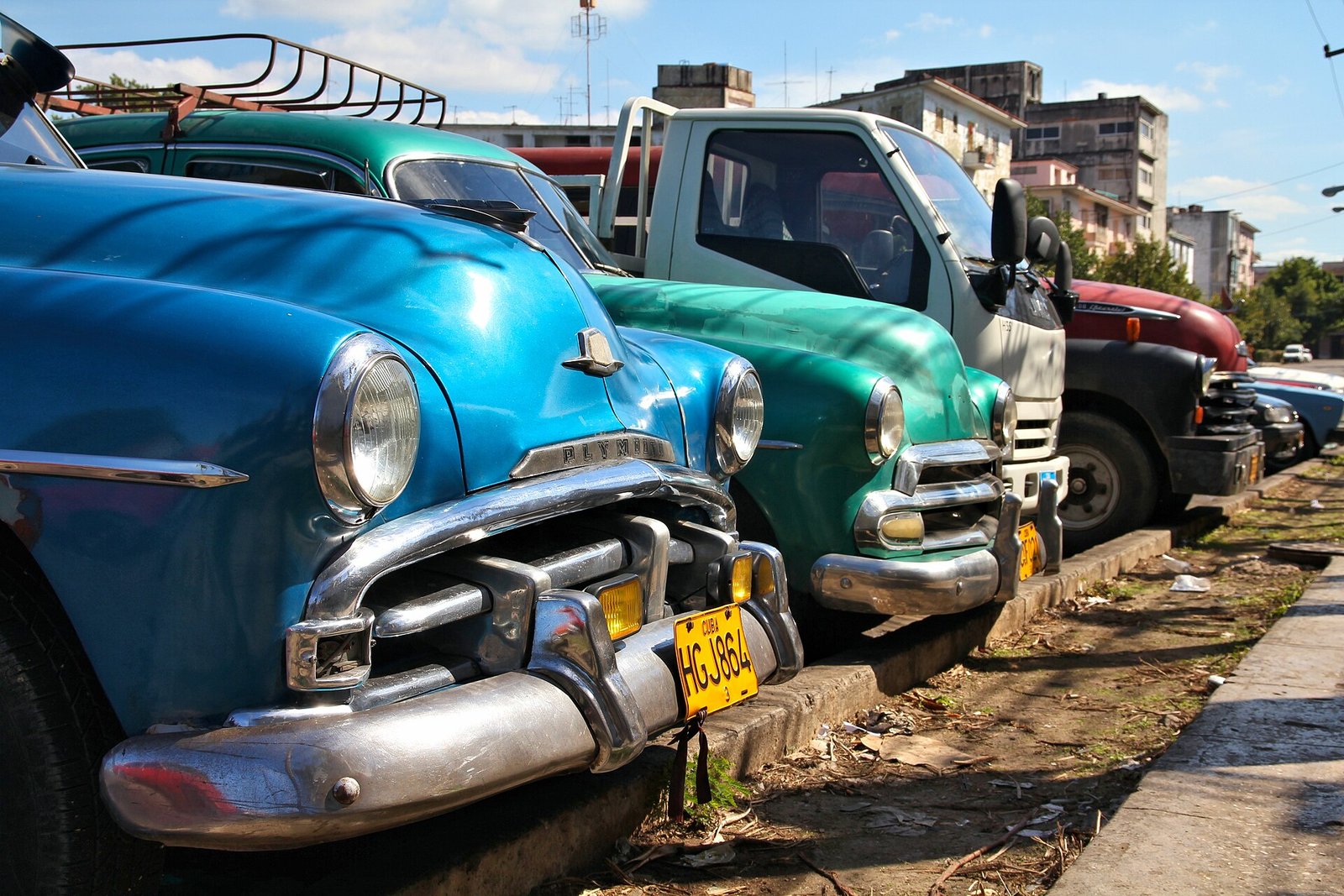
Cuba has so many old American cars because large imports before the 1959 revolution were followed by decades of restricted replacement. The US embargo stopped direct imports of American cars and parts, while Cuban import and sales restrictions, expensive newer cars and local repair skills kept older vehicles running.
A 1955 Chevrolet Bel Air belonging to mechanic Pedro Manso had a Toyota engine beneath its American body. That combination explains why you need to look beyond the bodywork. The story runs from American imports to trade restrictions, workshop repairs and the shared taxis that still carried ordinary Cubans in June 2026.
Where is Cuba located?
Cuba is an independent island country where the Caribbean Sea, the Gulf of Mexico and the Atlantic Ocean meet. Geographically, it belongs to North America. It lies south of Florida and east of Mexico’s Yucatán Peninsula.
About 150 kilometres separate Cuba from Key West across the Florida Straits. Havana, Cuba’s capital and largest city, is one of the main places where classic American automobiles can be seen. Yet the cars’ history involves national import rules and ownership restrictions as well as Havana’s streets.
How did so many American cars reach Cuba?
During the first half of the twentieth century, Cubans imported tens of thousands of cars from the United States. These vehicles were new when they arrived. The automobiles later described as classics began their Cuban lives as contemporary purchases.
That original volume matters. Cuba already had a substantial stock of American cars before restrictions interrupted their replacement. In May 2021, AFP estimated that about 60,000 American classics from the 1940s and 1950s were still circulating on the island.
If you picture those cars arriving as antiques, reverse the sequence. Large numbers arrived as new vehicles, then remained in service through decades of political and economic change. Their survival followed the interruption of a supply relationship that had brought both cars and replacement parts.
How did the revolution and US embargo affect Cuba’s cars?
The overthrow of Fulgencio Batista’s government in January 1959 marked a turning point in the Cuban Revolution. A new government emerged under Fidel Castro. The American cars already on the island remained, but the conditions governing imports and ownership changed.
On 19 October 1960, the United States introduced an export embargo covering goods sent to Cuba, with exceptions for medicines and certain foods. The embargo cut off direct imports of American automobiles and their spare parts. Maintaining an existing vehicle now meant working around an interrupted supply of replacements.
President John F. Kennedy’s Proclamation 3447 expanded the trade embargo. It took effect at 12:01 a.m. on 7 February 1962. The 1960 and 1962 measures belong to successive stages in the restrictions that shaped Cuba’s automobile history.
Cuban policy also limited access to replacements. According to a 2016 US International Trade Commission report, Cuba had almost completely prohibited individuals from importing foreign vehicles for most of the preceding approximately 50 years. The persistence of American classics therefore reflected restrictions on both sides of the trade relationship.
Did Cuba import cars from other countries?
Cuba imported Soviet vehicles for state ownership during the 1970s and 1980s. Lada, Moskvich and Volga cars joined the vehicle fleet, alongside ZIL and KrAZ trucks. American classics remained part of a fleet that also contained vehicles from other manufacturing countries.
From 2009, Cuba imported sedans made by the Chinese company Geely. These served as police cars, taxis and rental vehicles. Their arrival shows why you should distinguish the survival of old American cars from the separate question of whether newer vehicles entered Cuba.
Ownership rules helped preserve the older cars’ importance. Before the 2011 reform, vehicles that individuals could freely buy and sell were mainly those dating from before the 1959 revolution. A car’s place in the private market therefore depended on more than its condition or usefulness.
Timeline
- 20 May 1902: Cuba adopted its national flag.
- First half of the twentieth century: Cubans imported tens of thousands of new American cars.
- January 1959: The Cuban Revolution overthrew Batista’s government.
- 19 October 1960: The United States began its broad export embargo against Cuba.
- 7 February 1962: The expanded embargo under Kennedy’s Proclamation 3447 took effect.
- 1970s–1980s: Cuba imported Soviet vehicles for state use.
- 2009: Imports of Geely sedans began for police, taxi and rental fleets.
- 1 October 2011: Cuba removed model and year restrictions on car sales between individuals.
- 3 January 2014: Buyers no longer needed a special permit to purchase cars from the state.
- January–June 2014: Dealers nationwide sold only 50 cars and four motorcycles.
- May 2021: AFP reported an estimated 60,000 American classics in circulation.
- June 2026: Associated Press reported their continuing role as shared taxis.
Why didn’t the buying reforms replace the old cars?
Rules effective from 1 October 2011 allowed individuals to sell cars of all models and years to one another. They also permitted ownership of more than one automobile. This widened the private market beyond the vehicles that had previously been freely tradable.
The reform included transaction requirements. Buyer and seller each had to pay a tax of 4 percent. Buyers also had to declare that the money used for the purchase had been earned legally. Permission to trade came with costs and a declaration about the purchase funds.
A further change took effect on 3 January 2014. Cubans could buy new or used vehicles from the state without presenting a special permit. But the prices quoted that month show the financial barrier that remained after the permit requirement disappeared.
At Havana’s state Peugeot dealership, a 2013 model 206 carried an asking price of $91,000. A Peugeot 508 was priced at $262,000. Those figures help explain why a wider legal opportunity to purchase did not immediately produce widespread replacement of older cars.
The US International Trade Commission reached a related assessment in March 2016. It did not expect the removal of US restrictions to produce an immediate substantial increase in American spare-parts exports. It cited Cubans’ low purchasing power and Cuba’s controls over the vehicle market.
Details you won’t find in guidebooks
Pedro Manso’s 1955 Chevrolet Bel Air illustrates how an American car could survive with components from elsewhere. Its body concealed a Toyota engine. The vehicle’s appearance and its mechanical equipment therefore told different parts of its history.
At his workshop in Placetas, Manso reproduced Chevrolet parts using machines he had made himself. His work addressed the shortage of replacement components directly. Keeping an old car moving could involve making the needed part rather than obtaining another original one.
The name almendrón also comes from the cars’ physical form. Applied to large American sedans, it derives from a Spanish word that compares their rounded bodies to an almond. The nickname describes a shape that remained recognisable even when mechanical components changed.
The 2011 reform affected families leaving Cuba permanently. It allowed departing owners to sell their cars or transfer them to relatives. This changed the previous practice under which the state could take those vehicles, making ownership reform relevant to family property as well as purchases.
Sales figures reveal another less visible detail. Despite the relaxation of buying rules, dealers across Cuba sold only 50 cars and four motorcycles during the first six months of 2014. The small total gives concrete scale to the gap between permission to buy and completed purchases.
Are Cuba’s classic cars still part of everyday life?
Associated Press reported in June 2026 that almendrones continued to operate as shared taxis in Havana and across Cuba. They carried ordinary Cubans. Their continued use connected the history of pre-revolutionary imports to everyday transport decades later.
For an everyday-life comparison, think about keeping a car because replacing it costs too much. Cuba’s history adds direct import barriers, restrictions on private purchases and locally produced parts to that decision. When you see an old American body, you may also be looking at the accumulated work of mechanics keeping daily transport available.
FAQ
Why does Cuba have so many old American cars?
Cubans imported tens of thousands of American cars before the revolution. The US embargo cut off direct supplies of cars and parts, while Cuban restrictions and expensive replacements helped keep older vehicles in use.
How many classic American cars are there in Cuba?
An AFP report in May 2021 estimated that about 60,000 American classics from the 1940s and 1950s were circulating in Cuba.
Do Cuba’s classic cars still have their original engines?
Not all do. Mechanic Pedro Manso’s 1955 Chevrolet Bel Air, for example, had a Toyota engine beneath its American body.
Are Cuba’s old American cars used for everyday transport?
Yes. Associated Press reported in June 2026 that almendrones continued to carry ordinary Cubans as shared taxis in Havana and across the country.
Sources
- Vikipedi — Küba tr.wikipedia.org
- Wikipedia — Geography of Cuba en.wikipedia.org
- Wikipedia — Cuba en.wikipedia.org
- Smithsonian Magazine — Viva Vintage smithsonianmag.com
- AFP / Taipei Times — Cuba’s Chevy doctor keeps classics going taipeitimes.com
- TIME — The U.S. Trade Embargo on Cuba Just Hit 55 Years time.com
- US National Archives — Proclamation 3447 archives.gov
- Wikipedia — Transport in Cuba en.wikipedia.org
- US International Trade Commission — Overview of Cuban Imports of Goods and Services and Effects of U.S. Restrictions usitc.gov
- Associated Press / ABC7 — Cuba legalizes general purchase and sale of cars abc7.com
- Reuters / UOL — Após 50 anos, primeiros carros com venda liberada em Cuba têm preços muito altos noticias.uol.com.br
- Reuters / Forbes México — En seis meses, sólo 50 coches se han vendido en Cuba forbes.com.mx
- Associated Press — Cuba’s iconic antique cars sit idle as US energy blockade deepens fuel crisis apnews.com
Image: 016 Classic American cars in Havana, Cuba – old cars in Cuba.jpg — Marek Ślusarczyk (Tupungato) Photo portfolio, CC BY 3.0