The Berlin Conference of 1884 in short
The Berlin West Africa Conference was an international meeting. It dealt with claims over the Congo Basin and with the rules for colonial expansion. It opened on 15 November 1884 and closed on 26 February 1885. Otto von Bismarck, Chancellor of the German Empire, chaired it.
Fourteen states sent delegates. No African state did. That single fact explains why the conference still draws so much anger today.
The popular image is a group of men drawing straight lines across a map of Africa. It is a strong image. The real record is more complicated, and you will see why below.
Berlin Conference definition
A clear definition helps. The Berlin Conference was a diplomatic meeting of colonial powers. Its aim was to set rules for trade and for new territorial claims in Africa. One goal was to stop those claims from turning into wars between the colonial states themselves.
Notice what that goal covers. The rules were written to protect the powers from each other. They were not written to protect the people who lived on the land.
Berlin Conference where was it held?
The meeting took place in Berlin. It was held in a building whose address then was Wilhelmstraße 77. Under today’s numbering the same address is Wilhelmstraße 92.
If you visit Berlin, you can walk along Wilhelmstraße and look for that number. It is a street address, not a famous monument, so go there to see the setting rather than a display.
Berlin Conference of 1884 to 1885: why it happened
The conference did not come out of nowhere. Several things pushed the powers to Berlin.
Henry Morton Stanley worked in the Congo from 1878 to 1885. He acted as the representative of King Leopold II of Belgium. Leopold’s Congo organization wanted a firm hold on the region.
Other powers wanted to block that. On 26 February 1884, Britain and Portugal signed a treaty. Its aim was to stop Leopold’s Congo organization from reaching the Atlantic.
So the claims were crowding each other. The powers wanted common rules before the rivalry grew into open conflict. Berlin was the answer.
Who attended: the 14 states
The full list of participants was:
- Germany
- the United States
- the Ottoman Empire
- Austria-Hungary
- Belgium
- Denmark
- France
- Britain
- Italy
- the Netherlands
- Portugal
- Russia
- Spain
- Sweden-Norway
That is 14 states in all. The meeting dealt with African land, yet no African state was represented.
What the General Act decided
The conference ended with the signing of the Berlin General Act on 26 February 1885. The Act covered six main subjects:
- trade in the Congo
- the slave trade
- neutrality
- navigation on the Congo
- navigation on the Niger
- new occupations on the African coasts
Several articles stand out.
Article 1 granted freedom of trade to all nations in the Congo Basin and the regions linked to it.
Article 9 banned the use of the defined Congo region as a market or a transit route for the slave trade.
Articles 34 and 35 dealt with new claims. Article 34 said that a state taking new territory or a protectorate on the African coasts must tell the other signatory powers. Article 35 required that an occupying power set up an authority. That authority had to be able to protect existing rights. Where needed, it also had to protect freedom of trade and transit.
The Act also set separate rules for free navigation on the Congo and on the Niger.
You can read the full text yourself. The English text of the Act is published on the South African History Online site and on the World and Japan database. Both are listed in the Sources. If you are looking for a Berlin Conference 1884–1885 PDF, those pages are the place to start.
Berlin Conference scramble for Africa
The phrase “scramble for Africa” describes the rush of colonial claims. Berlin did not start that rush. It gave the rush a set of rules.
The most important rule was effective occupation. Raising a flag was no longer enough. A power had to show real authority on the ground. This pushed colonial administrations to move deeper into the African interior.
Here is an everyday comparison. Imagine renting a parking space. Leaving a cone on it for a day does not make it yours. You need a contract and you must actually use it. The Berlin rules asked for something similar from the colonial powers. The sad part is that the “space” in question was home to many people who were never asked.
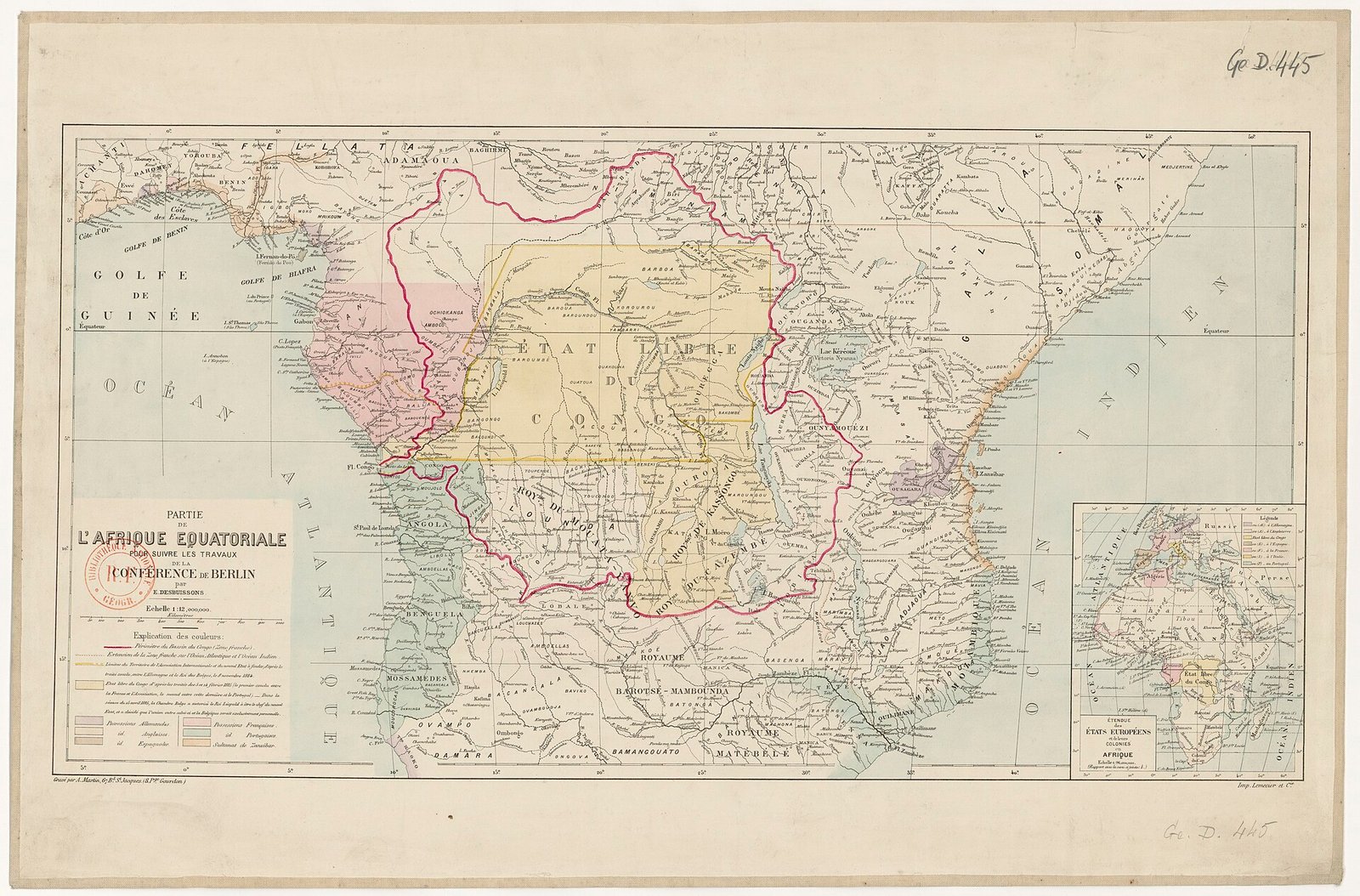
Berlin Conference map: was Africa divided with a ruler?
The ruler image is powerful. It stands for borders drawn from a distance, with no regard for the people who lived there.
The historians’ debate is more careful than the slogan. Two views are worth knowing.
The critical view. Francis Mangeni and Andrew Mold wrote a 2024 study. It connects the Berlin Conference story to the economic harm caused by colonial borders that split related communities.
The cautious view. Jack Paine, Xiaoyan Qiu and Joan Ricart-Huguet published a 2024 study. They argue that Berlin dealt only with the borders of the Congo region. In their account, most African borders were fixed much later.
They also looked at 107 bilateral borders on a colonial map from about 1960. Historical political borders directly shaped 62 percent of those borders.
So the fair summary is this. Berlin set rules for claiming land. The lines on the map came later, through further agreements. The “ruler” is a symbol more than a literal record of one meeting.
Berlin Conference of 1884–85 and the Ottoman Empire
If you are travelling in Turkey, this part connects the story to your trip. The Ottoman Empire was one of the 14 states at the table. Sultan Abdülhamid II was on the throne at the time.
The Ottoman delegation was Mehmed Said Pasha, the ambassador in Berlin, and Ohan Efendi, the embassy undersecretary. They argued for two things. First, Muslims in Africa should be protected on an equal footing with Christians. Second, the Nile should stay outside the free trade and navigation rules.
When you see Ottoman-era buildings in Istanbul, remember that the same state was also watching events in Berlin.
Not the same as the 1878 Congress of Berlin
People often mix up two Berlin meetings. The Congress of Berlin was held from 13 June to 13 July 1878. It revised the Treaty of San Stefano. The African conference of 1884–1885 is a separate event.
If you search “Berlin Conference” and land on pages about the Balkans, this is why.
Timeline
- 13 June–13 July 1878: The Congress of Berlin, separate from the Africa conference, revised the Treaty of San Stefano.
- 1878–1885: Henry Morton Stanley worked in the Congo on behalf of Leopold II.
- 26 February 1884: Britain and Portugal signed a treaty meant to keep Leopold’s Congo organization from reaching the Atlantic.
- 15 November 1884: The Berlin West Africa Conference opened.
- 26 February 1885: The Berlin General Act was signed and the conference closed.
- 1 August 1885: Francis de Winton announced the name Congo Free State.
Details you won’t find in guidebooks
- The building. The meeting was held at Wilhelmstraße 77, today’s Wilhelmstraße 92.
- One state, one vote. In official decisions each state had a single vote. It did not matter how many delegates a country sent.
- An invitation the Ottomans had to earn. The Ottoman Empire was not among the first states invited. It joined through diplomatic efforts with Germany and Britain.
- Reports by courier. Foreign Minister Asım Pasha asked for the conference minutes to be sent to Istanbul by courier. He also asked for an assessment report on every session.
- A name that is missing. The name Congo Free State does not appear in the General Act. Francis de Winton announced it on 1 August 1885, after the conference had closed.
FAQ
Where was the Berlin Conference held?
It was held in Berlin. The meeting took place in a building at Wilhelmstraße 77, which carries the number 92 in today’s numbering.
When did the Berlin Conference take place?
It opened on 15 November 1884 and ended on 26 February 1885, when the General Act was signed.
Did African leaders attend the Berlin Conference?
No. No African state was represented. Fourteen states took part: Germany, the United States, the Ottoman Empire, Austria-Hungary, Belgium, Denmark, France, Britain, Italy, the Netherlands, Portugal, Russia, Spain and Sweden-Norway.
Did the Ottoman Empire take part in the Berlin Conference?
Yes. Ambassador Mehmed Said Pasha and embassy undersecretary Ohan Efendi represented the Empire under Sultan Abdülhamid II.
Did the Berlin Conference draw the borders of Africa?
Not in full. One 2024 study argues that Berlin dealt only with the borders of the Congo region and that most African borders were fixed much later.
Sources
- German Federal Foreign Office, Political Archive: General Act archiv.diplo.de
- South African History Online: General Act of the Berlin Conference on West Africa, 26 February 1885 sahistory.org.za
- University of Tokyo and GRIPS, The World and Japan: General Act text worldjpn.net
- Wikipedia: Berlin Conference en.wikipedia.org
- Türkçe Vikipedi: Berlin Konferansı tr.wikipedia.org
- Ahmet Doğan, The Berlin West African Conference 1884–1885 and the Ottoman Empire, METU, 2021 open.metu.edu.tr
- Francis Mangeni and Andrew Mold, Borderless Africa, The Historical Antecedents, Oxford University Press, 2024 academic.oup.com
- Jack Paine, Xiaoyan Qiu and Joan Ricart-Huguet, Endogenous Colonial Borders, American Political Science Review, 2024 doi.org
Image: Partie de l’Afrique équatoriale pour suivre les travaux de la conférence de Berlin – par E. Desbuissons – btv1b84393600.jpg — Desbuissons, Edouard (1827-1908). Auteur du texte, Public domain