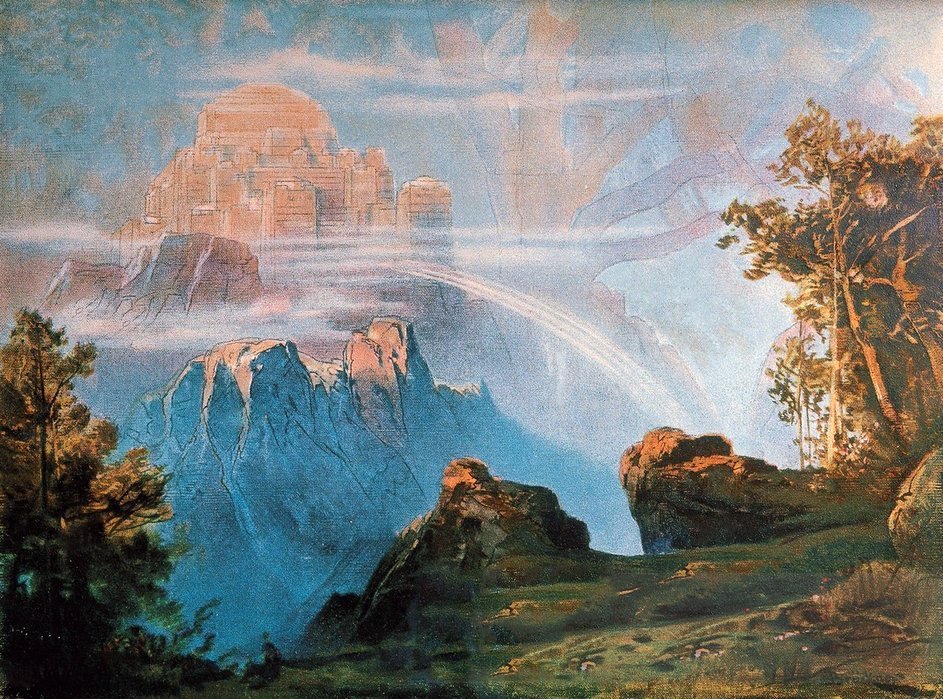
Valhalla is the great hall in Asgard ruled by Odin, where selected warriors killed in battle prepare to fight beside the gods at Ragnarök. In surviving Norse accounts, half of the battle dead go to Valhalla, while the other half go to Freyja’s Fólkvangr.
Yet Odin’s hall holds more than an army waiting for battle. Its warriors return to life each evening, its roof carries animals with extraordinary powers, and its architecture is built from weapons and armour. If you follow these details, you can see how Valhalla connects warfare, feasting and the imagined world of the dead.
Valhalla meaning: what does the name tell you?
The name Valhalla comes from the Old Norse word Valhǫll. It means “hall of those slain in battle.” The meaning points directly to the people associated with the place: warriors whose lives ended in combat.
The hall belongs to Odin. The Danish National Museum identifies kings, warrior leaders and their followers as especially devoted to him. Odin is also the father of Thor, the thunder god. These relationships place Valhalla within a wider world of gods and their human worshippers.
The Swedish History Museum connects the idea of Valhalla particularly with aristocrats and warriors. That association matters when you picture the hall. Its dead inhabitants form a fighting company under a divine ruler, and their shared meals take place within that military setting.
Where is Valhalla in Norse belief?
Valhalla stands in Asgard, the home of the gods. The poem Grímnismál gives a more specific location. Its stanzas 8–10 place the hall in the mythological region of Glaðsheimr. These names locate Valhalla within the geography of Norse mythology.
The building itself carries the signs of warfare. Spears support its roof, golden shields cover it, and coats of mail lie on its benches. The equipment associated with warriors becomes the fabric and furnishing of their home after death.
Grímnismál also describes 540 doors. Through each door, 800 warriors can pass abreast. The detail gives the hall an immense capacity for movement. Its entrances suit the gathering of the einherjar, the dead warriors preparing to fight at Ragnarök.
Who went to Valhalla? Vikings, Valkyries and Freyja
Valkyries are the female mythological beings who select fallen warriors on the battlefield and take them to Odin’s Valhalla. Their role connects a warrior’s death in combat with admission to the hall. Arrival there involves selection by these figures.
Surviving accounts divide the battle dead between Odin and Freyja. Half go to Valhalla, and half go to Freyja’s Fólkvangr. Within Fólkvangr stands a hall named Sessrúmnir. Freyja therefore has her own place for receiving fallen warriors.
If you assume every dead Viking entered Valhalla, this division changes the picture. Even among those killed in battle, Odin’s hall is only one destination. Fólkvangr belongs in any explanation of where fallen warriors went in Norse belief.
Old Norse poems also describe Hel, another realm of the dead. Its presence expands the picture beyond the halls of Odin and Freyja. Valhalla is part of a wider set of accounts about death, with different destinations appearing in the surviving material.
A strict rule that only people who died through sickness or old age went to Hel does not fit every story. Baldr, a god who is killed, also goes there. His destination prevents that simple division from explaining all the accounts.
What happened inside Odin’s hall?
The warriors in Valhalla are called einherjar. They prepare to fight beside the gods at Ragnarök. Their life in the hall therefore has a future purpose, even though its daily activities follow a repeating pattern.
Each day, the einherjar fight one another. In the evening, they return to life and join the feast in Valhalla. Fighting does not permanently remove members of the company. The same warriors can take part in the next day’s combat.
Think of the familiar rhythm of a demanding day followed by a shared evening meal. Valhalla gives you a mythological version of that everyday pattern: the warriors fight, recover and eat together. Its defining difference is their return to life before the feast.
The meal also depends on renewal. Sæhrímnir, the boar served at the feasts, comes back to life despite being slaughtered each day. Both the company and its food supply return, allowing the daily sequence of combat and feasting to continue.
Details you won’t find in guidebooks
Valhalla’s weapons do more than equip its warriors or shape its roof. In the accounts, shining weapons illuminate the hall. Light comes from objects already central to the building’s military character.
On the roof stands the goat Heiðrún. Mead flows from her udders for the warriors to drink. The feast thus has a drink supply with a named mythological source, just as its meat comes from the repeatedly restored Sæhrímnir.
Another roof animal connects the hall to the wider world. Water drips from the antlers of the stag Eikþyrnir. In the account, this water is the source of the world’s rivers. The roof holds a source of flowing water as well as the warriors’ drink.
Chapter 8 of Ynglinga saga adds a detail about possessions after death. It says that the dead could take to Valhalla the belongings placed with them at cremation. They could also take what they had hidden in the ground during life.
That passage gives Valhalla a connection with objects owned before death. Alongside the hall’s collective feasting and fighting, it describes individual belongings passing into the afterlife. Cremation goods and hidden possessions both appear in this account of what could accompany the dead.
Timeline
- AD 800–1100: The Klinta staff dates to this period. The small house on its top has been interpreted as either Valhalla or Freyja’s Fólkvangr.
- 10th century: The anonymous poem Eiríksmál commemorates King Erik Bloodaxe’s death and depicts Valhalla.
- 13th century: The Poetic Edda is compiled, and Snorri Sturluson writes the Prose Edda. Both are important written sources for Valhalla.
How do poems and objects describe Valhalla?
Eiríksmál connects Valhalla with a named king. Written to commemorate Erik Bloodaxe’s death, the anonymous poem depicts Valhalla. It places the hall in a specific commemorative setting.
The Poetic Edda and Snorri Sturluson’s Prose Edda are major written sources for Valhalla. Both belong to the 13th century in their compiled or written form. Grímnismál supplies some of the hall’s most concrete details, including its location and the number and capacity of its doors.
Objects require a different kind of reading. A silver pendant from Klinta on Öland, numbered 108864_HST, has been interpreted as a Valkyrie welcoming a warrior to Valhalla. Another interpretation identifies the figure as an aristocratic hostess taking part in a drinking ceremony.
The Klinta staff presents a similar uncertainty. Its small house has been read as Valhalla, but Freyja’s Fólkvangr is another proposed identification. The object therefore cannot settle which divine hall its maker intended to represent.
The Swedish History Museum places the staff in case 68 of its Vikingarnas värld exhibition in Stockholm. If you examine its interpretation, keep both suggested halls in view. The museum’s competing readings preserve a distinction between the surviving object and the mythological identity assigned to it.
FAQ
What does Valhalla mean?
Valhalla comes from the Old Norse Valhǫll, meaning “hall of those slain in battle.” In Norse mythology, it is Odin’s hall for selected fallen warriors.
Where is Valhalla?
Valhalla is in Asgard, the home of the gods in Norse mythology. Stanzas 8–10 of Grímnismál place it in the mythological region called Glaðsheimr.
Did all fallen warriors go to Valhalla?
No. Surviving accounts divide those killed in battle between Odin’s Valhalla and Freyja’s Fólkvangr, with half going to each.
What do warriors do in Valhalla?
The warriors, called einherjar, fight one another each day and return to life for the evening feast. They prepare to fight beside the gods at Ragnarök.
Sources
- Turkish Wikipedia — Valhalla tr.wikipedia.org
- National Museum of Denmark — The Viking gods en.natmus.dk
- Store norske leksikon — Valhall snl.no
- Swedish History Museum — The Valkyries welcomed the fallen to Valhalla vikingar.historiska.se
- Swedish History Museum — Freya’s hall for fallen warriors vikingar.historiska.se
- Swedish History Museum — The path to Hel vikingar.historiska.se
- English Wikipedia — Valhalla en.wikipedia.org
- Swedish History Museum — Pendant 108864_HST vikingar.historiska.se
- Swedish History Museum — The Klinta Staff historiska.se
Image: Walhalla (1896) by Max Brückner.jpg — Max Brückner, Public domain