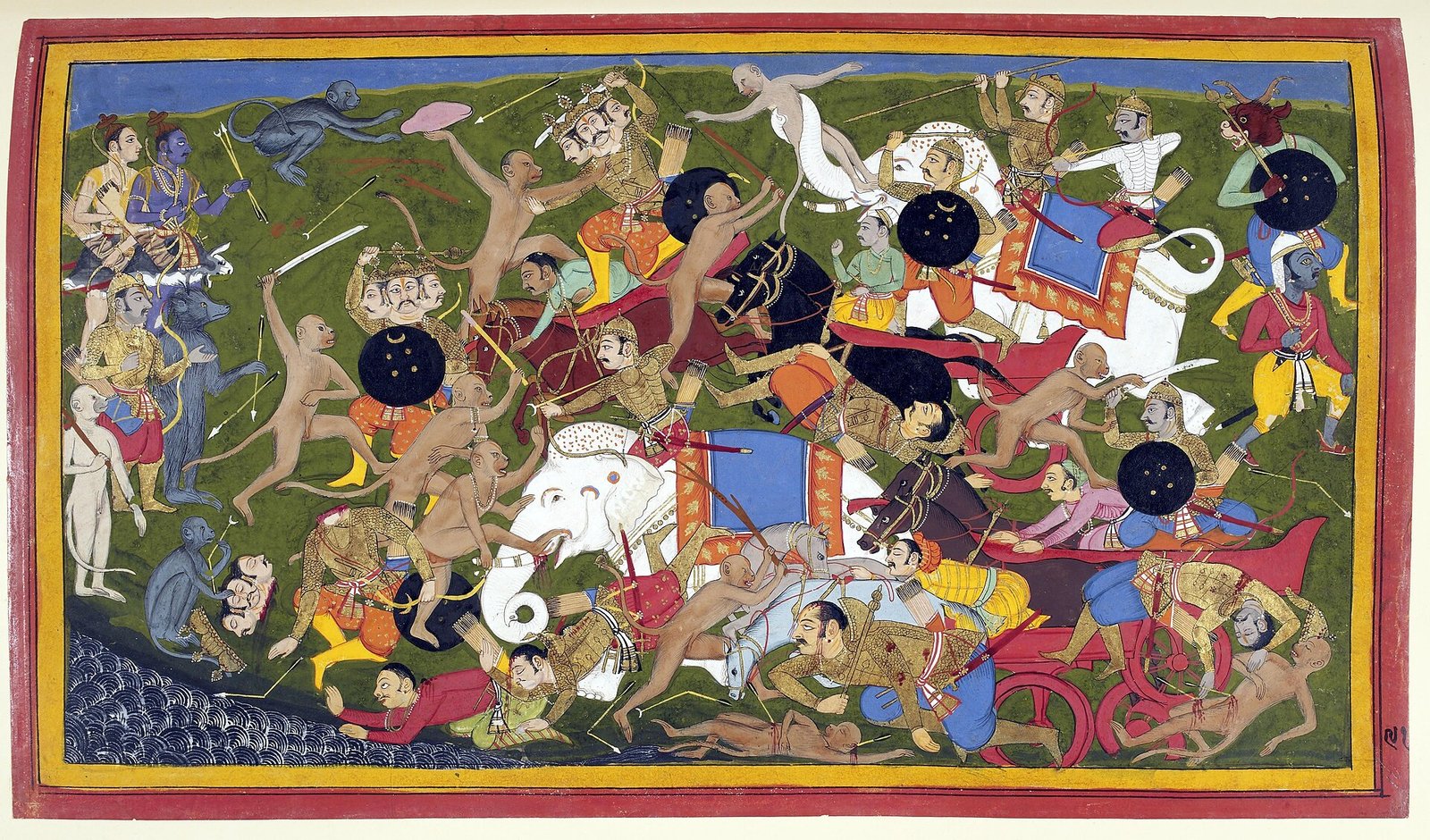
The Ramayana is a Sanskrit Hindu epic about Prince Rama’s exile, his wife Sita’s abduction by Ravana, and her rescue with help from Hanuman. Traditionally attributed to the poet Valmiki, it follows Rama’s journey from Ayodhya through separation, a search and war, ending its main conflict with a return to the throne.
Yet the rescue story is only part of what you encounter in the Ramayana. Its roughly 24,000 couplets also explore morality, kingship and divinity. Understanding its origins means separating the story’s events from the text’s formation, then following its passage into other languages, paintings and performances.
What does Ramayana mean?
The name combines Rama with the Sanskrit word ayana, meaning journey. Ramayana therefore means “Rama’s journey.” The title gives you a straightforward starting point: Rama’s movement through exile and return provides the central thread connecting the epic’s principal characters.
The Ramayana belongs alongside the Mahabharata as one of the Hindu tradition’s two major itihasa epics. The Valmiki Ramayana contains approximately 24,000 shlokas, or couplets, arranged in seven kandas, or books. Its scale extends well beyond a short account of Sita’s rescue.
Rama has both a royal and a religious identity. Within the narrative, he is the prince of Ayodhya. In Hindu belief, he is the seventh avatar of Vishnu. These identities help explain why the Metropolitan Museum describes his adventures as a way of exploring kingship, morality and divinity together.
Who are Rama, Sita and Hanuman?
Rama’s closest companions include his wife Sita and his brother Lakshmana. Sita is the daughter of Janaka, the ruler of Mithila. She marries Rama after he breaks a great bow while bending it. Their marriage precedes the exile and abduction that drive the central story.
Hanuman is Rama’s devoted helper. He combines human and monkey features and possesses extraordinary strength. His importance comes into focus during the search for Sita, when his leap across the sea makes him a direct link between the separated couple.
Ravana, the ruler of Lanka, is the figure responsible for Sita’s abduction. Other characters shape the circumstances around that conflict. Rama’s father Dasharatha rules Ayodhya, while Rama’s stepmother Kaikeyi demands both his exile and the throne for her own son, Bharata.
Why is Rama sent into exile?
Dasharatha sends Rama away for 14 years. Kaikeyi has requested this exile and demanded that Bharata receive the throne. Sita and Lakshmana accompany Rama, so the departure brings his wife and brother into the same extended separation from Ayodhya.
The exile connects a dispute over succession with the later search for Sita. Rama leaves the city where he is a prince. Ravana then abducts Sita and takes her to Lanka. Her removal creates the epic’s central conflict and gives Rama’s journey a new purpose: finding and rescuing her.
Ayodhya also has a geographical identity beyond its place in the narrative. The city lies beside the Sarayu River in the Indian state of Uttar Pradesh. It is traditionally identified with Rama’s city in the Ramayana. That traditional association should be kept distinct from questions about when the epic was composed.
How does Hanuman help rescue Sita?
The monkey king Sugriva sends Hanuman, Angada and Jambavan south to search for Sita. This detail makes the search a shared undertaking. Hanuman’s celebrated action takes place within that effort, with Jambavan providing the encouragement for his leap toward Lanka.
Hanuman jumps from Mount Mahendra and crosses the sea to reach Lanka. The episode brings his extraordinary strength into the search for the abducted Sita.
When Hanuman reaches Sita, he gives her Rama’s ring to establish his identity. She gives him her hair ornament to carry back to Rama. You can connect this exchange to an everyday concern: knowing whether a message really comes from someone you trust. Here, familiar personal objects provide that assurance.
The main war narrative ends with Ravana’s death and Sita’s rescue. Rama and Sita return to the throne of Ayodhya. This closes the central movement from departure to separation and reunion, although the seven-book text also raises questions about how its different parts developed.
When did the Ramayana originate?
The Ramayana formed over time, and its dating remains debated. Scholarly proposals reported by English Wikipedia place its oral core in either the eighth to fifth centuries BCE or the fifth to fourth centuries BCE. These proposals concern the development of the narrative, rather than dates for Rama’s adventures.
The Metropolitan Museum places the epic in roughly its present form around the first century BCE. These dates refer to different stages, so they should not be treated as interchangeable answers to a single question.
Traditional attribution places the seven-book epic under Valmiki’s name. A theory of textual layers, however, identifies Bala Kanda and Uttara Kanda as later additions. If you are studying its origins, distinguishing traditional authorship from theories about composition helps make sense of these accounts.
Timeline
- Eighth–fifth or fifth–fourth centuries BCE: Different proposals place the oral core within these periods. These are composition estimates, not dates for the story’s events.
- Around the first century BCE: The Metropolitan Museum dates the work’s approximate present form to this period.
- Mid-fifth century CE: Ramayana scenes appear at the Deogarh temples in northern India.
- Twelfth century: Kamban creates the Tamil adaptation Kambaramayanam.
- Sixteenth century: Tulsidas reworks the narrative in Avadhi as Ramcharitmanas.
- Around the 1680s: A Malwa painting depicts Hanuman with an ascetic’s prayer beads and a wealthy nobleman’s clothing.
- Late eighteenth century: The Thai Ramakien takes shape as a local telling of the Ramayana tradition.
- 2005: UNESCO proclaims Ramlila a masterpiece of oral and intangible heritage.
- 2008: UNESCO inscribes Ramlila on the Representative List of the Intangible Cultural Heritage of Humanity.
How did the Ramayana develop beyond Sanskrit?
Kamban’s Kambaramayanam dates to the twelfth century and retells the Ramayana in Tamil. Tulsidas later reworks the story in Avadhi as Ramcharitmanas during the sixteenth century. Both belong to the wider narrative tradition, while their languages and dates distinguish them from the Sanskrit epic attributed to Valmiki.
Thailand’s national epic, the Ramakien, is another local expression of the Ramayana tradition, dating to the late eighteenth century. Its Hanuman has an episode involving love for the mermaid Suvannamaccha, offering a concrete example of how a familiar character’s story changes across adaptations.
The narrative also lives through Ramlila in northern India. Performed during the autumn festival of Dussehra, Ramlila presents the Ramayana through song, narration, recitation and dialogue. UNESCO’s recognition in 2005 and inscription in 2008 concern this performance tradition.
Details you won’t find in guidebooks
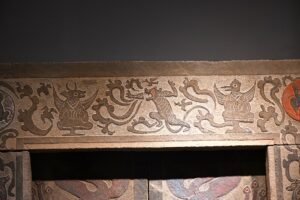
Ramayana scenes appear at the Deogarh temples in northern India. The Metropolitan Museum dates these depictions to the middle of the fifth century CE. They provide a visual point on the epic’s timeline, distinct from estimates for the formation of its Sanskrit text.
A Malwa painting dated by the Carlos Museum to around the 1680s shows Hanuman with an unusual combination of attributes. He carries an ascetic’s prayer beads while wearing the clothing of a wealthy nobleman.
Ramlila can require a substantial stretch of time. Most performances last 10–12 days, while the staging at Ramnagar can extend to a month. Its mixture of song, narration, recitation and dialogue therefore unfolds across repeated performances rather than a single brief presentation.
The IGNCA documents approximately 20 folk and tribal Ramkatha traditions. Among them is Lanka Chadai, performed by Muslim jogis from Mewat. This is a specific example of the range of performers and traditions through which the Rama narrative is transmitted.
FAQ
What is the Ramayana about?
The Ramayana follows Rama’s exile, Ravana’s abduction of his wife Sita, and the search and conflict that lead to her rescue. Hanuman is a devoted ally who helps Rama find her.
Who wrote the Ramayana?
The Sanskrit epic is traditionally attributed to Valmiki. Its composition developed over time, and one theory identifies Bala Kanda and Uttara Kanda as later additions.
When was the Ramayana composed?
Proposals for its oral core range from the eighth to fourth centuries BCE. The Metropolitan Museum dates something close to its present form to around the first century BCE, while other dating accounts extend later formation into the third century CE.
Who is Hanuman in the Ramayana?
Hanuman is an exceptionally strong helper devoted to Rama who combines human and monkey features. He leaps across the sea to Lanka and gives Sita Rama’s ring as proof of his identity.
Sources
- Wikipedia — Ramayana en.wikipedia.org
- The Metropolitan Museum of Art — Epic India metmuseum.org
- Wereldmuseum Amsterdam — Hanuman Travels the Globe amsterdam.wereldmuseum.nl
- Emory University, Michael C. Carlos Museum — Hanuman Leaps to Lanka digitalprojects.carlos.emory.edu
- UNESCO — Ramlila, the Traditional Performance of the Ramayana ich.unesco.org
- IGNCA — Living Traditions of Ramayana and Mahabharata ignca.gov.in
- Wikipedia — Ayodhya en.wikipedia.org
Image: Battle at Lanka, Ramayana, Udaipur, 1649-53.jpg — Sahibdin, Public domain