Battle of Thermopylae in 480 BC: who fought, and when
In 480 BC the army of the Achaemenid king Xerxes I met an alliance of Greek city-states led by the Spartan king Leonidas I at Thermopylae. The name means ‘Hot Gates’. It refers to the hot springs in the area. The actual fighting at the pass lasted three days.
If you search for the exact date, you will find disagreement. The Oxford Classical Dictionary places the battle probably in August 480 BC. Greece’s official commemorative brochure gives early September 480 BC. Both agree on the year and the season: late summer.
Battle of Thermopylae location: where it is on a map
The battlefield lies in Central Greece. It sits in the pass between the Malian Gulf and Mount Kallidromos. The coordinates are roughly 38.79583° north and 22.53694° east. If you are planning a trip to Turkey and want to add the site, note that it is in Greece, not in Turkey.
One warning for anyone reading a modern map. The Spercheios River delta has pushed the coast seaward since antiquity. So today’s shoreline does not show you the edge of the 480 BC battlefield. A 2010 geoarchaeological study found that in 480 BC the Middle Gate held a freshwater marsh fed by thermal springs. The ground Leonidas defended was narrow, wet and hemmed in by water.
Battle of Thermopylae 300: how many Greeks actually fought
The number 300 is real but incomplete. The Oxford Classical Dictionary gives Leonidas’s initial allied force as about 6,000 to 7,000 men. Herodotus lists the contingents in Book VII, sections 202 to 203. Beside the 300 Spartans stood 700 Thespians, 400 Thebans and 1,000 Phocians, among others.
The Persian side is harder to count. Ancient Greek sources put Xerxes’s expeditionary force above one million. Modern estimates run much lower, reaching up to roughly 300,000. Whichever figure you accept, the Greeks were heavily outnumbered.
How the Greek defence worked
The plan was built around the terrain. The narrow pass limited how many Persians could attack at once. It also stopped the Persian cavalry from spreading out. Think of a stadium exit after a match: thousands of people, but only a few can pass the turnstile at a time.
The land defence was one half of a joint operation. At the same time, the Greek fleet at Artemisium tried to stop the advance of the Persian navy. According to the official Greek summary, Xerxes waited four days before attacking. The Greek line then held the pass for the next two days. The Greek Ministry of Culture describes Leonidas’s men using feigned retreats to draw the Persians onto ground suited for a counterattack.
Battle of Thermopylae who won: the third day
Persia won. The ancient account says a man named Ephialtes showed the Persians the Anopaia path. This track led around the pass and behind the Greek position. Leonidas knew the path existed. He had posted the 1,000 Phocians to guard it. According to the Oxford Classical Dictionary, when the Phocians pulled back to a nearby hill, the Persian flanking route lay open.
What happened next is debated. Some accounts say most of the allies left in panic. Others say Leonidas ordered them away. One theory treats his stand as a rearguard action. The sources agree on one point: Leonidas did not stand with 300 men alone. The 700 Thespians and 400 Thebans also remained for the final fight. The pass was opened to Xerxes’s army.
Battle of Thermopylae casualties
Here too the numbers are contested. Figures attributed to Herodotus give about 4,000 Greek dead and 20,000 Persian dead. Modern assessments lower the Greek loss to about 2,000. They treat the 4,000 figure as far too high.
What came after
After Thermopylae the Persians advanced on Athens. The city had already been evacuated. In the same year, 480 BC, the Greek fleet defeated the Persians at Salamis. In 479 BC the Greeks won again at Plataea. Thermopylae was a defeat, but it was followed by two Greek victories.
Timeline
- 480 BC, late summer (exact date disputed): Xerxes’s campaign against Greece; the land defence at Thermopylae and the sea battle at Artemisium take place.
- The four days before the fighting: according to the official Greek summary, Xerxes waits before attacking.
- Days 1 and 2: the Greeks stop the Persian frontal assaults in the pass.
- Ephialtes shows the Persians the Anopaia path; Persian troops move around the pass to the rear of the Greek position.
- Day 3: most of the allies withdraw; the Persians take the pass.
- 480 BC, after Thermopylae: the Persians advance on Athens; the Greek fleet wins at Salamis the same year.
- 479 BC: the Greeks defeat the Persians at Plataea.
- 1939: Marinatos’s excavations at Thermopylae uncover arrowheads.
Battle of Thermopylae movie: how 300 fits the record
The film 300 was directed by Zack Snyder, with Gerard Butler as Leonidas.
Scholars have studied this gap. A doctoral thesis completed at University College London in 2016 examined how Thermopylae is represented in American popular culture. Its abstract describes the tension in film adaptations between historical accuracy on one side and aesthetics and audience expectations on the other.
Details you won’t find in guidebooks
- Leonidas chose his 300 Spartans from men who had sons. Herodotus records this in Book VII, section 205.
- Excavations led by Spyridon Marinatos in 1939 found arrowheads at Thermopylae. They entered the collection of the National Archaeological Museum in Athens.
- A 1987 study titled The Pass at Thermopylae analysed seven drill cores from the Malian Gulf sediment to reconstruct the ancient shoreline.
- The 2010 geoarchaeological study identified a freshwater marsh at the Middle Gate in 480 BC, fed by the thermal springs.
- The route of the Anopaia path is still unresolved. Paul W. Wallace’s 1980 article argued for the Vardates route but noted that earlier researchers had proposed other routes.
Battle of Thermopylae today: what you are looking at
Stand at the coordinates above and you are in Central Greece, between the Malian Gulf and Mount Kallidromos. But the sea has moved. The Spercheios delta has built new land where water once lay. The hot springs that gave the pass its name are the fixed point. The marsh they fed in 480 BC is recorded in the geoarchaeological study. The ground in front of you is wider than the ground the Greeks held.
FAQ
When was the Battle of Thermopylae?
In 480 BC, in late summer. The Oxford Classical Dictionary suggests August; Greece’s official commemorative brochure gives early September.
Where was the Battle of Thermopylae?
In Central Greece, in the pass between the Malian Gulf and Mount Kallidromos, at roughly 38.79583° north and 22.53694° east.
Did only 300 Spartans fight at Thermopylae?
No. The initial allied force was about 6,000 to 7,000 men. In the final stand, 700 Thespians and 400 Thebans remained alongside the Spartans.
How many people died at Thermopylae?
Figures attributed to Herodotus give about 4,000 Greek and 20,000 Persian dead. Modern assessments lower the Greek loss to about 2,000 and treat 4,000 as far too high.
Sources
- Vikipedi — Termopylae Muharebesi tr.wikipedia.org
- Wikipedia — Battle of Thermopylae en.wikipedia.org
- Oxford Classical Dictionary — Thermopylae, battle of academic.oup.com
- Hellenic Ministry of Culture — The Battle of Thermopylae 2500years.culture.gov.gr
- Tufts University, Perseus — Herodotus, Histories VII perseus.tufts.edu
- Hellenic Ministry of Foreign Affairs — Thermopylae–Salamis official brochure mfa.gr
- Pitt Rivers Museum, University of Oxford — Marathon Spearheads, note 92 web.prm.ox.ac.uk
- Kraft et al. — The Pass at Thermopylae, Journal of Field Archaeology, 1987 tandfonline.com
- Geodinamica Acta — Palaeogeographical reconstruction of the battle terrain in Ancient Thermopylae, Greece tandfonline.com
- Paul W. Wallace — The Anopaia Path at Thermopylai, American Journal of Archaeology journals.uchicago.edu
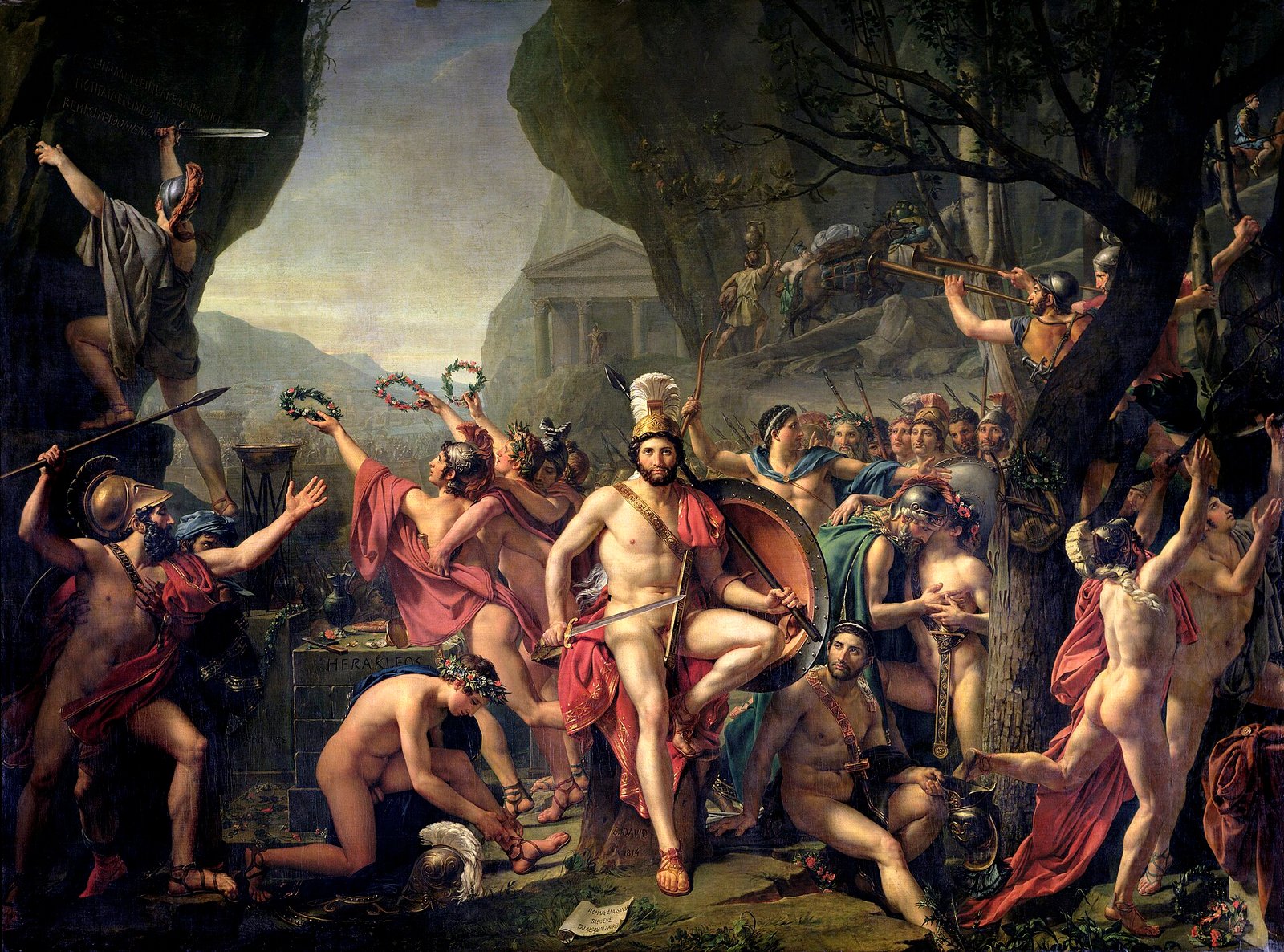
Image: Leónidas en las Termópilas, por Jacques-Louis David.jpg — Jacques-Louis David, Public domain