Wallachia was a historical region in southern present-day Romania, between the Danube to the south and the Southern Carpathians to the north. It became an Ottoman tributary principality and united with Moldavia under Alexandru Ioan Cuza in 1859, with a shared government and parliament following in 1862.
How could a principality pay tribute to the Ottoman ruler while keeping its own government? Wallachia’s history turns on that distinction. If you follow its changing relationship with Ottoman power, Russian intervention, and Moldavia, the steps toward Romanian unification become easier to separate.
Which part of present-day Romania was Wallachia?
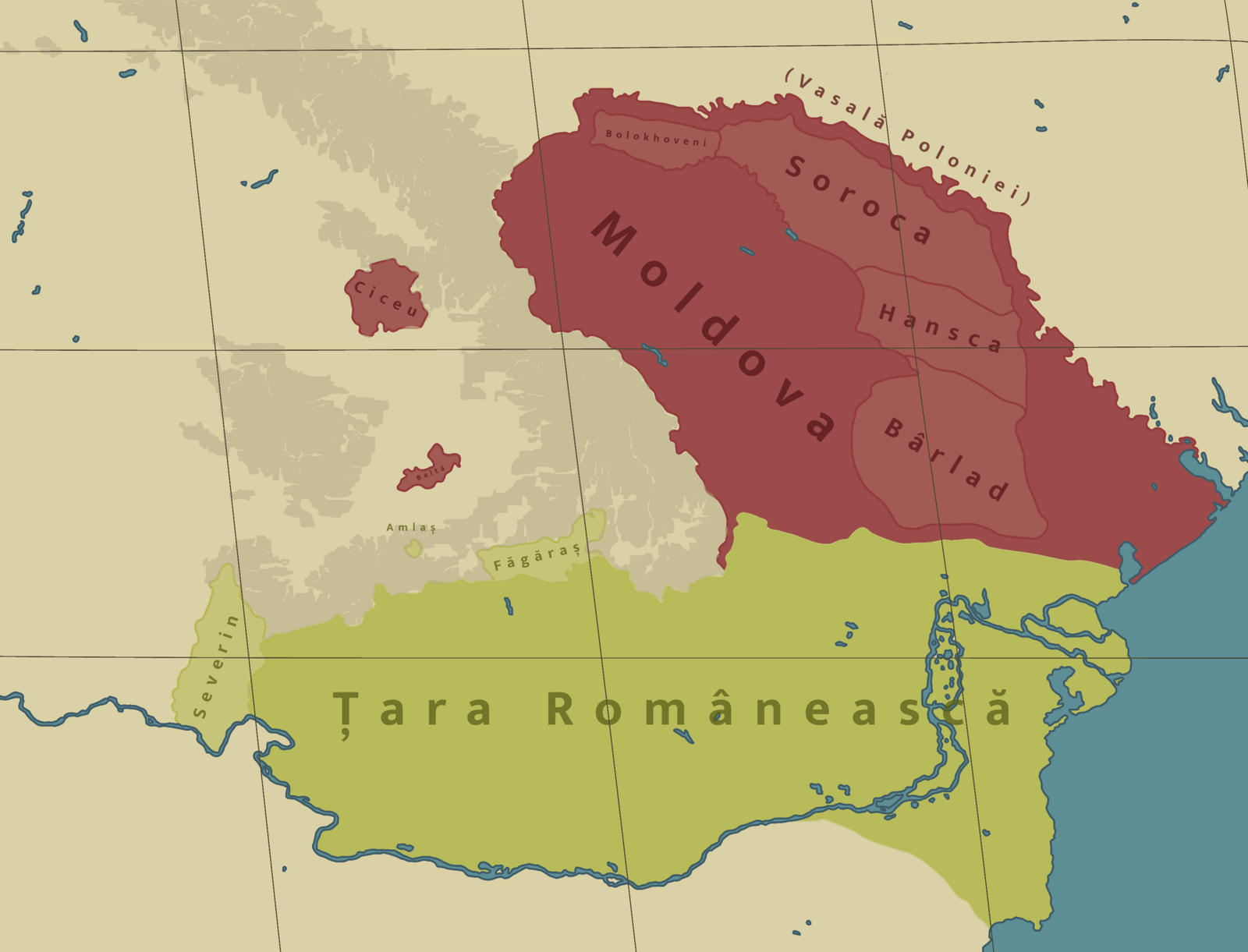
Wallachia covered the southern part of present-day Romania. Its two main divisions lay on either side of the Olt River: Muntenia to the east and Oltenia to the west. The Danube and the Southern Carpathians provide the clearest geographical frame for locating it.
Bucharest, Târgoviște, Curtea de Argeș, and Câmpulung are among the cities of historical Wallachia. If you are locating Bucharest on a map, you are also locating a city within this historical region. Wallachia therefore refers to a particular part of Romania, rather than the whole country.
Its local name, Țara Românească, means “Romanian land” or “land of the Romanians.” In Turkish historical usage, the region appears as Eflak. These names help connect Romanian geography with the terminology you may encounter when reading Ottoman history in Turkey.
How did the principality emerge and come under Ottoman suzerainty?
Wallachia’s foundation story must be separated from its documented political development. A founding legend describes Radu Negru crossing the Carpathians in 1290 and establishing Wallachia. The documented explanation centers on Basarab’s political unification activities. A Hungarian document from 1324 names him.
Basarab I strengthened the state’s independence through victory at Posada in 1330. He defeated the Hungarian king Charles I. That victory consolidated Wallachia’s independence from Hungary and forms a firmer historical marker than the founding legend.
The relationship with Ottoman power developed later. In 1417, Mircea agreed to pay annual tribute to Mehmed I and surrender territory. Wallachia was allowed to preserve its status as a principality and retain its Orthodox faith. Ottoman supremacy thus came with continuing local political and religious institutions.
The 1417 arrangement helps explain the term “suzerainty.” Wallachia accepted a superior power and obligations toward it, while retaining a local ruler and administration. Its history under Ottoman authority cannot be understood simply as the replacement of local government by direct provincial rule.
How did a tributary principality differ from a directly governed Ottoman province?
As an autonomous tributary principality, Wallachia kept its ruler and local administration. Its dependence on the Ottoman Empire operated through tribute and political obligations. A directly governed Ottoman province had a different administrative relationship with Ottoman authority.
For Wallachia, autonomy and subordination existed together. Keeping local institutions did not remove the obligation to pay tribute. Equally, paying tribute did not mean that every part of its government became a directly administered Ottoman institution. You need both sides of this arrangement to understand its status.
There were also exceptions within the region. The ports of Brăila and Giurgiu spent a period under direct Ottoman government. Their status differed from that of the surrounding principality. The geographical extent of historical Wallachia therefore did not always correspond to a single form of administration.
Ottoman terminology also linked Wallachia with Moldavia. The name Memleketeyn meant “the two countries.” This shared designation connected the principalities in Ottoman usage, although their political union under the same ruler would come in 1859.
How did Phanariote rulers and Russian interventions change its government?
Faced with threats from Russia and Austria, Ottoman authorities began appointing Phanariote Greek rulers in place of native princes. In Wallachia, this period lasted from 1716 to 1821. The principality retained its separate status, but the choice of ruler became a means of managing external pressure.
The Treaty of Küçük Kaynarca in 1774 granted Russia the right to establish consulates and trade freely in Wallachia.
The Phanariote period ended after Tudor Vladimirescu’s uprising and the Eterya movement in 1821. Ottoman authorities abandoned Phanariote appointments and returned to native rulers. This changed who governed Wallachia without bringing Ottoman suzerainty to an end.
The Treaty of Edirne, dated 14 September 1829, preserved Wallachia and Moldavia as autonomous principalities under Ottoman authority. It also strengthened Russian influence in the region. Autonomy, Ottoman supremacy, and Russian intervention remained parts of the same political arrangement.
The treaty also changed trade. Wallachia no longer had to sell food to the Ottoman state at prescribed prices and could open toward foreign markets. For an everyday-life connection, think about the relationship between food and prices: this obligation concerned both what Wallachia supplied and the prices set for those supplies.
Under Russian administration, the Regulamentul Organic introduced boyar assemblies, judicial reform, and arrangements for public education. It also preserved the boyars’ tax privileges. Administrative reform therefore coexisted with continued privileges for this group.
The Treaty of Paris in 1856 changed the external framework again. A collective guarantee by the great powers replaced the Russian-centered protectorate arrangement over Wallachia and Moldavia. The principalities’ future now rested within a different international structure.
How did the union with Moldavia take place in 1859?
The Paris Convention of 1858 provided separate political and administrative structures for Wallachia and Moldavia. It did not require the two thrones to be occupied by different people. That opening made it possible to elect one ruler in both principalities while the framework still envisaged separate institutions.
Alexandru Ioan Cuza was elected ruler of Moldavia on 5 January 1859 and ruler of Wallachia on 24 January. These are Julian calendar dates. Their Gregorian equivalents are 17 January and 5 February 1859. Both sets describe the same two elections.
Cuza’s double election created a personal union. Two separate states shared one ruler, and Ottoman suzerainty continued. If you distinguish the shared ruler of 1859 from the shared institutions of 1862, the process becomes clearer: political union and administrative consolidation were separate steps.
The first common government was established on 22 January 1862 under Barbu Catargiu. A common parliament met in Bucharest on 24 January. These institutions carried the union beyond the earlier arrangement of two states governed by the same person.
Romanian independence followed later. Romania declared independence in 1877, and the Berlin Treaty recognized it internationally in 1878. The proclamation of the kingdom came in 1881. Union, independence, and monarchy were distinct stages in the formation of the Romanian state.
Timeline
- 1324: A Hungarian document named Basarab.
- 1330: Victory at Posada consolidated Wallachia’s independence from Hungary.
- 1417: Mircea accepted Ottoman supremacy and annual tribute obligations.
- 1716–1821: Phanariote Greek rulers governed Wallachia.
- 1774: Küçük Kaynarca granted Russia rights to establish consulates and trade freely in Wallachia.
- 1821: Vladimirescu’s uprising and the Eterya movement preceded the end of Phanariote rule.
- 1829: Edirne changed arrangements for autonomy, trade, and Russian influence.
- 1856: Paris placed the principalities under the great powers’ collective guarantee.
- 1858: The Paris Convention envisaged separate political and administrative structures.
- 1859: Cuza won both thrones on 5 and 24 January, Julian calendar.
- 1862: A common government and parliament established administrative union.
- 1877–1878: Romania declared independence and obtained recognition through the Berlin Treaty.
- 1881: Romania became a kingdom.
- 1918: Bessarabia, Bukovina, and Transylvania joined Romania.
Details you won’t find in guidebooks
Military coordination began before the common government of 1862. In March 1859, a commission met at Focșani under Carol Davila. It comprised three Wallachian and three Moldavian officers. Their assignment was to prepare a common uniform for the two armies.
That uniform commission gives the union a concrete administrative detail. Cuza’s elections joined the thrones, while officers from both principalities worked on a shared military appearance. The March 1859 task belonged to the practical work of bringing the two states together.
The territorial enlargement of 1918 was a separate event from the Wallachian–Moldavian union. Bessarabia, Bukovina, and Transylvania joined Romania in 1918. Keeping that enlargement distinct from 1859 prevents two different stages of Romanian state formation from being folded into one.
FAQ
Was Wallachia part of present-day Romania?
Yes. Wallachia occupied southern present-day Romania, north of the Danube and south of the Southern Carpathians. Its two main divisions were Muntenia and Oltenia.
Was Wallachia directly governed by the Ottoman Empire?
Wallachia generally retained its ruler and local administration as an autonomous tributary principality under Ottoman suzerainty. Brăila and Giurgiu were exceptions, spending a period under direct Ottoman government.
Why are different dates given for Cuza’s elections?
The dates use different calendars. His elections in Moldavia and Wallachia occurred on 5 and 24 January 1859 in the Julian calendar, corresponding to 17 January and 5 February in the Gregorian calendar.
Did the 1859 union make Romania independent?
No. The union initially joined two separate states under one ruler while Ottoman suzerainty continued. Romania declared independence in 1877, and the Berlin Treaty recognized it in 1878.
Sources
- Vikipedi — Eflak tr.wikipedia.org
- YIVO Encyclopedia — Walachia encyclopedia.yivo.org
- TDV İslâm Ansiklopedisi — Eflak islamansiklopedisi.org.tr
- Wikipedia — Wallachia en.wikipedia.org
- Library of Congress — Romania: A Country Study tile.loc.gov
- Mensure Kızıl — Edirne Antlaşması’nda (1829) Tuna Nehri Sahil ve Adalarının Statüsü dergipark.org.tr
- Romanian National Military Archives — Unificarea armatelor Principatelor Unite amnr.defense.ro
- Romanian General Staff — 1859 defense.ro
- National History Museum of Romania — 125 de ani de la proclamarea independenţei mnir.ro
- Radio Romania International — Union of Romanians rri.ro
- Romanian National Heritage Institute — România: documentele Unirii 1918 biblioteca-digitala.ro
Image: Wallachia si Moldova in anul 1405.png — Joyfulmapper, CC0