Baldwin IV defeated Saladin at the Battle of Montgisard on 25 November 1177 with a smaller army, using a surprise attack aided by favorable terrain. Saladin’s forces had scattered before the battle, helping the 16-year-old king of Jerusalem, who had leprosy, turn a dangerous situation into victory.
The central puzzle is how Baldwin moved from sheltering behind Ascalon’s walls to defeating Saladin three days later. If you follow that movement, the scattered forces and the disputed troop figures, the result becomes easier to understand. The battlefield’s uncertain location and a much later painting also shape how the battle is remembered.
The Battle of Montgisard in 1177: why was Baldwin exposed?
Earlier in 1177, Baldwin IV and Philip of Alsace planned an attack on Egypt with Byzantine support. That expedition did not take place. The campaign that preceded Montgisard therefore developed after a proposed offensive had failed to materialize.
Philip instead joined Raymond III on the Harim expedition in northern Syria. His departure reduced the forces available to defend the Kingdom of Jerusalem. This matters because Baldwin faced Saladin while part of the kingdom’s military strength was committed elsewhere.
On 22 November 1177, Saladin reached Ascalon. Baldwin withdrew his forces inside its walls. At this stage, the king’s army was concentrated behind defenses, while Saladin could decide whether to remain nearby or continue toward Jerusalem.
Saladin did not consider Baldwin’s small army a sufficient threat. He left Ascalon behind and advanced toward Jerusalem. That judgment gave Baldwin the opening around which the story of Montgisard turns: the force Saladin had discounted remained capable of acting.
How did Baldwin IV defeat Saladin?
Baldwin left Ascalon after calling on the Templars at Gaza to join him. He then advanced along the coast. His withdrawal behind the walls had therefore been a stage in the campaign, rather than the end of his army’s involvement.
Meanwhile, attacks directed at Ramla and Lydda dispersed Saladin’s forces. This dispersal is central to explaining the outcome. The size of an army across a campaign does not, by itself, describe how concentrated that army was when an opponent struck.
The Crusader success at Montgisard is explained by surprise and favorable terrain. These factors worked alongside the dispersal of Saladin’s troops. Baldwin’s smaller force gained an opportunity to attack under conditions that helped offset its numerical disadvantage.
You can understand the victory more clearly by keeping those elements together. Saladin underestimated the army at Ascalon. Baldwin brought his force out and called for Templar support. Saladin’s troops had spread out, and the subsequent surprise attack benefited from the ground.
The Crusader leaders included Reynald of Châtillon, Baldwin of Ibelin, Balian, Reynald of Sidon and Joscelin. Their presence also broadens a story often reduced to a contest between Baldwin and Saladin. The young king’s victory involved a force with several prominent figures.
Battle of Montgisard numbers: how many soldiers fought?
William of Tyre gives a figure of 375 Crusader knights. That is not a total for the whole army, because it does not include infantry. Reading it as the complete force makes Baldwin’s numerical disadvantage appear more extreme than that particular figure establishes.
Templar grand master Eudes de Saint-Amand is reported to have joined the battle with approximately 80 Templar knights. This is another figure attached to a particular group. It should retain that meaning when you compare accounts of the army’s strength.
Broader estimates are disputed. Some put the Crusader force at approximately 4,500 men. Alternative calculations reach 7,000, including infantry. These totals should be presented as estimates, rather than combined into a single supposedly settled headcount.
For Saladin’s army, William of Tyre claimed 26,000 men. Historian W. B. Stevenson considered that figure exaggerated. The numerical contrast remains part of the battle’s story, but that large total requires an explicit qualification whenever it is used.
Think of an everyday headcount: counting one group of guests does not give you everyone attending. William’s 375 knights present the same reading problem. A count of knights and a count including infantry answer different questions, even when both concern Baldwin’s army.
Who won, and what were the Battle of Montgisard casualties?
Baldwin IV and the Kingdom of Jerusalem won at Montgisard. Saladin’s army suffered defeat despite its numerical advantage. The king was 16 and had leprosy, facts that make his role especially striking without explaining the military result on their own.
The victory also came with substantial reported Crusader losses. Hospitaller grand master Roger de Moulins gave figures of 1,100 dead and 750 wounded. Those figures belong alongside the account of success, because victory and heavy losses could form part of the same battle.
The casualty report should remain attributed to Roger de Moulins. Likewise, the competing army totals should retain their qualifications. Combining disputed strength estimates with reported losses to calculate a precise casualty rate would make the numbers appear more settled than they are.
Where was the Battle of Montgisard fought? Location today and map questions
The precise battlefield remains disputed. Tel Gezer is one proposed location. Another is Tell es-Safi, supported by Malcolm Barber and the account of Imad al-Din al-Isfahani. These alternatives prevent a confident identification of one modern spot as the battlefield.
Ramla creates a further map problem. In medieval accounts, the name could refer to a wider region. The present-day city center therefore cannot simply be treated as the place where Baldwin and Saladin fought.
If you are exploring the campaign on a map, distinguish its named places from its proposed battle sites. Ascalon, Gaza, Ramla and Lydda help explain movements and dispersal. Tel Gezer and Tell es-Safi belong to the separate question of where the fighting occurred.
For a travel itinerary built around Montgisard, the distinction matters. A modern map pin for Ramla does not resolve the battlefield debate. Keep both proposed sites in view, and avoid turning a regional reference into a precise location.
Timeline
- 1177: Baldwin and Philip’s planned expedition against Egypt, supported by Byzantium, did not take place.
- 22 November 1177: Saladin reached Ascalon, and Baldwin withdrew inside its walls.
- 25 November 1177: Baldwin’s forces defeated Saladin’s army at Montgisard.
- 1179: Saladin defeated forces of the Kingdom of Jerusalem at Marj Ayyun.
- 1187: Saladin won at Hattin and then captured Jerusalem.
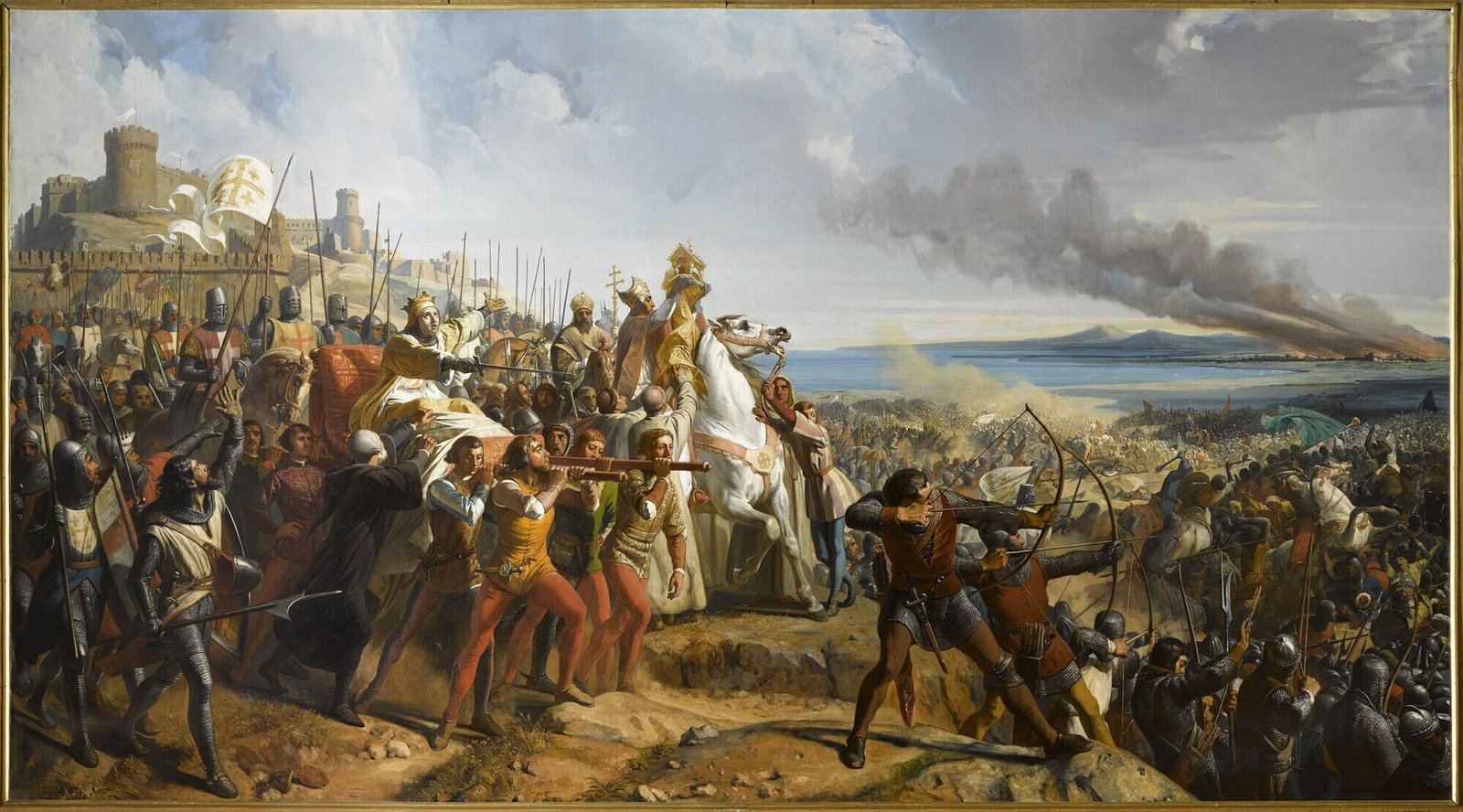
- 1842–1844: Charles-Philippe Larivière produced his painting of the Battle of Montgisard.
Details you won’t find in guidebooks
Chronicler Ralph de Diceto describes Saladin escaping capture on a fast camel. The detail gives the retreat a memorable image. It should also keep its attribution: this is Ralph’s account of Saladin’s escape following the defeat.
Baldwin commemorated the victory by having a Benedictine monastery built on the battlefield. It was dedicated to Saint Catherine, whose feast falls on 25 November. The dedication connected the battle’s anniversary with the monastery’s religious observance.
Charles-Philippe Larivière painted Montgisard in 1842–1844, more than six centuries after the battle. If you encounter the painting while reading about Baldwin, its date matters. It is a later representation of the victory, rather than an image produced during the campaign.
TU Dresden’s discussion questions the painting’s box-shaped reliquary. It argues instead for the possibility of a cross-shaped container visible from a distance. Even this small visual element therefore deserves care when the painting is used to imagine the battle.
Battle of Montgisard movie: is it in Kingdom of Heaven?
The 2005 film Kingdom of Heaven does not depict Montgisard, but it refers to Baldwin defeating Saladin when he was 16.
Did Montgisard give Baldwin lasting superiority?
Montgisard did not establish lasting superiority over Saladin. In 1179, two years after the defeat, Saladin beat the Kingdom of Jerusalem’s forces at Marj Ayyun. The later result limits any reading of Montgisard as a permanent reversal of the military balance.
In 1187, Saladin won at Hattin and captured Jerusalem. Montgisard remains a victory achieved through surprise, favorable terrain and an opportunity created by dispersed forces. Those later events show why the outcome of one battle must be distinguished from the longer struggle.
FAQ
Who won the Battle of Montgisard?
Baldwin IV and the smaller army of the Kingdom of Jerusalem defeated Saladin’s army on 25 November 1177.
How many soldiers fought at Montgisard?
Disputed estimates put the Crusader army at approximately 4,500 or 7,000 men. William of Tyre’s figure of 375 knights excludes infantry, while his claim of 26,000 men for Saladin was considered exaggerated by W. B. Stevenson.
Where was the Battle of Montgisard fought?
The battlefield’s precise location is disputed. Tel Gezer is one proposed site, while Malcolm Barber and the account of Imad al-Din al-Isfahani support Tell es-Safi.
What were the casualties at Montgisard?
Hospitaller grand master Roger de Moulins reported Crusader losses of 1,100 dead and 750 wounded.
Sources
- Vikipedi — Montgisard Muharebesi tr.wikipedia.org
- Wikipedia — Battle of Montgisard en.wikipedia.org
- TU Dresden — Templerlexikon, Montgisard tu-dresden.de
Image: Schlacht von Montgisard 2.jpg — Charles-Philippe Larivière, Public domain