Anwar Sadat arrived at Ben Gurion Airport on the evening of 19 November 1977. He became the first Arab head of state to visit Israel. The Egyptian president’s journey opened a path toward direct negotiations, the Camp David agreements of 1978, and the Egypt–Israel Peace Treaty of 26 March 1979.
If you follow the story from that airport arrival, keep three events separate: the Jerusalem visit, the Camp David negotiations, and the peace treaty. They happened at different stages. Sadat’s public gesture made direct contact possible, but further talks and American mediation were still needed to reach an agreement.
Who was Anwar Sadat, Egypt’s president?
Muhammad Anwar al-Sadat was born on 25 December 1918 in Mit Abu al-Kum, Egypt. He graduated from the Cairo Military Academy in 1938. A soldier and politician, he became Egypt’s third president in 1970 and remained in office until his death in 1981.
The Sinai Peninsula stood at the center of his conflict with Israel. Israel had occupied it in 1967. Sadat led Egypt in the October War of 1973 with the aim of recovering that territory. His later diplomatic initiative concerned land as well as relations between governments.
Four years later, Sadat publicly offered to go to Jerusalem. The same Egyptian president who had led his country in war would now carry his peace initiative into Israel’s parliament.
Why did Anwar Sadat visit Israel in 1977?
On 9 November 1977, Sadat announced that he was prepared to travel to Jerusalem. He arrived in Israel ten days later. That short interval turned a public declaration into a visit by Egypt’s serving president, giving direct diplomacy a visible setting.
His proposals became clear in the Knesset on 20 November. Speaking in Arabic, Sadat called for Israeli withdrawal from territories captured in 1967. He also called for a homeland for the Palestinians. His visit therefore placed territorial and Palestinian questions alongside the pursuit of peace.
Sadat also described a psychological barrier between Arabs and Israelis. In his speech, he said that this accounted for 70 percent of the problem. You can understand the everyday logic through a difficult conversation with a neighbor: agreeing to meet can open discussion, while the disagreement still needs an answer. Sadat’s arrival opened that conversation; his territorial demands remained part of it.
What happened during Sadat’s visit to Jerusalem?
Sadat received a ceremonial welcome at Ben Gurion Airport. It included a 21-gun salute and the national anthems of Egypt and Israel. These details gave the arrival the formal character of a state reception, with both countries represented in the ceremony.
His visit lasted about 36 hours, and he stayed at Jerusalem’s King David Hotel. The itinerary included Al-Aqsa Mosque, the Church of the Holy Sepulchre, and Yad Vashem, the Holocaust memorial. His short stay thus combined political meetings with visits to religious and commemorative sites.
The parliamentary address came on 20 November 1977. For you as a reader, its location matters: Sadat presented his peace initiative inside the Knesset. The Egyptian president addressed Israel’s parliament directly while stating his demands for withdrawal and a Palestinian homeland.
How did the visit lead to Camp David?
Direct Egyptian–Israeli talks began in December 1977 after the Jerusalem visit. They failed to achieve substantial progress. In January 1978, the United States again took a more prominent mediation role. The visit had opened negotiations, but it had not settled their central issues.
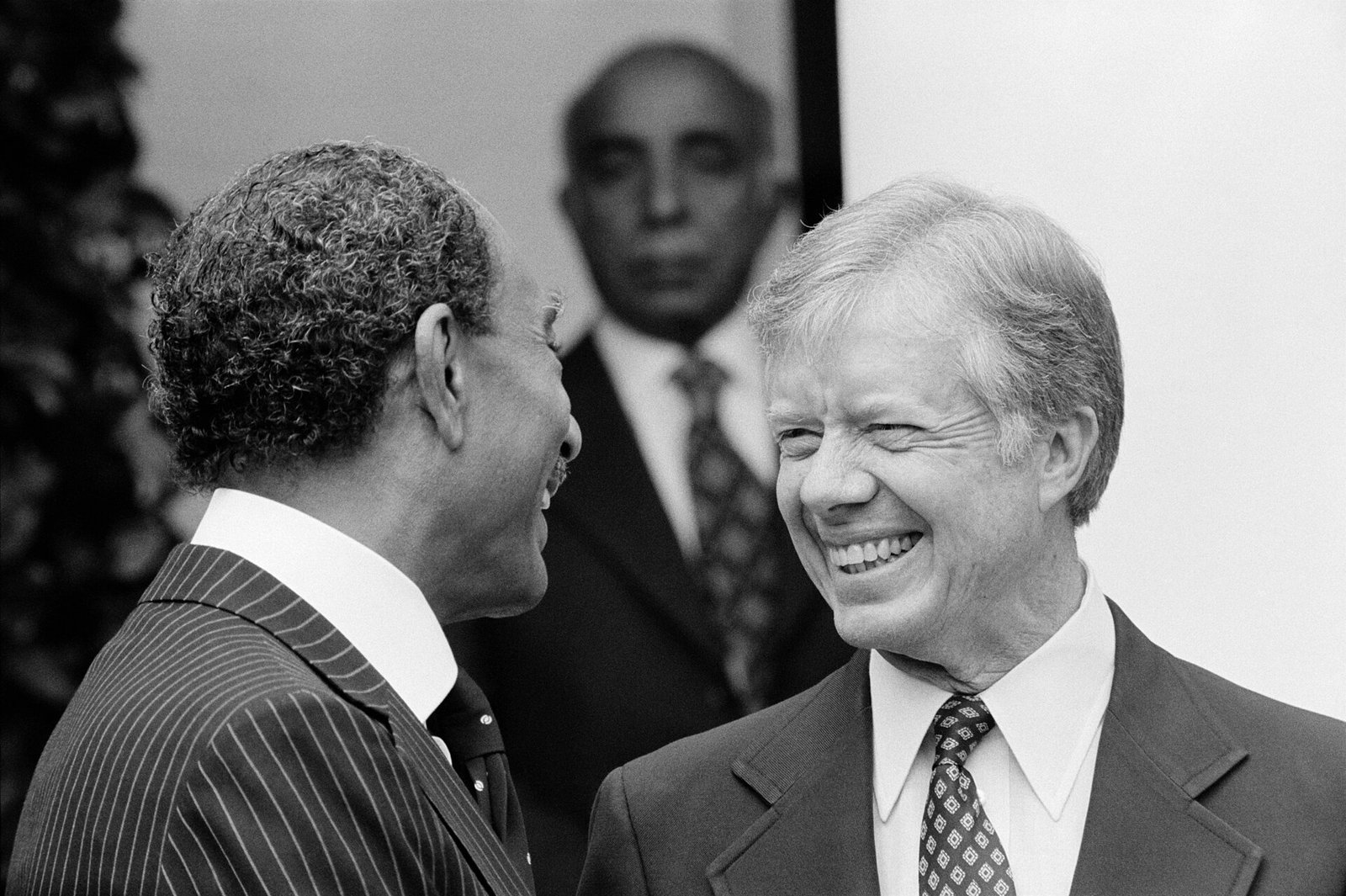
Sadat, Israeli Prime Minister Menachem Begin, and US President Jimmy Carter negotiated at Camp David in Maryland from 5 to 17 September 1978. The talks brought the Egyptian and Israeli leaders together with the American president. Carter’s mediation formed part of the process connecting Jerusalem to an agreement.
Two framework documents emerged on 17 September. One set out the basis for peace between Egypt and Israel. The other included a formula for Palestinian self-government in the West Bank and Gaza. The Camp David outcome therefore addressed both bilateral peace and a wider Palestinian question.
The Egypt–Israel Peace Treaty followed on 26 March 1979. It was the first peace treaty between Israel and an Arab state. When you trace the sequence, the distinction is clear: Jerusalem opened direct contact, Camp David produced frameworks, and the treaty established the formal peace agreement.
What year did Anwar Sadat receive the Nobel Peace Prize?
Sadat received the Nobel Peace Prize in 1978, sharing it equally with Begin. The award recognized their negotiation of peace between Egypt and Israel. It came in the year of the Camp David agreements, before the signing of the peace treaty in March 1979.
The diplomatic achievement also brought regional consequences. After the treaty, the Arab League suspended Egypt’s membership in 1979. It moved its headquarters from Cairo to Tunis. Egypt’s agreement with Israel thus coincided with its exclusion from the organization.
Timeline
- 25 December 1918: Sadat was born in Mit Abu al-Kum.
- 1938: He graduated from the Cairo Military Academy.
- 1970: He became Egypt’s third president.
- 1973: Sadat led Egypt in the October War with the aim of recovering the Sinai Peninsula.
- 9 November 1977: Sadat announced his willingness to visit Jerusalem.
- 19 November 1977: He arrived at Ben Gurion Airport.
- 20 November 1977: He addressed the Knesset.
- 5–17 September 1978: Sadat, Begin, and Carter negotiated at Camp David.
- 17 September 1978: The two Camp David framework documents emerged.
- 1978: Sadat and Begin shared the Nobel Peace Prize.
- 26 March 1979: Egypt and Israel signed their peace treaty.
- 1979: The Arab League suspended Egypt’s membership.
- 6 October 1981: Sadat was assassinated at a military parade in Cairo.
Details you won’t find in guidebooks
Three lanterns given to Sadat during the Jerusalem visit are held in the Sadat Museum at the Bibliotheca Alexandrina. They represent Islam, Christianity, and Judaism. These objects offer a material connection to a visit whose itinerary included Al-Aqsa Mosque and the Church of the Holy Sepulchre.
The museum also displays the bloodstained military uniform Sadat wore when he was assassinated. The lanterns and uniform connect two episodes in his presidency: the Jerusalem peace initiative of 1977 and his death in 1981.
Sadat’s own writing provides another object from this period. The English translation of his Arabic work, al-Bahth an al-Dhat, appeared as In Search of Identity. Collins published the 360-page volume in London in 1978, the year of Camp David and his Nobel award.
Anwar Sadat’s wife, children, and religion
Sadat married Jehan Sadat in 1949. He had seven children across two marriages. His religion was Islam. These basic biographical facts sit alongside the military and presidential career that brought him to Jerusalem in November 1977.
Sadat was Egyptian. His mother, Sit Al-Berain, was the daughter of an Egyptian mother and a Sudanese father. He was born in Mit Abu al-Kum and later trained at the Cairo Military Academy before entering the career that led to Egypt’s presidency.
Anwar Sadat’s assassination: when did he die, and why was he killed?
Sadat was killed on 6 October 1981 in Cairo. He was watching a military parade commemorating the 1973 war when gunmen attacked him. His death came during a ceremony tied to the war he had led before pursuing peace with Israel.
Khalid al-Islambuli, one of the principal perpetrators, belonged to Egyptian Islamic Jihad. The Nobel Foundation’s biographical account states that Sadat’s killers opposed his reconciliation with Israel and his close relations with the United States. Those stated motives connect the assassination to opposition to his foreign policy.
Sadat was buried within the Unknown Soldier Memorial complex in Cairo’s Nasr City district. His presidency ended in 1981, two years after the Egypt–Israel Peace Treaty was signed.
FAQ
In what year did Anwar Sadat receive the Nobel Peace Prize?
Sadat received the Nobel Peace Prize in 1978. He shared it equally with Menachem Begin for negotiating peace between Egypt and Israel.
Who was Anwar Sadat’s wife, and how many children did he have?
Sadat married Jehan Sadat in 1949. He had seven children across two marriages.
Sources
- Nobel Prize — Anwar al-Sadat: Facts nobelprize.org
- University of Maryland — Anwar Sadat sadat.umd.edu
- US Department of State, Office of the Historian — Camp David Accords and the Arab-Israeli Peace Process history.state.gov
- US Department of State — Foreign Relations of the United States, Volume VIII, Document 152 history.state.gov
- Knesset — A Look Back: Foreign Leaders Address the Knesset main.knesset.gov.il
- Center for Online Judaic Studies — President Anwar Sadat’s Speech to the Israeli Knesset cojs.org
- Nobel Prize — The Nobel Peace Prize 1978 nobelprize.org
- Bibliotheca Alexandrina — Sadat Museum bibalex.org
- Bibliothèque nationale de France — In Search of Identity catalogue.bnf.fr
- AP Archive — Anwar Sadat Assassinated – 1981 youtube.com
- Wikipedia — Anwar Sadat en.wikipedia.org
- Vikipedi — Enver Sedat tr.wikipedia.org
Image: Carter and Sadat White House2.jpg — Leffler, Warren K., photographer or Trikosko, Marion S., pho, Public domain