Where were Sodom and Gomorrah located?
Sodom and Gomorrah have no confirmed archaeological location. The two cities appear in Genesis as places destroyed by God. Searches for their remains focus on the Dead Sea basin. Bab edh-Dhra and Numeira are among the proposed sites, but the archaeological evidence does not establish a definitive identification.
If you want to place the debate on a map, start with the Dead Sea. Jordan lies to its east, the West Bank to its west, and Israel to its southwest. The candidate sites discussed here belong to this basin.
The biblical geography groups Sodom and Gomorrah with Admah, Zeboiim, and Zoar. Together, they form five cities of the plain. That grouping belongs to the textual account. Matching those names to excavated settlements remains disputed.
Sodom and Gomorrah today: what are the proposed locations?
Bab edh-Dhra lies on the plain southeast of the Dead Sea, in present-day Jordan. It is an Early Bronze Age settlement. Numeira also appears among the proposed locations for the biblical cities. Neither identification has been established conclusively.
Tall el-Hammam lies northeast of the Dead Sea, in Jordan’s Jordan Valley. Excavations there began in 2005. A university brochure for the excavation project identifies the site as Sodom. That is an identification claim, rather than a settled archaeological conclusion.
Another proposal places the cities beneath the southern part of the Dead Sea. Some researchers have suggested that rising water submerged them. This remains a theory about their location. It does not provide a confirmed position for either city.
What does the archaeological evidence at Bab edh-Dhra show?
The Bab edh-Dhra town excavation report covers communities from the last quarter of the fourth millennium BCE to the end of the third millennium BCE. This gives the settlement an archaeological history extending across a substantial period. Its proposed biblical name remains a separate question.
Walter Rast and R. Thomas Schaub published the town excavation report in 2003. It presents evidence from the 1975, 1977, 1979, and 1981 seasons. The report documents an excavated settlement. Its existence and occupation do not, by themselves, establish that it was Sodom or Gomorrah.
Human remains from the Bab edh-Dhra cemetery also provide evidence about the community. At the University of Notre Dame, researchers studied the remains of 230 people. Their work examined diet, disease, working conditions, and signs of violence.
Think of the everyday connection between what you eat and your health. Diet and disease were among the questions investigated through these remains. That work concerns the lives of people buried at Bab edh-Dhra. The cemetery’s proposed association with the biblical cities remains disputed.
Feifa shows why the type of archaeological site matters. It has appeared among candidates associated with Sodom and Gomorrah. Investigations there revealed an Early Bronze Age cemetery and later walls, rather than a Bronze Age city. Those findings change what the location can contribute to an identification claim.
Was Tall el-Hammam destroyed by a cosmic airburst?
A paper by Ted Bunch and colleagues, published on 20 September 2021, proposed that a cosmic airburst destroyed Tall el-Hammam around 1650 BCE. Scientific Reports later retracted that paper. The proposed date must therefore remain attached to the disputed claim. It is not a confirmed destruction date for Sodom.
Steven Jaret and R. Scott Harris challenged the interpretation in 2022. Their scientific critique argued that Tall el-Hammam lacked mineralogical or geochemical evidence demonstrating a cosmic impact. Their objection addressed the physical evidence used to support the proposed event.
Mark Boslough and Andy Bruno published another critique on 22 April 2025. They argued that an airburst comparable to Tunguska could not produce the airflow claimed for Tall el-Hammam. The disputed conditions included temperatures above 1,000 °C and speeds above 3 kilometres per second.
On 24 April 2025, Scientific Reports retracted the 2021 paper. The editors stated that the data did not sufficiently support its conclusion that a cosmic airburst destroyed Tall el-Hammam. If you encounter that explanation presented as a proven discovery, the retraction is essential context.
The airburst proposal and the identification as Sodom are also distinct claims. The excavation project’s brochure promotes the biblical identification. The retracted paper proposed a destruction mechanism. Neither provides a definitive archaeological identification of the settlement as Sodom.
Sodom and Gomorrah in the Bible: where is the story?
Genesis 18 contains Abraham’s appeal on behalf of Sodom. He asks God to spare the city if righteous people can be found there. During the exchange, the number falls from 50 to 10. This episode precedes the destruction account in Genesis 19.
In Genesis 19, two angels arrive in Sodom and receive hospitality in Lot’s house. A crowd surrounds the house. The angels strike the crowd with blindness. These are events within the biblical narrative, rather than conclusions drawn from an excavation.
Genesis 19:24–26 describes sulfur and fire falling on Sodom and Gomorrah. It also tells of Lot’s wife looking back and becoming a pillar of salt. In the biblical account, Lot and his two daughters survive, while Zoar, where they take refuge, is spared.
What do Sodom and Gomorrah mean?
The origins of the names Sodom and Gomorrah are uncertain. Researchers have not reached agreement on their etymologies. A proposed meaning for either name should therefore be distinguished from the moral themes attached to the cities in religious texts.
Ezekiel 16:49–50 names pride, abundant living, and failure to help the poor among Sodom’s offences. This passage gives you another biblical reference alongside Genesis. Its emphasis includes how people treat those in need.
Claims about ancient written names have also been disputed. In 1976, Giovanni Pettinato linked names in the Ebla tablets with Sodom and Gomorrah. Alfonso Archi argued that the relevant names instead referred to places in northern Syria and to Emar. The proposed tablet connection is therefore contested.
Sodom and Gomorrah in Islam
The Qur’anic account in Hud 11:81–83 describes Lot being instructed to leave with his family at night. His wife shares the punishment of those who remain. The passage also describes stones of baked clay raining upon the settlement.
The treatment of Lot’s wife differs from the pillar-of-salt episode in Genesis 19:24–26. The cited Qur’anic passage places her among those punished. Genesis describes her looking back and becoming salt. Keeping those accounts distinct preserves the details of each text.
Further historical and archaeological details
A salt formation southwest of the Dead Sea has a traditional connection with Lot’s wife. The TDV İslâm Ansiklopedisi records a 15-metre pillar on Usdum hill associated with her. That association is a tradition attached to a physical landmark, rather than an archaeological identification of a person.
Paul Lapp’s excavations in 1965 changed the understanding of Bab edh-Dhra. The site had previously been regarded as a special ceremonial area. His work showed that it was an Early Bronze Age settlement. This was a concrete change in the interpretation of the site itself.
The cemetery material also has an unexpected modern detail. According to the University of Notre Dame, human bones from Bab edh-Dhra arrived for research in 600 beer cases and photocopy-paper boxes. The collection supported investigations into the health and lives of the ancient community.
Timeline
- Last quarter of the fourth millennium BCE–end of the third millennium BCE: Occupation period covered by the Bab edh-Dhra town excavation report.
- Around 1650 BCE: Destruction date proposed for Tall el-Hammam in the retracted 2021 paper; not a verified date for Sodom’s destruction.
- 1965: Paul Lapp’s excavations establish Bab edh-Dhra as an Early Bronze Age settlement.
- 1975, 1977, 1979, and 1981: Bab edh-Dhra town excavation seasons covered by the published report.
- 2003: Walter Rast and R. Thomas Schaub publish that report.
- 2005: Excavations begin at Tall el-Hammam.
- 20 September 2021: Scientific Reports publishes the Tall el-Hammam airburst paper.
- 2022: Jaret and Harris challenge the mineralogical and geochemical evidence.
- 22 April 2025: Boslough and Bruno publish their critique of the Tunguska comparison.
- 24 April 2025: Scientific Reports retracts the 2021 paper.
FAQ
Where were Sodom and Gomorrah located?
Their exact locations remain unconfirmed. Proposed sites around the Dead Sea include Bab edh-Dhra and Numeira, while Tall el-Hammam is another disputed identification.
Where are Sodom and Gomorrah mentioned in the Bible?
Genesis 18 contains Abraham’s appeal for Sodom. Genesis 19 describes the visitors at Lot’s house and the destruction. Genesis 19:24–26 includes the account of sulfur, fire, and Lot’s wife becoming a pillar of salt.
Has archaeology proved that Tall el-Hammam was Sodom?
No definitive identification has been established. The 2021 paper proposing destruction by a cosmic airburst was retracted by Scientific Reports on 24 April 2025.
Where is the salt pillar associated with Lot’s wife?
The TDV İslâm Ansiklopedisi records a traditional association with a 15-metre salt pillar on Usdum hill, southwest of the Dead Sea. This is a traditional attribution.
Sources
- Vikipedi — Sodom ve Gomora tr.wikipedia.org
- Wikipedia — Sodom and Gomorrah en.wikipedia.org
- TDV İslâm Ansiklopedisi — Lût islamansiklopedisi.org.tr
- Wikipedia — Dead Sea en.wikipedia.org
- ASOR — Burton MacDonald, East of the Jordan bu.edu
- Harvard University — Bâb edh-Dhrâ‘: Excavations at the Town Site whitelevy.fas.harvard.edu
- University of Notre Dame — Skeleton collection gives clues to ancient civilization news.nd.edu
- East Carolina University — Biblical Burning news.ecu.edu
- Veritas International University — Tall el-Hammam Excavation Project brochure ves.edu
- Scientific Reports — Retracted Tall el-Hammam paper nature.com
- Scientific Reports — No mineralogic or geochemical evidence of impact at Tall el-Hammam nature.com
- Scientific Reports — Misunderstandings about the Tunguska event nature.com
- Scientific Reports — Tall el-Hammam retraction notice nature.com
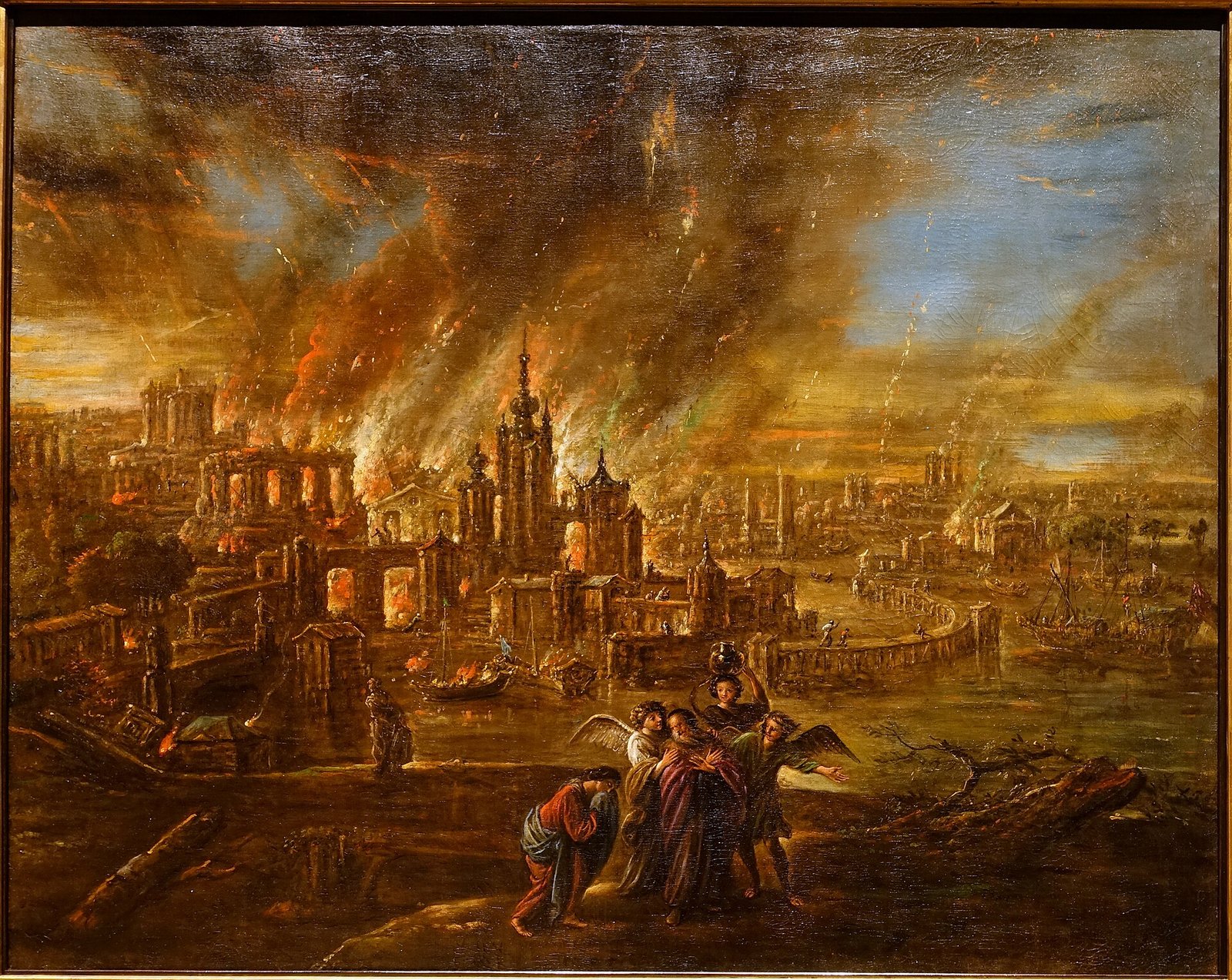
Image: Sodom and Gomorrah afire, by Jacob Jacobsz. de Wet d. J., probably Köln, c. 1680, oil on canvas – Hessisches Landesmuseum Darmstadt – Darmstadt, Germany – DSC01149.jpg — Daderot, Public domain