Where Is the Ark of the Covenant Now?
The short answer: nobody knows. No verified evidence places the Ark of the Covenant in Ethiopia, in Rome or anywhere else. There is no known discovery site.
Two big claims compete in searches. One points to Aksum in Ethiopia. The other points to Rome, often called “the Vatican” in popular retellings. A third link runs through Hagia Sophia in Istanbul, which matters if you are travelling in Turkey. This article checks each claim against the sources.
The Ark of the Covenant in the Bible
The Hebrew Bible describes the Ark as a portable wooden chest. It held the documents of the covenant between God and the Israelites. It stood at the center of worship.
Exodus 25:10-21 gives the build. The wood is acacia. The inside and outside are covered with gold. The length is 2.5 cubits. The width and height are 1.5 cubits each.
The lid carried two golden cherub figures facing each other. Two carrying poles slid through four golden rings. If you search for images of the Ark, these are the details to look for in any drawing.
Ark of the Covenant Meaning
The word “covenant” means the agreement between God and the Israelites. In the narrative, the Ark guards the tablets of the Ten Commandments given to Moses.
The biblical story places the Ark first in a portable sacred tent. Later it sits in the most sacred part of Solomon’s Temple in Jerusalem.
What Was Inside It?
The Bible does not give one answer. 1 Kings 8:9 says that when the Ark was placed in Solomon’s Temple, it held only two stone tablets.
Hebrews 9:4 lists more. It names the covenant tablets, a golden pot holding manna, and Aaron’s budding rod.
The Ark in the Biblical Stories
The Ark appears in several famous episodes.
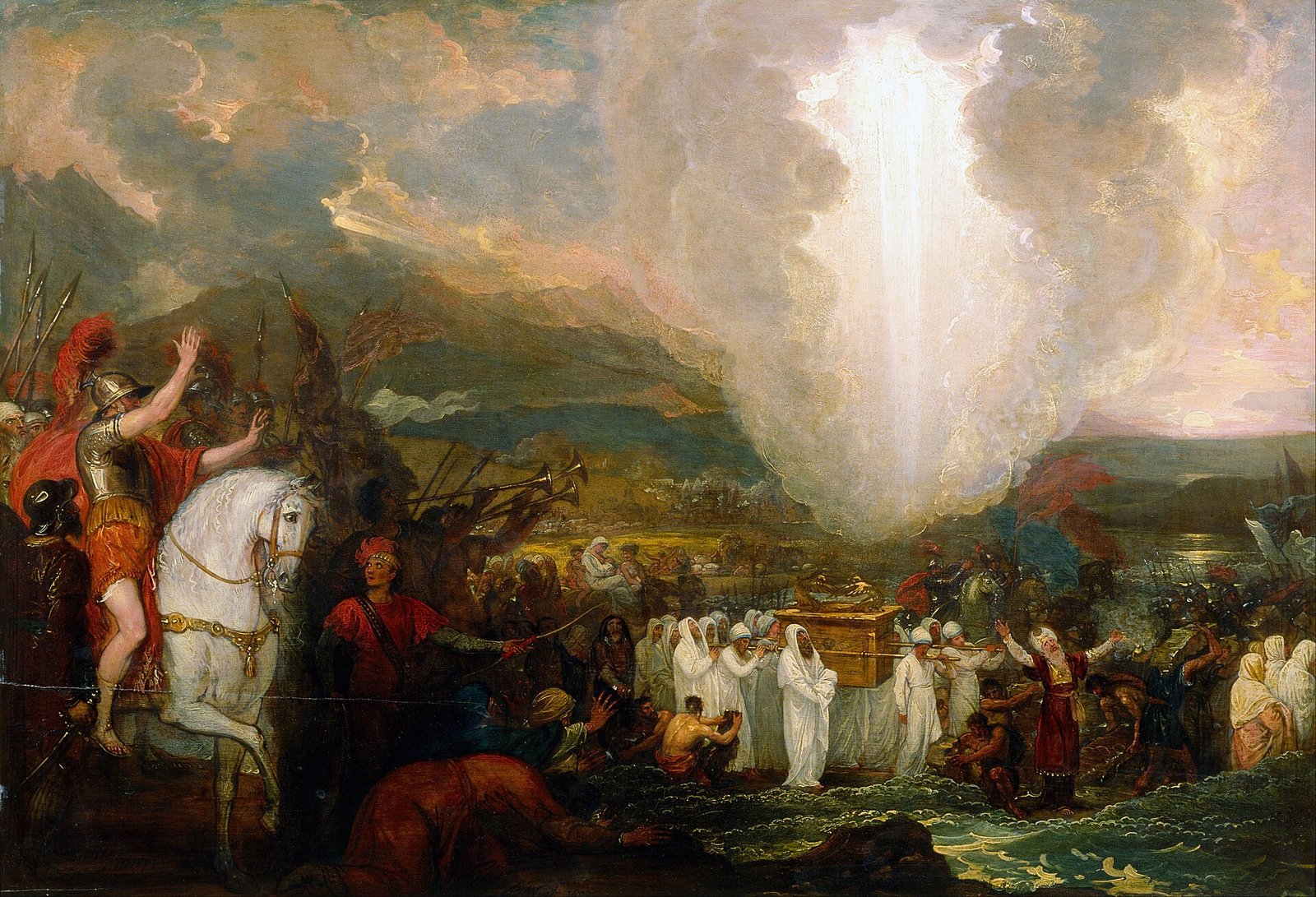
- In Joshua, priests carrying the Ark reach the Jordan River. The waters stop, and the Israelites cross.
- In 1 Samuel, the Philistines capture the Ark and take it to the Temple of Dagon in Ashdod. After seven months they send it back.
- In 2 Samuel 6, David brings the Ark to Jerusalem and places it in a tent he prepared for it.
The same chapter tells of Uzza, who dies after touching the Ark. Some people use this story to claim the Ark would kill whoever finds it. It is a religious narrative. It is not scientific evidence about any future find.
Ark of the Covenant in Islam
Islamic sources know the chest as the tabut. Al-Baqara 2:248 says the tabut returning, carried by angels, is a sign of Talut’s kingship. The verse says it contains sakina and what remained of the families of Moses and Aaron.
What Happened to the Ark?
The Babylonians destroyed Jerusalem and the First Temple in 587/586 BCE. The Ark’s disappearance is linked to that event. Its exact fate is not known.
Several theories try to fill the gap:
- Hidden by King Josiah. Some Jewish traditions say he hid it in underground chambers around the Temple. No find confirms this.
- Hidden by Jeremiah. 2 Maccabees 2:4-8 says Jeremiah put it in a cave on the mountain where Moses saw the promised land. Archaeology has not confirmed this.
- Taken by the Babylonians. Penn State historian Baruch Halpern finds this more likely than the idea that it was hidden from them.
The Romans are not the answer either. National Geographic’s review of 12 December 2025 notes that Josephus does not list the Ark. He describes the Temple treasures looted in 70 CE and paraded in Rome. The Ark is not among them.
Ark of the Covenant in Ethiopia
Ethiopian Orthodox tradition says Menelik brought the Ark from Jerusalem to Ethiopia. Menelik is regarded as the son of Solomon and the Queen of Sheba. The tradition says the Ark is kept in Aksum.
The claim has not been verified. UNESCO states that the Church of Our Lady Mary of Zion in Aksum was rebuilt in the 17th century. It records the belief that the church holds the Ark. It does not record a verified discovery.
Smithsonian reporter Paul Raffaele met the guardian in Aksum in 2007. He could not see the Ark. He wrote that he could not settle whether the Ethiopian claim is true.
There is one counter-claim. Live Science reported in 2018 on the testimony of Edward Ullendorff. He said the object he saw in Aksum in 1941 was a medieval copy, not the original Ark. That is a recollection, not a modern laboratory test.
If you visit Aksum, expect to see the church. Do not expect to see the Ark.
What Is a Tabot?
Every Ethiopian Orthodox church has at least one tabot, according to the British Museum. A tabot represents the Ark. On festival days, tabots are carried out beneath covers, on the heads of priests.
Think of a family keeping a sealed box that only one person is allowed to open. Everyone knows it exists. Almost nobody looks inside. The guardian system works in a similar way.
Ark of the Covenant in Rome: The Vatican Claim
The Roman claim is older than most people expect. A text called Descriptio Lateranensis Ecclesiae, written around 1100, says the Ark lies under the main altar of the Basilica of San Giovanni in Laterano. This is a medieval text. It is not an archaeological discovery made in the Vatican.
Eivor Andersen Oftestad’s 2019 research explains the claim in its context. She reads it as a message that strengthened the standing of the papal cathedral after the First Crusade in 1099.
The Church itself later acted on the objects. In May 1745, Pope Benedict XIV ordered three objects removed from the Lateran. They had been shown as the Ark of the Covenant, the rod of Moses and the rod of Aaron.
Ark of the Covenant and Hagia Sophia
If you travel to Istanbul, you may hear that the Ark is linked to Hagia Sophia. The scholarly link is about design. Jelena Bogdanović’s 2017 study treats the Ark as one of the intellectual and architectural models of the building. Her work does not say the Ark is in Hagia Sophia.
Timeline
- Moses period (date cannot be fixed): In the biblical narrative, the Ark is made and the tablets are placed in it.
- David and Solomon periods (dates cannot be fixed): In the narrative, the Ark is brought to Jerusalem, then placed in Solomon’s Temple.
- 587/586 BCE: The Babylonians destroy Jerusalem and the First Temple. The Ark’s later fate is unknown.
- 70 CE: The Romans plunder the Second Temple. Josephus’s list of treasures taken to Rome does not name the Ark.
- About 1100: Descriptio Lateranensis Ecclesiae claims the Ark lies under the Lateran main altar.
- May 1745: Pope Benedict XIV orders the removal of objects shown at the Lateran as the Ark and two sacred rods.
- 1941: Edward Ullendorff, in later testimony, sees an object in Aksum kept as the Ark and judges it a copy.
- 2007: Paul Raffaele meets the guardian in Aksum but cannot examine the Ark.
- 2019: Eivor Andersen Oftestad publishes her study of the Lateran claim in its medieval context.
Details You Won’t Find in Guidebooks
- Who built it? Exodus links the Ark’s construction to Bezalel. Deuteronomy 10 says Moses made it.
- Nobody can see it. In 2007, Abune Paulos, Patriarch of the Ethiopian Church, said only the guardian has the authority to see the Ark. He said even he could not see it.
- A tabot in London. The British Museum holds tabot Af1990,22.1. It is a stone slab with Ge’ez writing on both faces, made before 1868.
- A pope removed the relics. The 1745 order came from Benedict XIV himself. The objects at the Lateran were not simply forgotten.
FAQ
Where is the Ark of the Covenant now?
Nobody knows. No verified evidence places it in Ethiopia, Rome or anywhere else. The Babylonian destruction of Jerusalem in 587/586 BCE is linked to its disappearance, but its fate is unknown.
Is the Ark of the Covenant in Ethiopia?
Ethiopian Orthodox tradition says it is kept in Aksum. Independent examination has not confirmed this. UNESCO records it as a belief, not a verified discovery.
Is the Ark of the Covenant in the Vatican?
No. A text from about 1100 claimed it lay under the main altar of the Lateran Basilica in Rome. That is a medieval claim, not an excavation, and the basilica is not inside the Vatican.
What was inside the Ark of the Covenant?
1 Kings 8:9 says only two stone tablets. Hebrews 9:4 also lists a golden pot of manna and Aaron’s budding rod.
Is the Ark mentioned in the Quran?
Yes. Al-Baqara 2:248 describes the tabut, carried by angels, as a sign of Talut’s kingship. It holds sakina and what remained of the families of Moses and Aaron.
Sources
- Oxford Bibliographies — Ark of the Covenant academic.oup.com
- TDV İslâm Ansiklopedisi — Ahid Sandığı islamansiklopedisi.org.tr
- Vikipedi — Ahit Sandığı tr.wikipedia.org
- The Catholic Encyclopedia — Ark of the Covenant newadvent.org
- Wikipedia — Ark of the Covenant en.wikipedia.org
- Penn State University — Is the Ark of the Covenant real? psu.edu
- National Geographic — What happened to the Ark of the Covenant? nationalgeographic.com
- Smithsonian Magazine — Keepers of the Lost Ark? smithsonianmag.com
- Live Science — Ark of the Covenant location livescience.com
- UNESCO World Heritage Centre — Aksum whc.unesco.org
- British Museum — Tabot Af1990,22.1 britishmuseum.org
- Eivor Andersen Oftestad — The Lateran Church in Rome and the Ark of the Covenant jstor.org
- Cambridge Core — The Lateran Church in Rome and the Ark of the Covenant cambridge.org
- Oxford Academic — Nested in Its Own Shape academic.oup.com
Image: Benjamin West – Joshua passing the River Jordan with the Ark of the Covenant – Google Art Project.jpg — Benjamin West, Public domain